


A complete, fully-resourced lesson on thin lenses, aligned to the Cambridge IGCSE (9-1) Physics (0972/0625) syllabus — section 3.2.3.
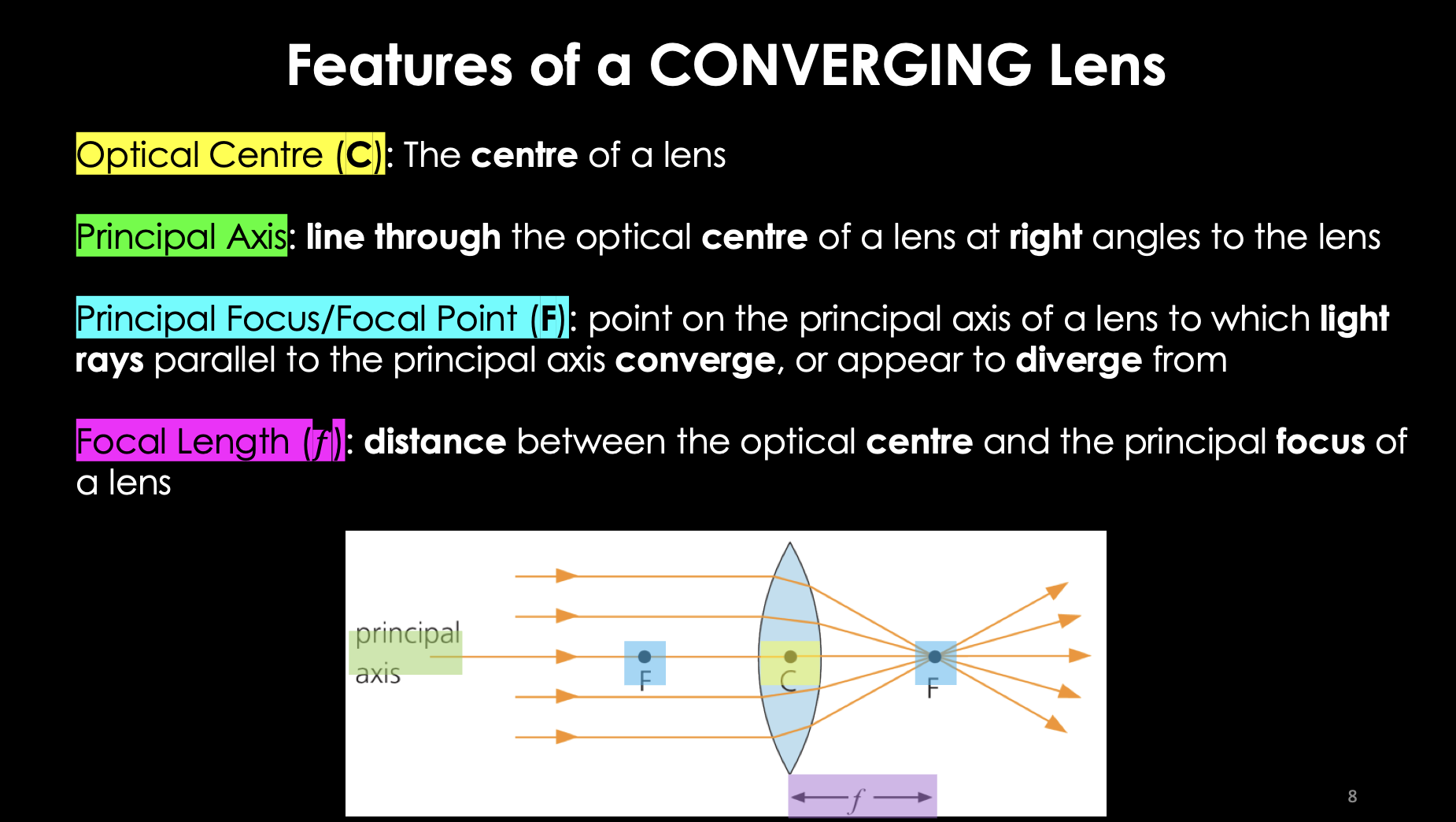
This resource, last updated June 2026, covers all eight learning objectives: the action of converging (convex) and diverging (concave) lenses on a parallel beam of light; key terminology (focal length, principal axis, principal focus); constructing ray diagrams for real and virtual image formation using a converging lens, using the three standard rays (parallel to axis → through F; through F → parallel; through optical centre); a full summary table of image characteristics at each object position (beyond 2F, at 2F, between F and 2F, at F, and inside F — magnifying glass); the distinction between real and virtual images; and the use of converging and diverging lenses to correct long-sightedness and short-sightedness, with a clear comparison table of both conditions (cause, image position, corrective lens). Interactive simulations (oPhysics and Walter Fendt) are embedded for independent ray diagram practice.
Includes retrieval questions and exam-style Q&A slides — suitable for Years 9–11. Follows on from refraction of light and pairs well with lenses and the eye.
Part of the complete Cambridge IGCSE Physics (0972/0625) Waves series — all individual lessons are available separately or as a bundle in the shop.
Explore the full series in the shop for all other units: https://www.tes.com/teaching-resource/igcse-physics-waves-unit-bundle-7-full-lessons-0972-0625-13480926
Something went wrong, please try again later.
This resource hasn't been reviewed yet
To ensure quality for our reviews, only customers who have purchased this resource can review it
Report this resourceto let us know if it violates our terms and conditions.
Our customer service team will review your report and will be in touch.
£4.00