


This is a 5-lesson enquiry on the Vietnam War, designed particularly to develop students’ disciplinary understanding of historical sources.
The sequence begins by establishing the historical context of Vietnam and the Cold War before progressively moving students from understanding what a historical source is, to making inferences from visual sources, identifying messages and purpose, and finally considering usefulness, reliability and propaganda.
Lessons included
-
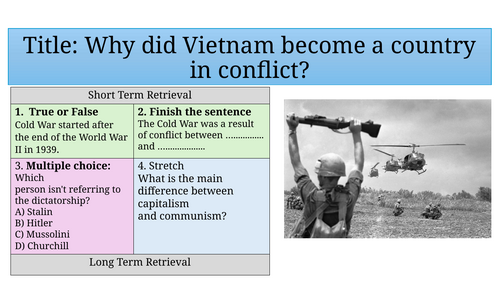
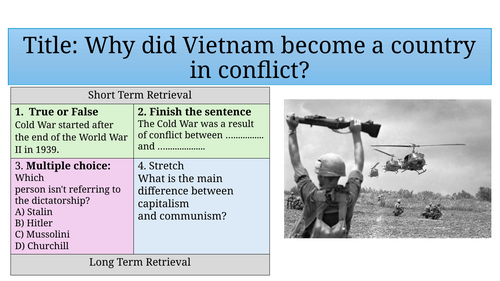
Why did Vietnam become a country in conflict?
Students establish the essential context: French colonial rule, the Geneva Conference, the division of Vietnam, communism, the Domino Theory and Vietnam as a Cold War proxy conflict. -
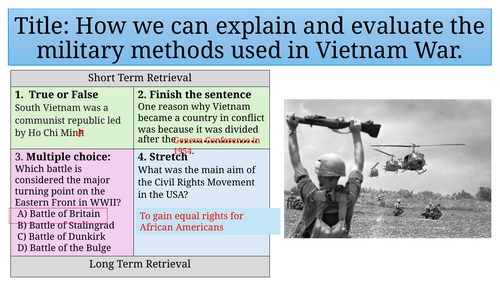
How can we explain and evaluate the military methods used in the Vietnam War?
Students compare the objectives, strategies and tactics of the USA, North Vietnam and the Viet Cong. The lesson begins introducing photographs as historical evidence and asks students what images can reveal about the different armies. -
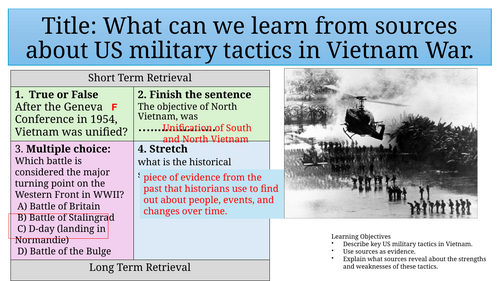
What can we learn from sources about US military tactics in the Vietnam War?
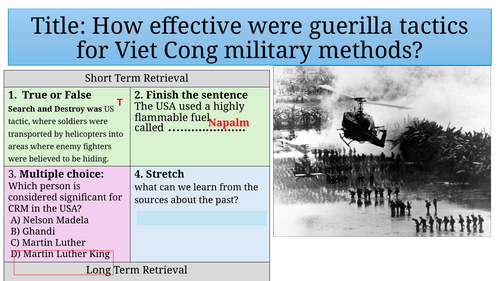
A source-focused lesson examining Search and Destroy, helicopters, Napalm, Agent Orange and interrogation. Students work with contemporary photographs, distinguish observation from inference and use visual evidence to make supported inferences about American tactics. -
How effective were Viet Cong guerrilla tactics?
Students explore tunnels, booby traps, jungle warfare and the Viet Cong’s ability to fight a technologically superior opponent. Visual sources and magazine covers are then used to investigate the message being communicated about the war. -
Can historians trust sources from the Vietnam War?
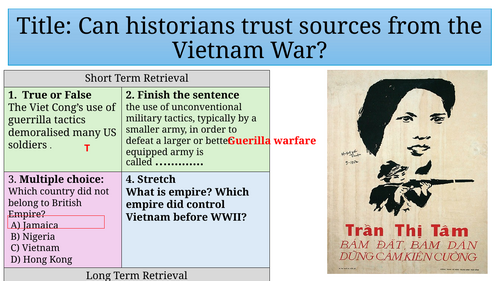
The final lesson brings the source skills together. Students examine photographs, posters, newspapers, letters, speeches, diaries and film as potential historical evidence before focusing particularly on propaganda, provenance, audience, purpose, usefulness and reliability. Students evaluate American and North Vietnamese propaganda and progress towards independently answering a source usefulness question.
Why this enquiry works
The key strength of this sequence is the progression in source analysis. Students do not encounter source evaluation as an isolated skill. Instead, their disciplinary thinking develops across the enquiry:
What is a source? → What can I see? → What can I infer? → What is the message? → Who produced it and why? → How useful/trustworthy is it to a historian?
The Vietnam War provides particularly powerful material for this approach because students can work with photographs, military imagery, propaganda and contrasting representations of the conflict while simultaneously developing secure contextual knowledge.
Key concepts and skills: historical sources, evidence, inference, message, provenance, purpose, audience, propaganda, usefulness and reliability.
Suitable for: KS3 History / Year 9
Enquiry focus: Historical sources and evidence
Something went wrong, please try again later.
This resource hasn't been reviewed yet
To ensure quality for our reviews, only customers who have purchased this resource can review it
Report this resourceto let us know if it violates our terms and conditions.
Our customer service team will review your report and will be in touch.
£1.00