


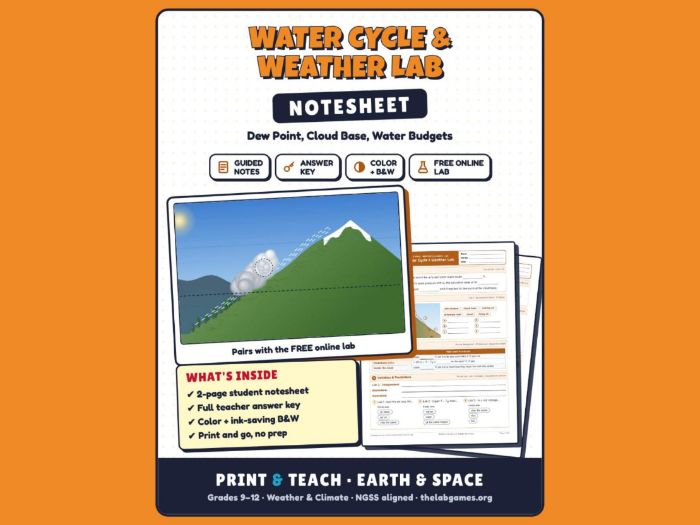
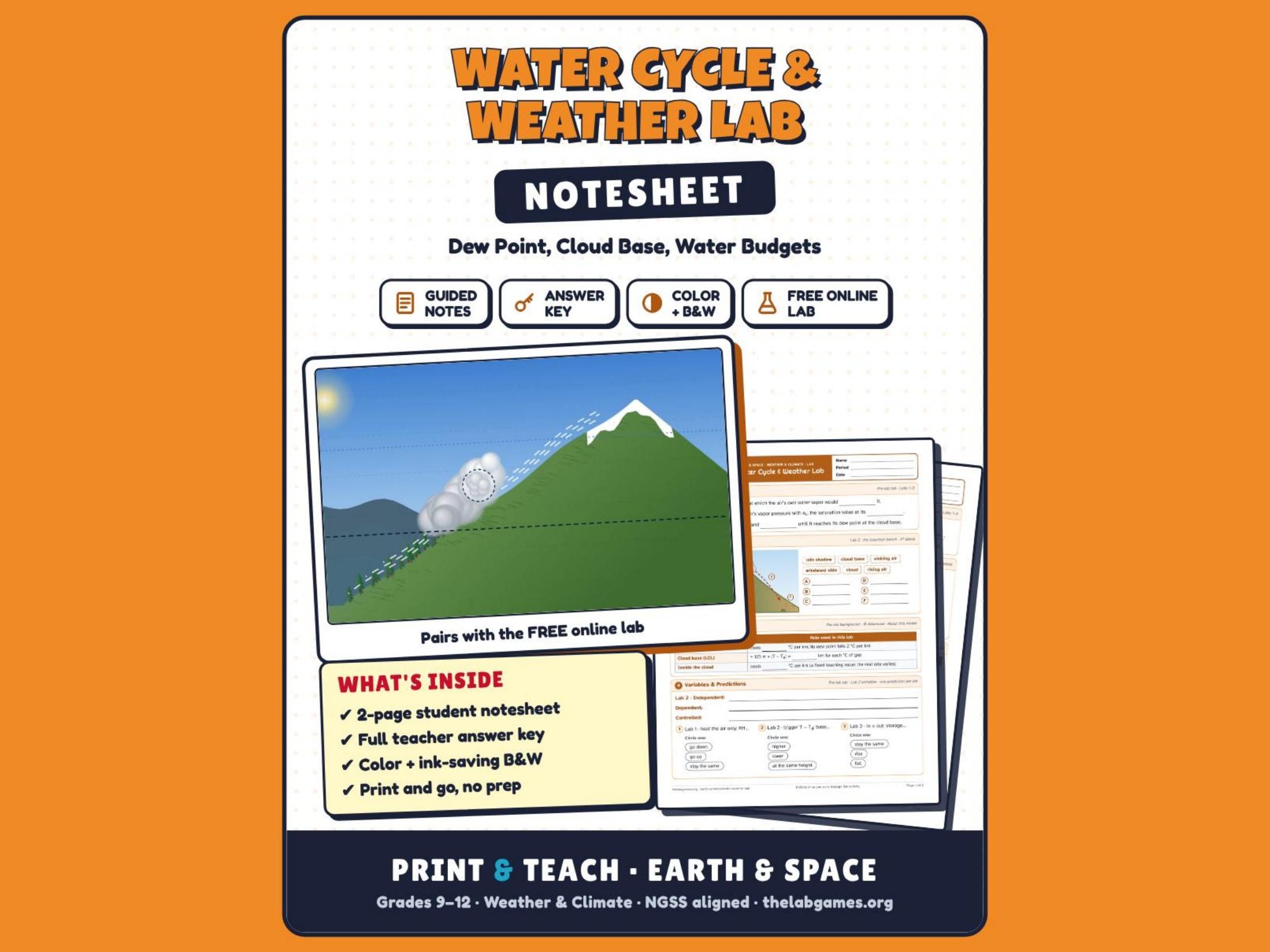
Help students find out why clouds form where they do. In this roomy, student-friendly 2-page lab notesheet, students fill in the background on dew point and relative humidity, label air flowing over a mountain (windward side, cloud base, cloud, sinking air and rain shadow), record the lab’s cooling rules, name the variables and make one prediction for each lab. On page 2 they record a rising parcel’s temperature and cloud condition at several heights for two starts, add quick data from the humidity and water budget labs, graph temperature against height, answer analysis questions and write a claim, evidence and reasoning.
It pairs with the Water Cycle & Weather Lab, a free online lab at thelabgames.org where students chill a cup until dew forms, lift air up a mountain until a cloud forms, and keep a lake’s water budget. Use it in class, for absent-student makeups, or on sub days. A complete teacher key is included.
What’s Included
- Student notesheet (2 pages) in full color AND black & white
- Teacher answer key (red answers) in full color AND black & white
What Students Do
- Background fill-in: dew point, relative humidity and why rising air cools
- Air Over a Mountain: label the windward side, rising air, cloud base, cloud, sinking air and rain shadow
- The Lab’s Rules: the dry cooling rate, the cloud-base rule (125 m per °C) and the cooling rate inside a cloud
- Variables & Predictions: Lab 2 variables, plus one circle-the-prediction question for each of the three labs
- Lab 2 Data: cloud base, parcel temperature, hygrometer reading and cloud condition at five heights for two starting dew points
- Labs 1 & 3 Quick Data: relative humidity before and after warming the air, and a lake gaining, losing and holding steady
- Graph & Analysis: a temperature-against-height graph for both starts, latent heat, and where evaporated water goes
- Claim, Evidence, Reasoning for “What decides the height of the cloud base?”
Skills & Standards
- Humidity, relative humidity, dew point, condensation, lapse rates, cloud base (lifting condensation level), latent heat, orographic lifting, rain shadow, water budgets, conservation of water
- Supports NGSS HS-ESS2-4, HS-ESS2-5, MS-ESS2-4, MS-ESS2-5
- Grades 9–12 Earth Science (with AP Environmental Science connections)
Great For
- Weather and climate or water cycle units
- Absent-student makeups
- Sub plans
- Lab write-up practice
- Test review
Something went wrong, please try again later.
This resource hasn't been reviewed yet
To ensure quality for our reviews, only customers who have purchased this resource can review it
Report this resourceto let us know if it violates our terms and conditions.
Our customer service team will review your report and will be in touch.
$4.00