


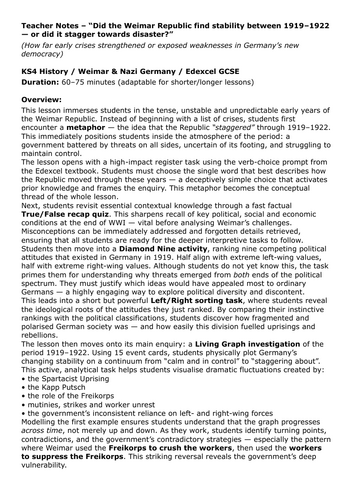
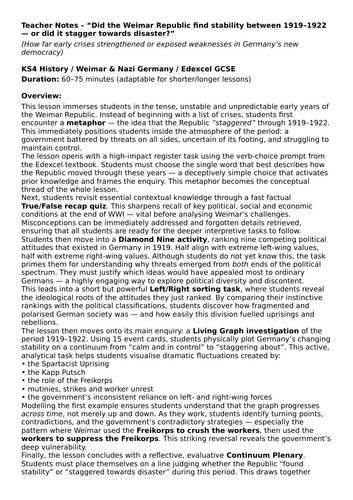
A fully resourced, interactive GCSE lesson on the early challenges faced by the Weimar Republic between 1919 and 1922. Students investigate whether Germany’s new democracy was stabilising after the First World War — or whether political extremism, uprisings and government weakness meant it was already staggering towards disaster. Through enquiry-led activities, students explore fluctuating stability, the rise of left- and right-wing threats, and the government’s inconsistent, often desperate attempts to maintain control.
The lesson includes:
• A metaphor-based register starter using the Edexcel textbook prompt to introduce the enquiry
• A quick True/False recap quiz consolidating prior knowledge
• A Diamond Nine ranking task exploring nine competing political attitudes in Germany
• A left/right-wing reveal activity showing how divided German politics had become
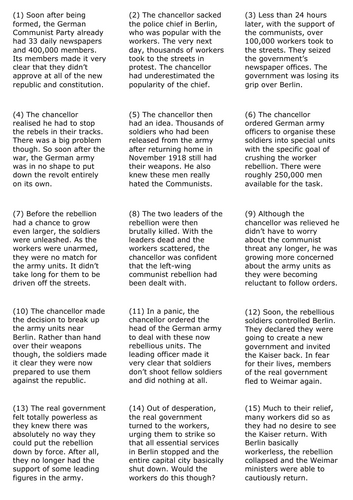
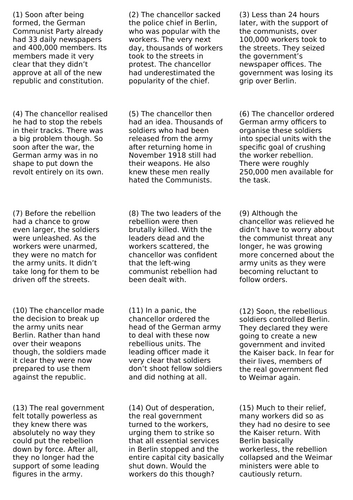
• A major Living Graph task where students plot 15 crisis cards across the years 1919–22
• Clear teacher modelling of the first living-graph example
• Structured discussion exploring how the government relied on the Freikorps to crush the workers — and the workers to crush the Freikorps
• A whole-class judgement continuum plenary: did Weimar find stability or stagger toward collapse?
• Full teacher notes for every slide, including Purpose, Guidance, Insight and Differentiation
All worksheets, living-graph cards and detailed teacher notes are included.
Designed for Edexcel GCSE History (Weimar & Nazi Germany) but easily adaptable for AQA, OCR or Eduqas.
Ideal for helping students develop inference, explanation and evaluative judgement while deepening their understanding of why the early Weimar Republic was so politically unstable.
Something went wrong, please try again later.
This resource hasn't been reviewed yet
To ensure quality for our reviews, only customers who have purchased this resource can review it
Report this resourceto let us know if it violates our terms and conditions.
Our customer service team will review your report and will be in touch.
£4.50