ppt, 1.48 MB
ppt, 1.48 MB
pdf, 215.51 KB
pdf, 215.51 KB
pdf, 31.2 KB
pdf, 31.2 KB
pdf, 38.81 KB
pdf, 38.81 KB
docx, 40.31 KB
docx, 40.31 KB
docx, 15.28 KB
docx, 15.28 KB
docx, 14.3 KB
docx, 14.3 KB

This KS4 History lesson explores why Brezhnev chose to crush the Prague Spring in 1968 and how the Soviet Union justified its actions. Students examine the Brezhnev Doctrine, the USSR’s motives, and the international reaction to the invasion.
The lesson is designed for the Edexcel GCSE unit The Cold War 1945–91, but it can be easily adapted for other exam boards.

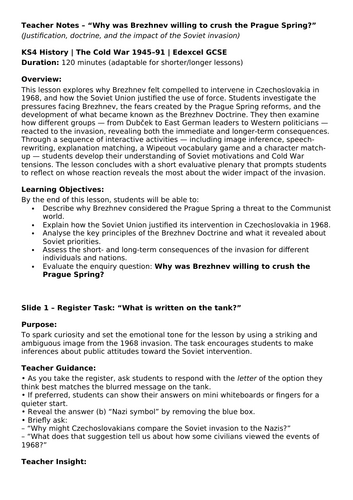
Students work through a sequence of engaging and fully resourced activities including:
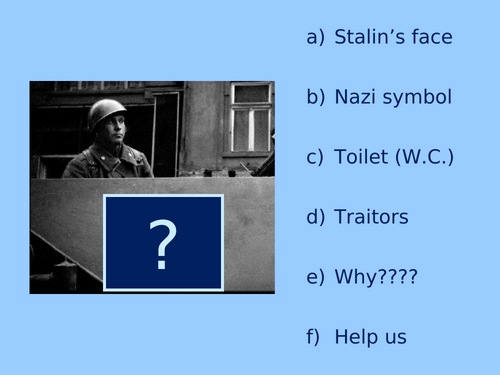
• A visual inference starter based on Czech reactions to the invasion
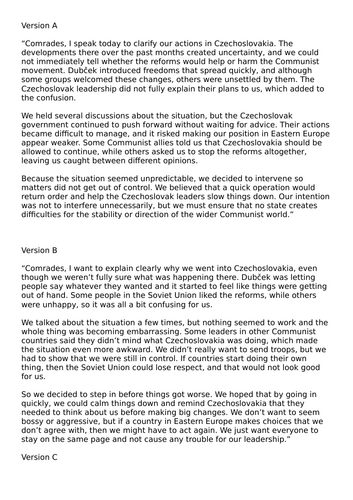
• A step-by-step modelling task rewriting Brezhnev’s “justification” speech
• A wipeout game introducing key ideas behind the Brezhnev Doctrine
• A cloze activity consolidating understanding of the Doctrine’s wording
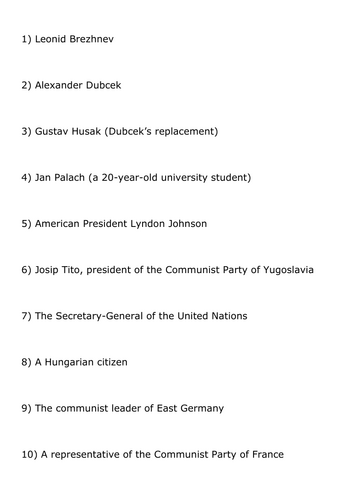
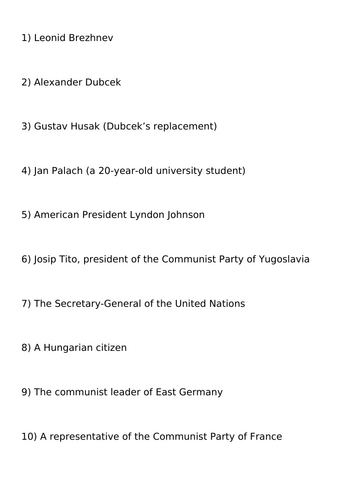
• A character match-up exploring the short- and long-term consequences for leaders, citizens, and foreign governments
• A final plenary asking students to judge which reactions reveal the greatest impact

Teacher notes are included for every slide, offering clear guidance, key insights, and suggestions for differentiation and extension.
This lesson can be taught as a 60–75 minute session or extended into a double lesson for greater depth. It forms part of a wider Cold War decision-making series including The Prague Spring and Soviet Control of Eastern Europe.

Get this resource as part of a bundle and save up to 22%

A bundle is a package of resources grouped together to teach a particular topic, or a series of lessons, in one place.

Bundle

Cold War Crises Bundle: Berlin, Cuba & Czechoslovakia – Complete GCSE Enquiry Lessons

A fully resourced, enquiry-driven GCSE bundle exploring how Cold War tensions repeatedly erupted into crisis between 1958 and 1968. Students investigate why Berlin became the flashpoint of superpower rivalry, how the Cuban Crisis brought the world to the brink of nuclear war, and why the Prague Spring forced the USSR to reassert control over Eastern Europe. Through rich source voices, decision-making tasks and analytical activities, students build a clear, connected understanding of how and why these crises shaped the direction of the Cold War. Designed for the Edexcel GCSE unit The Cold War 1945–91, but easily adaptable for other exam boards. The lessons include a wide variety of fully resourced and highly engaging activities such as: • Thought-provoking register starters introducing each crisis • Continuum tasks exploring the motives and choices of key leaders • Quote-matching and inference challenges revealing contrasting perspectives • Character and voice-based match-ups for Cuba and Czechoslovakia • Living graph activities charting pressure points and key turning moments • Decision-making enquiries (WWYD?) for Berlin, Bay of Pigs and the Brezhnev Doctrine • Diamond Nine ranking tasks evaluating causes and consequences • Creative plenaries asking students to judge responsibility, impact or effectiveness Teacher notes accompany every slide, offering clear guidance, historical insight, and built-in suggestions for differentiation and extension. All worksheets, character cards, source tasks and activity sheets are included. This bundle can be taught as a sequence of 60–75 minute lessons or extended into a longer enquiry. It forms the central section of the wider Asa Merrin Cold War series, sitting between the Early Cold War Bundle (1943–56) and the End of the Cold War Bundle (1972–91).

£28.00

Reviews

Something went wrong, please try again later.

This resource hasn't been reviewed yet

To ensure quality for our reviews, only customers who have purchased this resource can review it

Report this resourceto let us know if it violates our terms and conditions.
Our customer service team will review your report and will be in touch.