


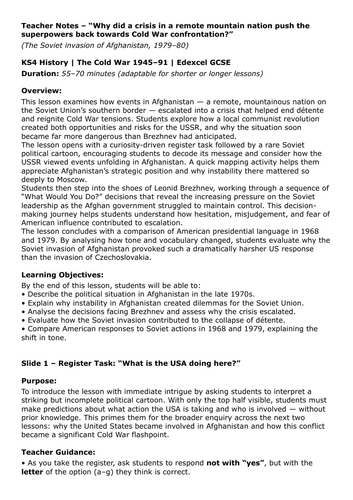
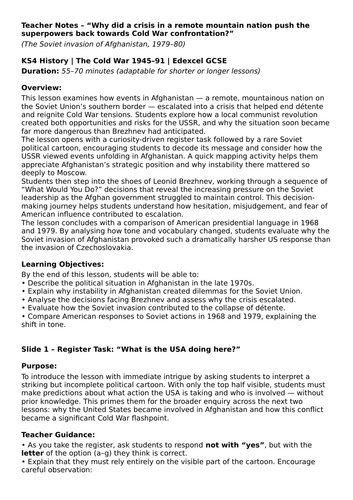
This KS4 History lesson examines how a crisis in Afghanistan helped push the superpowers back towards Cold War confrontation in 1979–80. Students investigate why the situation in a remote mountain nation became so important to the Soviet Union, and how the collapse of détente unfolded.
The lesson is designed for the Edexcel GCSE unit The Cold War 1945–91, but it can be easily adapted for other exam boards.
Students work through a sequence of engaging and fully resourced activities including:
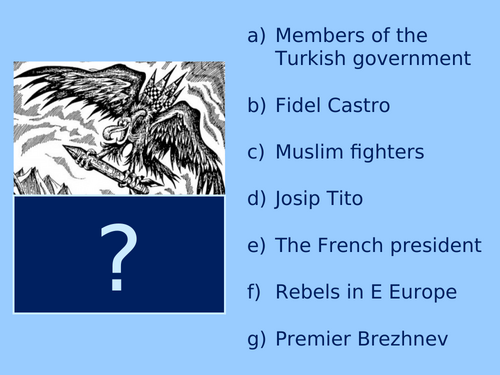
• A curiosity-driven register task using a rare Soviet cartoon
• An image analysis activity exploring how America and Afghan fighters were portrayed
• A quick mapping task to locate Afghanistan and understand its strategic position
• A “Step into the shoes of Brezhnev” introduction to frame the crisis
• A multi-stage What Would You Do? decision-making activity revealing how events escalated
• A vocabulary-sorting challenge comparing US reactions in 1968 and 1979
Teacher notes are included for every slide, offering clear guidance, key insights, and suggestions for differentiation and extension.
This lesson can be taught as a single 55–70 minute session or extended for greater depth. It forms part of a wider Cold War decision-making series that includes the Berlin Ultimatum, détente, and the Cuban Revolution.
Something went wrong, please try again later.
This resource hasn't been reviewed yet
To ensure quality for our reviews, only customers who have purchased this resource can review it
Report this resourceto let us know if it violates our terms and conditions.
Our customer service team will review your report and will be in touch.
£4.50