


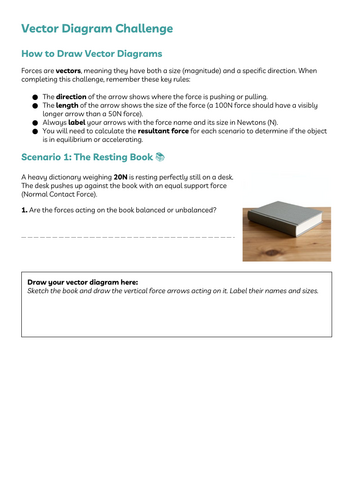

This lesson builds directly on pupils’ understanding of what forces are by introducing resultant force, balanced vs unbalanced forces, and the idea of equilibrium. Through clear modelling, diagrams, and scaffolded examples, pupils learn how to calculate the resultant force acting on an object and use this to predict changes in motion.
The lesson includes opportunities for pupils to practise drawing force diagrams, reason about motion, and apply scientific vocabulary with accuracy. It is designed to be accessible, visual, and misconception‑focused—ideal for Year 7 learners.
What Students Will Learn
How to calculate the resultant force acting on an object
The difference between balanced and unbalanced forces
How to predict changes in motion using force diagrams
What it means for an object to be in equilibrium
Some visuals in this resource were made with AI to help bring ideas to life and support student understanding.
Something went wrong, please try again later.
This resource hasn't been reviewed yet
To ensure quality for our reviews, only customers who have purchased this resource can review it
Report this resourceto let us know if it violates our terms and conditions.
Our customer service team will review your report and will be in touch.
£2.00