



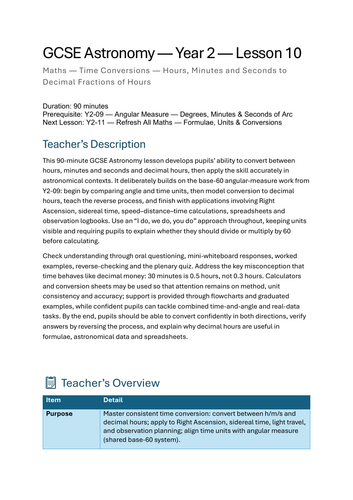
This 90-minute GCSE Astronomy lesson develops pupils’ ability to convert between hours, minutes and seconds and decimal hours, then apply the skill accurately in astronomical contexts. It deliberately builds on the base-60 angular-measure work from Y2 09: begin by comparing angle and time units, then model conversion to decimal hours, teach the reverse process, and finish with applications involving Right Ascension, sidereal time, speed–distance–time calculations, spreadsheets and observation logbooks. Use an “I do, we do, you do” approach throughout, keeping units visible and requiring pupils to explain whether they should divide or multiply by 60 before calculating.
Check understanding through oral questioning, mini-whiteboard responses, worked examples, reverse-checking and the plenary quiz. Address the key misconception that time behaves like decimal money: 30 minutes is 0.5 hours, not 0.3 hours. Calculators and conversion sheets may be used so that attention remains on method, unit consistency and accuracy; support is provided through flowcharts and graduated examples, while confident pupils can tackle combined time-and-angle and real-data tasks. By the end, pupils should be able to convert confidently in both directions, verify answers by reversing the process, and explain why decimal hours are useful in formulae, astronomical data and spreadsheets.
Get this resource as part of a bundle and save up to 30%
A bundle is a package of resources grouped together to teach a particular topic, or a series of lessons, in one place.
Something went wrong, please try again later.
This resource hasn't been reviewed yet
To ensure quality for our reviews, only customers who have purchased this resource can review it
Report this resourceto let us know if it violates our terms and conditions.
Our customer service team will review your report and will be in touch.
£3.00