


Covering National Curriculum Areas
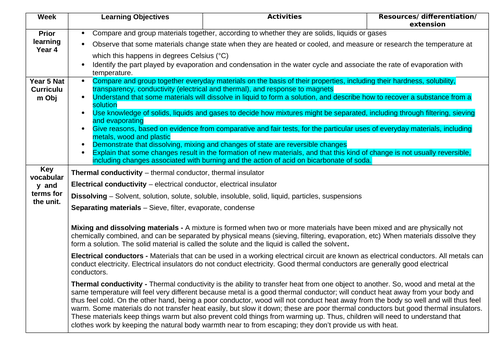
• Compare and group together everyday materials on the basis of their properties, including their hardness, solubility, transparency, conductivity (electrical and thermal), and response to magnets
• Understand that some materials will dissolve in liquid to form a solution, and describe how to recover a substance from a solution
• Use knowledge of solids, liquids and gases to decide how mixtures might be separated, including through filtering, sieving and evaporating
• Give reasons, based on evidence from comparative and fair tests, for the particular uses of everyday materials, including metals, wood and plastic
• Demonstrate that dissolving, mixing and changes of state are reversible changes
• Explain that some changes result in the formation of new materials, and that this kind of change is not usually reversible, including changes associated with burning and the action of acid on bicarbonate of soda.
Lessons for 90 mins
Each lesson has a hook through mini activity or thinking picture to support scientific connections to previous and current learning at start of lesson. Vocabulary outlined with definitions within the plan. Suggested ideas to support engagement
Something went wrong, please try again later.
I CANT FIND THIS - CAN YOU HELP ME PLEASE ;-) When finished, children to complete the table at the bottom of the sheet stating which materials dissolved, reacted or floated or sank. and lesson 4 I can't seem to find any powerpoint to go with this as stated on the lesson plan
Great ideas and thoroughly planned against NC objectives
Report this resourceto let us know if it violates our terms and conditions.
Our customer service team will review your report and will be in touch.
£1.00