


The final lesson of the reggae unit students perform Three Little Birds using authentic reggae rhythms and ensemble techniques.
Students bring together all skills from the unit chord construction, off-beat rhythm, syncopation, and ensemble communication to perform Three Little Birds by Bob Marley. They apply A and D major chords, a chop rhythm, and a steady bassline, refining timing and coordination in groups.
This session supports experiential learning and self-regulation, as students set goals, rehearse, and reflect on their progress.
What’s Included
PowerPoint with Three Little Birds rehearsal guide
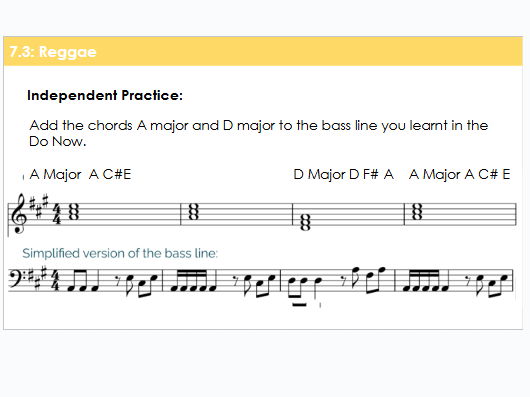
Do Now: bass clef revision & chord recall
Knowledge Check: tonality, rhythm, texture
Performance success criteria
Self- and peer-assessment template
Why Teachers Will Love It
Practical, joyful conclusion of the unit
Reinforces rhythmic control and ensemble skills
Suitable for classroom instruments or small bands
Easily adapted for end-of-term showcase
Get this resource as part of a bundle and save up to 40%
A bundle is a package of resources grouped together to teach a particular topic, or a series of lessons, in one place.
Bundle
Music Year 7 - Complete Carousel Curriculum (3 units)
Reduce the workload with this complete Year 7 music curriculum covering keyboard skills, sampling music, and reggae, designed to build strong foundations in performance, composition, and listening through engaging, practical lessons. This curriculum map is designed for a Carousel Curriculum where you might see you students once a fortnight or where they might rotate with another subject each half term. This comprehensive Year 7 music curriculum provides a fully resourced, carefully sequenced and designed to introduce students to the core elements of music through practical, engaging learning. Across the 3 units, students develop essential musical skills through three interconnected units: 🎹 Keyboard Skills, building fundamental technique, rhythm, chords, and notation fluency 🎧 Recycling Music/ Sampling & Music Technology, exploring how music is created using pre exsisting music and reimagined using digital tools 🌍 Reggae, understanding rhythm, culture, and ensemble performance through world music The curriculum is structured to ensure progression from basic performance skills to independent musical thinking, with students gradually developing confidence in playing, creating, and analysing music. Curriculum Intent The curriculum is designed to: Build strong musical foundations in rhythm, pitch, and harmony Develop confident performers and creative composers Introduce students to diverse musical styles and cultures Foster musical curiosity, creativity, and independence Implementation (How It Works in the Classroom) Each lesson follows a consistent, evidence-informed structure: 🎯 Do Now / Retrieval Practice: reinforce prior knowledge and build long-term memory 🧠 Knowledge Checks: develop fluency in key vocabulary and concepts 🎹 Guided Practice: teacher modelling and scaffolded performance tasks 🎶 Independent Task: students perform, create, or rehearse 💬 Reflection: peer/self-assessment to consolidate learning This structure ensures lessons are predictable, supportive, and challenging, particularly for mixed-ability KS3 classes. Impact (What Students Achieve) By the end of Year 7, students will be able to: Perform using correct technique, rhythm, and coordination Understand and apply basic chords, scales, and musical structures Create music using loops, samples, and simple compositions Perform as part of an ensemble with awareness of timing and texture Use key musical vocabulary to describe and evaluate music What’s Included: 20 fully resourced lessons across 3 units: 🎹 Keyboard Skills Develop rhythm, chords, basslines, and coordination Build confidence in reading notation and performing 🎧 Sampling Music Explore how music is created using technology Understand loops, structure, and remixing Introduce ethical discussions around music ownership 🌍 Reggae Learn about Caribbean musical traditions Perform syncopated rhythms and off-beat patterns Develop ensemble performance ❤️ Why Teachers Will Love It ✅ Fully planned 20-lesson curriculum – no prep required 🎵 Strong focus on practical music-making in every lesson 🧠 Built on evidence-based teaching strategies (Rosenshine | Retrieval Practice | Scaffolding) 🌍 Promotes cultural understanding and diversity in music 🎹 Works with keyboards, ukuleles, guitars, or mixed ensembles 👩🏫 Suitable for both specialists and non-specialists 🧠 Curriculum & Pedagogy Links KS3 National Curriculum: Performing | Composing | Listening & Appraising Model Music Curriculum (Year 7): Rhythm and pulse Basic harmony and chords Ensemble performance Introduction to music technology Pedagogical Foundations: Rosenshine (2012) – modelling, sequencing, practice EEF (2020) – retrieval practice & scaffolding Kolb (1984) – experiential learning Cognitive Load Theory (Sweller) – structured progression Who It’s For: KS3 Music, Year 7 Ideal for whole-class teaching Suitable for mixed-ability groups Designed for carousel curriculum, could be used as part of a full curriculum however this would only cover half a year.
£36.00
Bundle
Year 7 Music – Reggae | Origins, Rhythm and Ensemble Performance | Full Unit
A six-lesson practical unit introducing students to the origins, rhythm, and feel of reggae music. Learners trace the style’s roots in Calypso, Mento, Ska, and Rock Steady, before performing Three Little Birds in small ensembles. This engaging unit immerses students in the sound and culture of reggae, exploring how the genre grew from earlier Caribbean traditions. Students study the rhythmic and harmonic characteristics that make reggae distinctive off-beat “chop” patterns, syncopation, steady tempos, and rich storytelling lyrics before applying them in performance. Each lesson follows a clear, consistent structure: Retrieval / “Do Now” tasks reinforce notation and chord construction. Knowledge Checks build fluency with tonality, scales, and harmony. Guided practice develops ensemble and rhythmic accuracy. Independent performance encourages teamwork and reflection. The sequence follows Rosenshine’s Principles of Instruction for structured skill-building, while drawing on Kolb’s experiential learning cycle to connect listening, theory, and performance. What’s Included 6 fully editable PowerPoints 1️⃣ Reggae/ Melody: introduce the genre, scales, chords, and major-scale construction. 2️⃣ Calypso Origins: discover Trinidad’s influence and practise syncopated rhythm. 3️⃣ Mento Origins: explore Jamaica’s folk fusion and create off-beat accompaniments. 4️⃣ Connecting Ska and Reggae: layer bass, chords, and melody; understand the “chop.” 5️⃣ Connecting Rock Steady and Reggae: compare clefs, triads, and rhythmic movement. 6️⃣ Reggae Performance: rehearse and perform Three Little Birds using authentic rhythmic feel. Student Booklet (7.3 Reggae Booklet) vocabulary, context, chord charts, reflection tasks. Instrumental Parts Pack, ukulele, guitar, and bass notation. Assessment & Reflection sheet. Perform • Create • Listen • Evaluate framework. Why Teachers Will Love It Zero-prep, clearly sequenced and fully resourced Builds cross-curricular links with history and culture of the Caribbean Encourages ensemble skills and rhythmic accuracy Differentiated parts for mixed-instrument classes Integrates cultural capital, notation fluency, and practical musicianship Supported by evidence-based pedagogy (Rosenshine | Kolb | Bandura) Curriculum & Pedagogy Links KS3 Music National Curriculum: Performing | Composing | Listening | Appraising Model Music Curriculum (Y7): rhythm, syncopation, and world music awareness Pedagogical Frameworks: Rosenshine Modelling → Guided Practice → Independent Application Kolb – Experience → Reflection → Concept → Application Cultural Learning Theory – building respect and understanding through world music Who It’s For KS3 Music | Year 7 Suitable for classroom keyboards, ukuleles, guitars, or band-style ensembles Works perfectly across 6–8 lessons
£12.00
Bundle
Year 7 Music – Reggae | Origins, Rhythm & Ensemble Performance | Full Uni
A six-lesson practical unit introducing students to the origins, rhythm, and feel of reggae music. Learners trace the style’s roots in Calypso, Mento, Ska, and Rock Steady, before performing Three Little Birds in small ensembles. This engaging unit immerses students in the sound and culture of reggae, exploring how the genre grew from earlier Caribbean traditions. Students study the rhythmic and harmonic characteristics that make reggae distinctive off-beat “chop” patterns, syncopation, steady tempos, and rich storytelling lyrics before applying them in performance. Each lesson follows a clear, consistent structure: Retrieval / “Do Now” tasks reinforce notation and chord construction. Knowledge Checks build fluency with tonality, scales, and harmony. Guided practice develops ensemble and rhythmic accuracy. Independent performance encourages teamwork and reflection. What’s Included 6 fully editable PowerPoints: 1️ Reggae – Melody: introduce the genre, scales, chords, and major-scale construction. 2️ Calypso Origins: discover Trinidad’s influence and practise syncopated rhythm. 3️ Mento Origins: explore Jamaica’s folk fusion and create off-beat accompaniments. 4️ Connecting Ska and Reggae: layer bass, chords, and melody; understand the “chop.” 5️ Connecting Rock Steady and Reggae: compare clefs, triads, and rhythmic movement. 6️ Reggae Performance: rehearse and perform Three Little Birds using authentic rhythmic feel. Student Booklet (7.3 Reggae Booklet) with vocabulary, context, chord charts, reflection tasks. Instrumental Parts Pack for ukulele, guitar, and bass notation. Assessment & Reflection sheet. Perform • Create • Listen • Evaluate framework. Why Teachers Will Love It Zero-prep, clearly sequenced and fully resourced. Builds cross-curricular links with history and culture of the Caribbean, Encourages ensemble skills and rhythmic accuracy. Differentiated parts for mixed-instrument classes. Integrates cultural capital, notation fluency, and practical musicianship, Supported by evidence-based pedagogy.
£12.00
Something went wrong, please try again later.
This resource hasn't been reviewed yet
To ensure quality for our reviews, only customers who have purchased this resource can review it
Report this resourceto let us know if it violates our terms and conditions.
Our customer service team will review your report and will be in touch.
£3.00