pptx, 2.62 MB
pptx, 2.62 MB
pptx, 394.08 KB
pptx, 394.08 KB

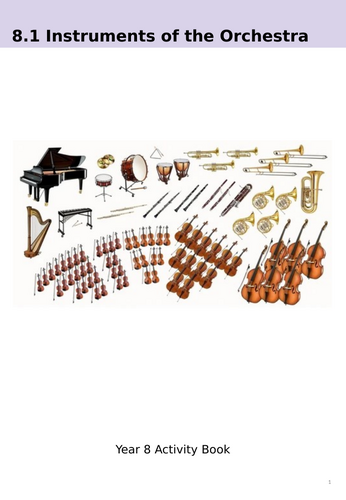
An engaging Year 8 lesson introducing students to the instruments and families of the orchestra through the theme of Ode to Joy. Students identify instruments by sight and sound, perform the main melody, and explore how texture and harmony create orchestral colour.

This first lesson launches the Instruments of the Orchestra unit by combining aural discovery, notation fluency, and performance.
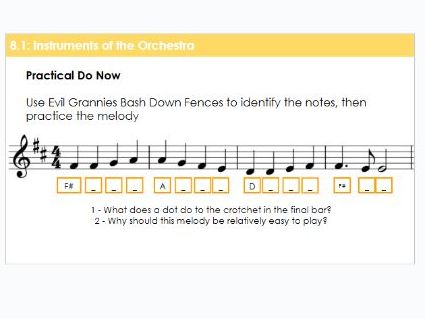
Learners begin by practising the Ode to Joy melody in D major, identifying notes on the stave using Evil Grannies Bash Down Fences and “FACE in the space.”
They then analyse how orchestral families contribute to texture, discussing which instruments carry melody, harmony, or rhythm.

Through paired keyboard or ukulele tasks, students play the melody and add chords to experience how tonic and dominant harmony supports melodic writing.
The lesson blends practical learning with musical understanding, preparing students for later work on cadences, contrast, and composition.

What’s Included

Fully editable PowerPoint lesson
Practical Do Now: notation recall & melody warm-up
Knowledge Check: melody, chord, and texture definitions
Listening task: identify orchestral families and texture in a live performance
Performance task: play Ode to Joy melody in D major, adding tonic & dominant chords
Reflection prompts linking melody, harmony, and texture

Why Teachers Will Love It

Ready-to-teach, no prep required
Builds students’ confidence in reading notation and understanding texture
Connects aural analysis, theory, and performance in one lesson
Perfect starting point for orchestral studies or classical music units
Clear scaffolding supports both specialists and non-specialists

Get this resource as part of a bundle and save up to 17%

A bundle is a package of resources grouped together to teach a particular topic, or a series of lessons, in one place.

Bundle

Year 8 Music – Instruments of the Orchestra | Form, Cadence & Composition | Full Unit

A six-lesson practical and theory-based unit exploring the orchestra, structure, and harmony through Beethoven’s Ode to Joy. Students learn about instrument families, texture, cadences, and ternary form before composing and performing their own re-imagined version of this iconic melody This engaging Year 8 scheme of work introduces students to orchestral sound, musical form, and harmonic language. Using Ode to Joy as the anchor piece, learners explore how melody, texture, and structure combine to create contrast and expression. Each lesson gradually builds from performance into analysis and composition. Students first learn to play the melody and chords, then explore how cadences and contrasting sections provide musical punctuation. The unit culminates in students composing and performing their own ternary-form piece using learned harmonic progressions. Lessons follow a consistent, evidence-based structure: Retrieval / “Do Now”: recall notation, chords, and pitch reading. Knowledge Checks: reinforce tonality, scale degrees, and terminology. Guided Practice: modelled keyboard or ensemble tasks with step-by-step scaffolds. Independent Work: composition and rehearsal with reflection. What’s Included 6 fully editable PowerPoints: 1️ Instruments of the Orchestra – Introduce instrument families, texture, and tonality (D major). 2️ Tutti – Explore orchestral unity, SATB voices, and ensemble texture. 3️ Cadences – Learn perfect and imperfect cadences using tonic & dominant chords. 4️ Contrasting Sections – Add variation and contrast through new chords and phrase development. 5️ Composition – Plan and compose original melodic phrases following the “Ode to Joy” model. 6️ Ternary Form – Combine A–B–A sections and perform or record final compositions. Why Teachers Will Love It Zero-prep, clear sequencing with retrieval and reflection built in Connects theory to practice through Ode to Joy performance tasks Develops listening, performing, and composing in equal measure Builds vocabulary: cadence, texture, tutti, contrast, ternary form Differentiated challenges for mixed-ability groups Fully aligned with Ofsted’s 3 I’s (Intent–Implementation–Impact) Supported by research-informed pedagogy Who It’s For KS3 Music | Year 8 Perfect for whole-class keyboards, small ensembles, or mixed-instrument groups Ideal for a 6-week half-term (or extendable to 8 weeks with composition rehearsals)

£15.00

Reviews

Something went wrong, please try again later.

This resource hasn't been reviewed yet

To ensure quality for our reviews, only customers who have purchased this resource can review it

Report this resourceto let us know if it violates our terms and conditions.
Our customer service team will review your report and will be in touch.