This Unit of 5 weeks covers the story of the Titanic
Week 1: Setting Sail
Week 2: Captain and Crew
Week 3: Mirgation and Push and Pull
Week 4: The Sinking
Week 5: The Legacy and Aftermath
Home Learning Each week and Assesment
This lesson investigates why the ‘unsinkable’ Titanic sank in April 1912. It looks at a number of mistakes that were made and asks students to discuss and evaluate which was the most important cause of the sinking.
This download includes a fully editable powerpoint with all activities, instructions, clip links and worksheets/information sheets you need. It is differentiated 2 ways where possible with scaffolding and challenge options and is fully planned with plenty of activities for your students to complete including a starter, all clips and related tasks, reading comprehension task, , a consolidation explain written question and a plenary.
Activities are planned to encourage thinking and discussion.
This lesson can be used as a part of a growing bundle on ‘Disasters’, which includes the Aberfan Disaster, Chernobyl and Medieval Disasters, available here:
https://www.tes.com/teaching-resource/historical-disasters-12911227
Please take a look at my growing TES shop where you can find free or inexpensive lessons:
https://www.tes.com/teaching-resources/shop/DiscoveringHistory
CUSTOMER SERVICE IS VERY IMPORTANT TO ME - If, by any chance, you encounter any issues with the resource, please email me at discoveringhistoryuk@gmail.com and I’ll try to solve them for you. I really appreciate being given the chance to make things right.
Please support my small business by leaving a review.
There are more KS3 & GCSE History lessons on the way - follow my social media pages for freebies, new resources and interesting facts!
Got a lesson suggestion? Or looking for something in particular? Email me!
The Titanic Ticket activity has real names of passengers and crew, to bring any study of this tradegy alive. This is a very popular lesson that never fails to catch the imagination of a class and they will talk about it for years to come.
When you download you get:
• 30 tickets with the names of 30 different real passengers and crew, including well-known names like Captain Smith, First Officer Murdoch and Bruce Ismay.
• Each ticket says the name and class of travel.
• The number of passengers in each class matches the percentages in each class on board the Titanic when she sank.
• It also includes a page of information for you as the teacher to make it easy for you to facilitate discussion. This gives you information about key passengers, a list of who survived and died, as well as the stats for each class of travel.
• As a full lesson you also get a 36 slide PowerPoint with images, sources and information on to introduce the sinking of the Titanic and setup the tasks.
• 14 Sources on the Titanic, at the end of the PowerPoint, which can be either printed or shown on the PowerPoint.
• Bonus: Menus and Table signs for each class of travel.
• New updated version 2023
Once you have downloaded the product, print out the tickets ready for your students to be issued as they enter the classroom. Use the PowerPoint to introduce the topic and tasks for the lesson. The Teacher’s information sheet will make facilitating the whole class discussion quick and easy, with no additional preparation required.
The tickets hook the students every time and leads on beautifully to the enquiry question of why so many people died when the Titanic sank.
An easy to follow lesson on Titanic. Students review pieces of evidence and categorise and organise this these into a diamond 9 (or score each piece of evidence) to determine who they think was to blame for the Titanic disaster. They follow this up with a report writing activity to explain their theory and also to offer suggestions on how future disasters might be avoided. Literacy support and differentiated materials/ resources are included. As always there are clear instructions and high quality differentiated resources. These lessons take many hours to plan and create so please leave a review if you have time :)
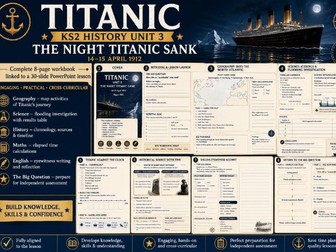
Teach the dramatic events of 14–15 April 1912 with this complete Upper KS2 Titanic lesson package, designed to combine History with Geography, Science, Maths and English.
This resource is Unit 3: The Night Titanic Sank and builds directly on earlier learning about what Titanic was, how it was built and what life was like on board. Pupils investigate the final hours of the voyage, explore how the iceberg collision damaged the ship, model progressive flooding, sequence key events, calculate elapsed time, analyse historical sources and complete an eyewitness writing task.
The lesson is practical, cross-curricular and classroom-ready, with the PowerPoint, workbook and teacher guide designed to match each other closely.
Included in this resource:
30-slide PowerPoint lesson
8-page pupil workbook
10-page teacher guide
Independent assessment opportunities
Retrieval practice from previous Titanic learning
North Atlantic geography and route mapping
Iceberg and ice-warning discussion
Practical flooding investigation
Watertight compartment and progressive flooding explanations
Human timeline activity
Elapsed-time maths questions
Historical source analysis
Fact, opinion and inference activity
Eyewitness writing task
PEE-style Big Question response
Support and challenge guidance
Misconceptions for teachers to address
Extension activities
Teacher answers and guidance
Curriculum Links
History: chronology, cause and consequence, evidence, historical sources and different perspectives
Geography: North Atlantic, Europe, North America, Newfoundland and Titanic’s route
Science: icebergs, modelling, flooding, stability and observations
Maths: elapsed time and chronological sequencing
English: first-person eyewitness writing, sensory language, historical vocabulary and evidence-based explanation
Big Question
How did an “unsinkable” ship sink?
The lesson encourages pupils to move beyond the simple idea that Titanic sank because it hit an iceberg. Pupils develop a more secure understanding of the chain of events, including hull damage, flooding of several watertight compartments, the bow sinking lower and progressive flooding through the ship.
Ideal for
Years 5–6
Upper KS2 History
Titanic topic work
Cross-curricular topic lessons
Enrichment days
Home education
Cover lessons
Mixed-ability classes
The lesson can be taught over approximately 2–3 hours or split across two sessions.
Designed to be engaging, practical and easy to deliver, this resource gives pupils opportunities to investigate, discuss, calculate, experiment, write and think like historians.
Bring Titanic to life with this introduction to non-fiction texts at KS3. 16 lessons focusing on evaluating non-fiction texts, opinion writing, evaluating a statement and writing a summary. Fully resourced with PowerPoints, contextual information to illuminate understanding and Interactive White Board activities.
Lesson 1: an introduction to Titanic
Lesson 2: online research
Lesson 3: a timeline of the sinking
Lesson 4: newspaper articles
Lesson 5: a survivor’s account
Lesson 6: radio broadcasts
Lesson 7: creating Titanic characters
Lesson 8: character profiles
Lesson 9: grammar
Lesson 10: writing a speech
Lesson 11: performing a speech
Lesson 12: report writing
Lesson 13: evaluating blame
Lesson 14: the Titanic quiz
Lesson 15: poster lesson
Lesson 16: descriptive writing
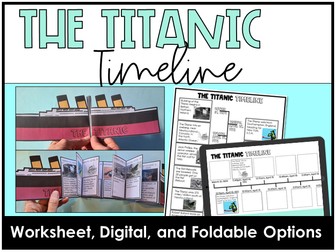
This Titanic timeline activity is a hands-on way to trace the story of the Titanic from when it was being built, through to the detailed events of the sinking, up to the time the wreck was discovered.
There are several options:
worksheet or foldable timeline
Cut-and-paste or write the events.
Worksheet has dates written or students write the dates.
Digital Google™ Slide: Drag and drop the pictures and events to match the dates and times on the timeline.
Students will be able to work out the order of the events using pictures on the timeline and clue cards which are included.
I hope your students enjoy learning about the Titanic as they make their timelines.
U.K. and U.S. versions are included.
You will receive PDFs (not editable) and a link to the Google slide version.
If you need something editable, please reach out to me via email.
You may also like:
Titanic PowerPoint and Google Slides presentation with comprehension questions
Lesson 1 TES Description – Life on Board the Titanic: Class & Contrast
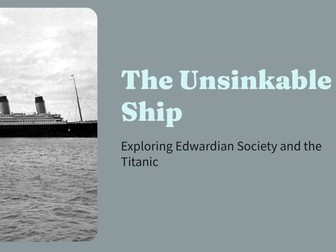
Enquiry question: How did the Titanic reflect Edwardian society and its class divisions?
Lesson focus: Students explore Edwardian society, the idea of the “unsinkable” ship, and the diversity of passengers on board. Through source analysis, structured peer discussion and guided in‑lesson tasks, students build a clear understanding of how class shaped experience on the Titanic. The lesson concludes with two contrasting diary entries: one from a First Class passenger and one from a Working Class passenger.
Learning objectives
Students will:
Understand Edwardian society and its class divisions.
Examine why the ship was marketed as “unsinkable”.
Investigate the diversity of those on board.
What’s included
In‑lesson tasks using adverts, images and passenger information
Peer tasks to compare interpretations and build vocabulary
Worksheet to support note‑making and diary planning
Writing outcome: two diary entries (First Class vs Working Class)
Why teachers love this lesson
A strong, visually engaging introduction to the Titanic enquiry. Clear historical context, purposeful peer talk and a high‑impact writing task make this lesson ideal for developing empathy, literacy and understanding of early 20th‑century society.
Some visuals in this resource were made with AI to help bring ideas to life and support student understanding.
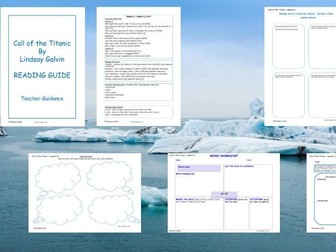
A fully-resourced pack for Call of the Titanic, by Lindsay Galvin, which includes a Teacher Guide for chapter by chapter resources. Discussion questions; reading comprehension and vocabulary work for every chapter; writing ideas and GPS activities are also included. Each chapter also has reading activities which vary from chapter to chapter but may include:
Character analysis
Emotion graphs
Comparisons
Explanations
Inference
Prediction
Drama
In total there are 94 files included in this download.
This reading Guide works well with the following topics:
The Titanic Tragedy
North America
Frozen Kingdoms - Arctic
Pre World War 1 Britain
Supporting a prior learning assessment, retrieval process or assessment of the taught topic. Children define the key terms and answer the questions to assess their knowledge.
A good starter for any work or topic about Titanic - a range of sources with a nice option to colour code and categorise …
You may also find useful …
Titanic Investigation – who was to blame?
https://www.tes.com/teaching-resource/resource-12316415
History Skills + Titanic
https://www.tes.com/teaching-resource/resource-12287899
Holocaust Full Pack - 100 page teaching pack + Anne Frank + activities + skills
https://www.tes.com/teaching-resource/-12649611
First World War 150 + Page Teaching Pack
https://www.tes.com/teaching-resource/resource-10002492
World War 2 PowerPoint
https://www.tes.com/teaching-resource/-11391771
Skills Unit Introduction
https://www.tes.com/teaching-resource/resource-11116434
What is Bias?
https://www.tes.com/teaching-resource/resource-12574124
Questioning Primary Sources
https://www.tes.com/teaching-resource/resource-11114807
Phil@icHistory Tes Shop
https://www.tes.com/teaching-resources/shop/Ichistory
Who was really to blame for the Titanic disaster, and why has the sinking continued to fascinate people for over a century?
This lesson investigated the causes of the Titanic disaster and challenges students to evaluate responsibility for one of the most famous maritime tragedies in history. Rather than simply retelling the events of the sinking, the lesson focuses on the decisions, mistakes and misconceptions that contributed to the disaster, encouraging students to reach their own judgement about who was most to blame.
Students begin by recalling what they already know about the Titanic and considering why the story still captures the public imagination through books, films, documentaries and exhibitions. They are then introduced to the context of the ship’s maiden voyage and explore some of the common myths and misunderstandings that surround the disaster.
The lesson examines a range of possible causes, including the actions of the captain, the role of the ship’s owners, the design and safety features of the vessel, and sensationalist claims in the media about the Titanic being “unsinkable”. Students analyse a variety of sources, infer meaning from historical evidence and use a range of facts to assess where responsibility for the sinking may lie.
By weighing up evidence and considering different viewpoints, students are encouraged to make a substantiated judgement about who should be held most responsible for the disaster. Excellent video links are included throughout, including survivor testimony, helping to bring the events to life and deepen students’ understanding.
The lesson concludes with a Find and Fix plenary focused on correcting further misconceptions about the Titanic, reinforcing knowledge and encouraging careful historical thinking.
As with the wider unit, the lesson is built around a central enquiry question introduced at the start through a light bulb activity and revisited at the end to allow students to reflect on the progress of their learning.
Included in this lesson:
Fully editable PowerPoint
Investigation into the captain, owners, ship design and media influence
Source analysis & inference tasks
Video links including survivor testimony
Find and Fix plenary to challenge Titanic misconceptions
Differentiated activities
Suggested teaching strategies
Please review this resource if you found it useful .
55 Titanic passenger (and some crew) information cards. Each card shares a photo of the passenger (or crew member) and gives information on nationality, age, class, ticket number and much much more! A brilliant resource when looking at who was on board the Titanic. A supporting document also states whether the person survived or not.
Created for a lesson during my PGCE year that aims to help students empathise with characters on board the Titanic in order to reveal societal attitudes to class at this time. Students are greeted for the lesson with 'tickets' that indicate the 'class/table' they sit on. Once in the room/on board the ship they read the on board information booklet to learn about the facilities on offer to them depending on the class they are sat in. After this they write a post card 'home' which is used by other groups so that all students learn what it was like in each class on board the ship. At the end students are asked to draw upon all of their knowledge to answer the question 'What does the interior tell us about the class divide of the time?'
I transformed the tables in my room so that they reflected the 'class', for example, third class had cramped tables and resources (such as glue sticks) that they needed to share whereas first class had a large table with a view out of the room with enough resources for one each. Small differences that really helped my class engage and empathise.
All resources are included right down to tickets and place cards for the desks as well as postcard templates, recording worksheet and brochures for each of the 'classes'. I have included some practical advice/information on how I executed the lesson. I used this lesson with several Year 9 classes (3 year KS3) but it really could adapt to any year group depending on their literacy levels/behaviour when put into a group setting.
Easy to use source work history cover lesson. All you need to do is print it out and leave it with the cover teacher - all the instructions are on the worksheets. This doesn’t contain any of our previous material so you don’t need to worry about students having already completed any tasks,
The pack includes:
4 sources
3 worksheets
8 tasks in total to work through
Check out loads more history and geography resources - both inexpensive and free at our store: HISTORY GEEKS
Or check out some Citizenship GCSE, RE, Tutor Time, PSHE + RSE new Curriculum 2020 resources at EC Resources
If you’re also teaching Citizenship GCSE or PSHE next year, why not join our Citizenship and PSHE teachers Facebook group, with almost 4000 other teachers, for guidance, advice and resource sharing.
A fantastic statistics project based on passengers of the Titanic, that works with small groups, individual students & large classes.
The data has been differentiated to suit all levels of ability/attainment.
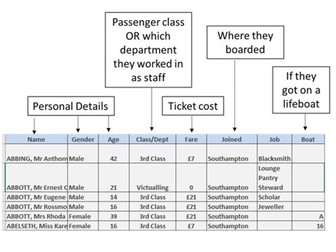
Zip file includes an excel spreadsheet containing the real data for over 2000 passengers of the Titanic (including links to the lifeboats giving some real interesting information!), a booklet containing frequency tables and graphs for groups that need more support and teachers notes to support with delivering the activity.
A set of visual aids, information sheets, word mats for whole class and for EAL children to support the teaching of the Titanic topic. Some worksheets are about the Thompson dock, some are about the different class bedrooms and some are for the Titanic books ‘Samson’s Titanic journey’ and ‘If you were a kid aboard Titanic.’
Activities I used for a study on The Titanic with Year 6. 1 week was not enough! The kids loved it and we ended up creating a 3D ship which included facts, figures, illustrations and diagrams which the children created themselves - can’t wait to do it again next year!
 Quick View


 Quick View
 Quick View
 Quick View
 Quick View
 Quick View
 Quick View
 Quick View
 Quick View
 Quick View
 Quick View
 Quick View
 Quick View
 Quick View
 Quick View