A series of scaffolded writing frames to help students develop a structured approach to answering questions in the AQA GCSE English Language Paper 1.
This includes sentence starters for questions 2-4, along with two separate story-writing word-mats to help develop students’ vocabulary in Q5 (descriptive writing/ story).
These are aimed at EAL/ SEN/ reluctant writers to help build confidence through a highly scaffolded approach to writing.
They may also be useful for KS3 students in preparation for GCSE content.
Files:
Q2 Analysing Language (word-mat)
Q3 Analysing Structure (word-mat)
Q4 Agreeing/ disagreeing with a statement
Q5 Writing your own story
Q5 Describing a character’s appearance
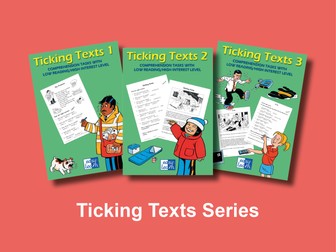
The 3 Ticking Texts books encourage early readers to understand texts. Book 1 is aimed at KS1 plus older pupils with literacy problems, whilst books 2 and 3 are more suitable for KS2 plus KS3 pupils struggling with literacy. Each book includes various types of short texts with a low reading level and a high interest level, and the format allows children with poor coordination/writing ability to concentrate solely on text comprehension skills. The sheets are useful for shared and guided reading and for homework and are also suitable for speaking and listening work. Discussion points and extension activities are included for each text. This is a useful resource for children who have ‘learnt to read’ and are now ‘reading to learn.’ Previously available through Easylearn.
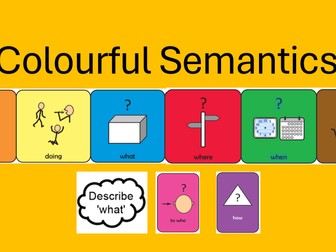
This comprehensive pack contains everything you need to successfully introduce Colourful Semantics into your classroom or school. Tried and tested in both KS1 and KS2, these resources have been used as part of whole-school training and embedded into daily writing practice
All of my 10 Makaton worksheet in one handy bundle. That is 240 Makaton Signs for only £10.
It includes:
Actions/requests Makaton Signs (36 signs)
Animals Makaton Signs (60 signs)
Body Parts Makaton Signs (12 signs)
Colour Makaton Signs (12 signs)
Days of the week Makaton Signs (12 signs)
Feelings Makaton Signs (12 signs)
Greeting and Requests Makaton Signs (12 signs)
Months and Time Makaton Signs (24 signs)
People Makaton Signs (24 signs)
Toys and Objects Makaton Signs (36 signs)
Please write a review if you are liking my resources and let me know if you would like any other specfic resources and I can make them for you.
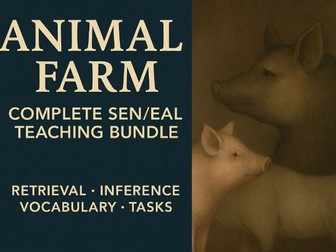
This complete SEN/ALN/EAL Animal Farm unit includes both a printable booklet and a simplified retelling PowerPoint, designed to support students through the full novel. A fully differentiated and illustrated Animal Farm unit of work for SEN, ALN and EAL learners. Includes a simplified teacher/student guide and a realistic-image PowerPoint retelling the novel with retrieval, inference and vocabulary tasks.
Includes:
• Full contextual guide (Orwell, Russian Revolution, Communism)
• Character analysis with allegorical links
• Simplified chapter summaries and key quotations
• Retrieval, inference and vocabulary questions for each chapter
• Discussion, creative and persuasive writing tasks
• PEE paragraph scaffolds
• Editable Word and PowerPoint files with realistic visuals (no film images)
Ideal for KS3–KS4 ALN, SEND or EAL students, nurture groups or GCSE foundation English. Suitable for WJEC, AQA and Edexcel courses.
Please check my shop for other adaptations and support materials for a range of GCSE texts.
SEN Communication Coreboards.
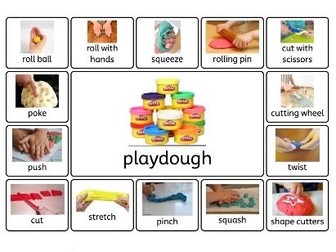
Includes communication boards using widgit symbols and real life images for everyday use, including the following topics: Cars/ Playdough/ Ball/ Book/ Bubbles/ Body/ Musical instruments/ Blocks/ Sand/ Zoo animals/ Farm animals
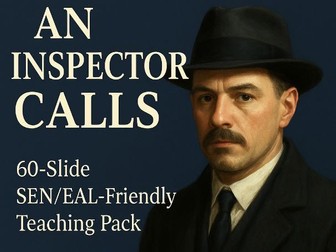
A complete, lesson-ready PowerPoint covering the entire play scene-by-scene. Designed specifically to support SEN, EAL, ALN, and lower-attaining GCSE students, this resource provides clear, accessible explanations of every key moment in the text.
Perfect for:
KS3 and GCSE English (WJEC / AQA / Edexcel)
Intervention groups
Nurture groups
Small-group teaching
TAs, non-specialists, and new teachers
Students who need simplified, structured support
What’s Included
✔ 60-slide PowerPoint covering the whole play (Acts 1–3)
✔ Scene summaries written in clear, student-friendly language
✔ Retrieval questions (yellow boxes) to secure understanding
✔ Inference questions to build analytical thinking
✔ Key vocabulary explained simply
✔ Key quotes included throughout
✔ High-quality, realistic images to aid comprehension
✔ Consistent layout and structure for ALN/SEN accessibility
Every slide is ready to use with no preparation needed. Just open and teach.
Why This Resource Works for SEN/EAL Learners
Short, manageable paragraphs
Clear chunking of information
Repeated question types to build routine
Visual support on every slide
Vocabulary highlighted and explained
Logical step-by-step progression through the play
Ideal for reducing cognitive load
This PowerPoint has been created to be supportive without being patronising — accessible, but still rigorous enough for GCSE requirements.
Suitable For
Whole-class teaching
One-to-one intervention
Small-group English support
Revision sessions
Home learning
Cover lessons
Coming Soon
A matching SEN/EAL-friendly student booklet will be available shortly.
This PowerPoint will also form part of a complete teaching bundle.
File Format
✔ PowerPoint (PPTX)
✔ Fully editable
Try act 1 for free: https://www.tes.com/teaching-resource/resource-13366030
These slides now have a matching GCSE revision & essay booklet, including character arc infographics, theme summaries and exam writing support.
https://www.tes.com/teaching-resource/resource-13409391
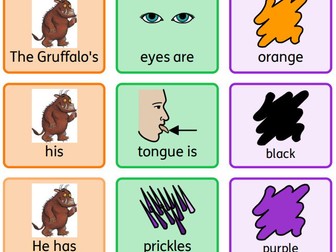
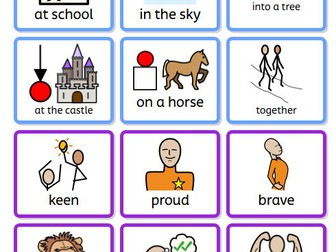
This Colourful Semantics resource supports pupils in building clear, structured sentences using the well-known story Zog by Julia Donaldson.
Using the colour-coded approach (Who? Doing? What? Where? Describing?), pupils can construct and expand sentences based on key events from the story, including Zog learning new skills at dragon school, hurting himself, being helped by the girl, and the final resolution with Princess Pearl.
Includes:
Colour-coded sentence building grids
PowerPoint Feelings doc
Structured sentence frames
Past tense verb modelling (e.g. learned, crashed, captured, trained)
Character vocabulary (e.g. keen, brave, proud)
Opportunities to build simple and expanded sentences
Ideal for:
EYFS and KS1
Speech and language groups
SEND and EAL learners
Pupils working below age-related expectations
Designed to strengthen sentence structure, vocabulary development and confidence in spoken and written language using a popular classroom text.
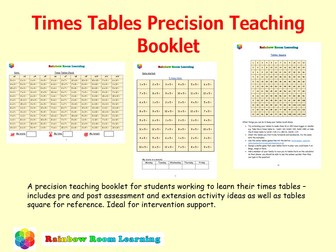
Need a quick and easy intervention to support student to learn tables - This booklet is designed to support a student to develop recall of tables through a focused daily minute of recall. The booklet has a pre and post assessment as well as record space to track daily progress.
Some students need to use a structured approach to get number facts into their long-term memory – they do not seem to keep them there just by regular use in maths lessons. This booklet can be used to support this process.
On each page is a grid with items to prompt the student to say a tables fact. Each day they should count how many oral responses they can give in a minute – and record that on the sheet. The aim is to be able to recall a few more each day.
The precision teaching approach works best if the student can do an activity using the content of the page they are currently working on for a few minutes ( 5 to 10) before they do the one-minute timed activity. There are lots of interactive maths sites online e.g. Topmarks: teaching resources, interactive resources, worksheets, homework, exam and revision help – and this is a great way to give student this opportunity in a way that they can do independently.
At the end of the booklet is a tables square for reference and some ideas for extension activities.
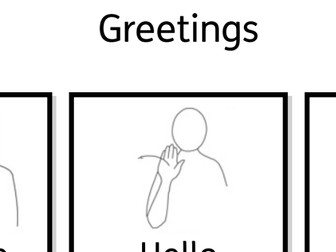
This resources contains the Makaton signs for 12 greetings on one A4 piece of paper. It is easy to take with you to learn the signs or to have it on hand if needed.
The greetings are:
Hello
Good Morning
Good Afternoon
Good Night
Goodbye
Yes
No
Please
Thank You
How are you
Sorry
Ok
Please see my other Makaton resources for further Makaton signs on simple A4 sheets.
Please leave me a review, if you like my resources. If there is a resource you would find particular helpful please let me know and I can make it.
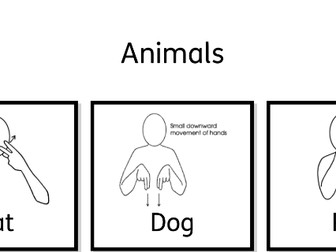
This resource is a handy A4 sheets with 60 Makaton signs for lots of different Animals.
This resource includes the signs for:
Cat
Dog
Pig
Sheep
Horse
Cow
Goat
Frog
Bird
Donkey
Mouse
Chicken
Lion
Tiger
Giraffe
Fox
Elephant
Camel
Snake
Monkey
Bear
Seal
Penguin
Fish
Rhinoceros
Leopard
Zebra
Catterpillar
Hippopotamus
Antelope
Kangroo
Ape
Tortoise
Animal
Dinosaur
Rabbit
Guinea Pig
Rat
Hamster
Polar Bear
Shark
Dolphin
Whale
Turtle
Crab
Octopus
Squirrel
Lizard
Insect
Ant
Bee
Butterfly
Lady Bird
Grass Hopper
Beetle
Slug
Worm
Fly
Dragon Fly
Spider
Please check out my other Makaton resources to learn more Makaton signs, all on with 12 makaton signs per side of A4 for easy reading.
Please leave me a review, if you like my resources. If there is a resource you would find particular helpful please let me know and I can make it.
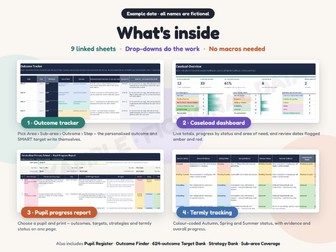
A comprehensive Excel toolkit for SENDCos, SEND teachers and support staff, covering the full cycle from writing EHCP outcomes and IEP targets through to tracking pupil progress against them.
The workbook contains 624 pre-written EHCP outcomes spanning all 6 areas of need - Communication & Interaction, Cognition & Learning, Literacy, Maths, SEMH, and Sensory & Independence - organised into 48 sub-areas for quick navigation. Each outcome is broken into 3 progressive yearly steps (Foundational, Developing, Securing/Achieving), reflecting typical progress across a key stage rather than a single end-point target.
Selecting a pupil and an outcome auto-populates the relevant SMART target, personalised with the pupil’s name, and links directly to a coded strategy bank for matching classroom provision. All wording remains fully editable.
Included:
624 EHCP outcomes across 6 areas of need, each with a 3-step yearly breakdown (Year 1/2/3)
A coded strategy bank (30 strategies) linked to each outcome
A pupil tracker supporting an entire caseload on one sheet, covering EHCP, SEN Support and Monitoring/Early Help pupils
PPG, FSM and EAL flags for cross-referencing SEND with other vulnerable-group data
Colour-coded termly progress tracking (Not Yet Started / Emerging / Working Towards / Embedding / Achieved)
A keyword, category and sub-area search tool, compatible with all versions of Excel
A pupil summary dashboard showing progress totals at a glance
A print view generating a one-page progress report per pupil, suitable for annual reviews or paper files
Suitable for primary and secondary settings, mainstream and specialist provision.
Names on example are made up
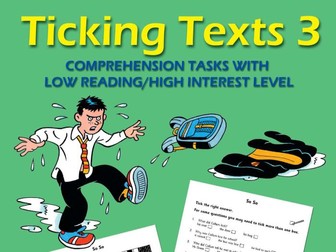
The 3 Ticking Texts books encourage early readers to understand texts. Book 3 is aimed at KS2 plus KS3 pupils with literacy problems. Each book includes various types of short texts with a low reading level and a high interest level, and the format allows children with poor coordination/writing ability to concentrate solely on text comprehension skills. The sheets are useful for shared and guided reading and for homework and are also suitable for speaking and listening work. Discussion points and extension activities are included for each text. This is a useful resource for children who have ‘learnt to read’ and are now ‘reading to learn.’ Previously available through Easylearn.
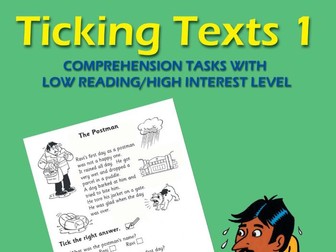
The 3 Ticking Texts books encourage early readers to understand texts. Book 1 is aimed at KS1 plus older pupils with literacy problems. Each book includes various types of short texts with a low reading level and a high interest level, and the format allows children with poor coordination/writing ability to concentrate solely on text comprehension skills. The sheets are useful for shared and guided reading and for homework and are also suitable for speaking and listening work. Discussion points and extension activities are included for each text. This is a useful resource for children who have ‘learnt to read’ and are now ‘reading to learn.’ Previously available through Easylearn.
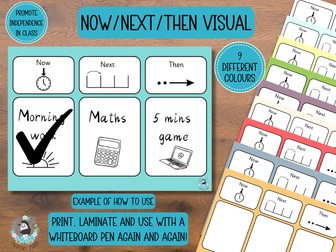
Now/Next/Then-Visual
This resource is a definite daily staple of mine!
I love that you can laminate them and use the how you wish.
9 different variations and 1 example.
Any questions, please get in touch.
Creative Zebra
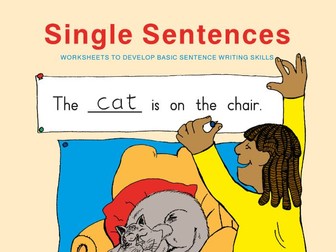
This book helps to create confident sentence writers. It is ideal for those with limited decoding skills and a poor working knowledge of syntax and word order. The worksheets progress from asking pupils to add a single word to complete a sentence, to writing a short sentence of their own. The activities will suit pupils at Key Stage 1 who are struggling with literacy. They are also useful for pupils with poor fine motor skills and those who are new to English. 48 worksheets plus 3 photocopiable word lists, 2 of which are illustrated, are included. Previously available through Easylearn.
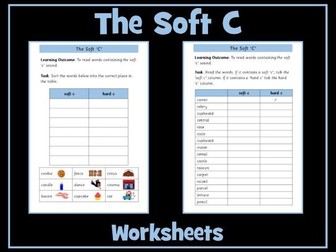
This resource contains two worksheets on the ‘soft c’ sound - Year 2 National Curriculum - the /s/ sound spelt c before e, i and y.
You may also be interested in:
The Soft C - 15 Page Workbook
This is a 15 page workbook with answers on the soft’c’ sound.
The Soft C PowerPoint Lesson
This resource contains a 35-slide PowerPoint lesson explaining when to use the soft ‘c’ sound. The PowerPoint provides many opportunities for the pupils to decide whether words contain a soft c sound or a hard c sound with various tasks involved.
Save money and buy both resources together at a discounted rate:
The Soft C Words - PowerPoint Lesson and 15 Page Workbook
More English Resources
Thinking of publishing your own resources or already an author and want to improve your resources and sales? Check out this step-by-step guide:
How to Become a Successful TES Author: Step-by-Step Guide
This resource provides a range of activities to develop fine motor skills, designed with learners with severe learning difficulties in mind. It is by no means exhaustive, but covers a range of activities to develop discrimination of left and right, hand-eye coordination, crossing the mid-line, in-hand strength, finger and in-hand manipulations, finger isolation skills, grasps, releases, pencil control skills, early drawing skills and early letter formation skills.
The handbook includes background information for teachers about common spelling patterns, useful strategies, including mnemonics, and spelling and phonic games. Many of the ideas resources have been posted elsewhere - acknowledged at end.
This was created with a very wide ranging ability group. It has several levels of 'closure' and allows for differentiation and personalised learning for pupils without them feeling either patronised or discriminated against. This type of worksheet is usually produced during a lesson with input from pupils. Pupils choose the words to remove and put into boxes. The sheet can then be copied and differentiated. I often let youngsters decide which level of sheet that they want to do.
Please rate or give feedback if you found this useful.