









GCSE Chemistry / Combined Science (8462 / 8464)
Complete lesson + worksheet + exam questions
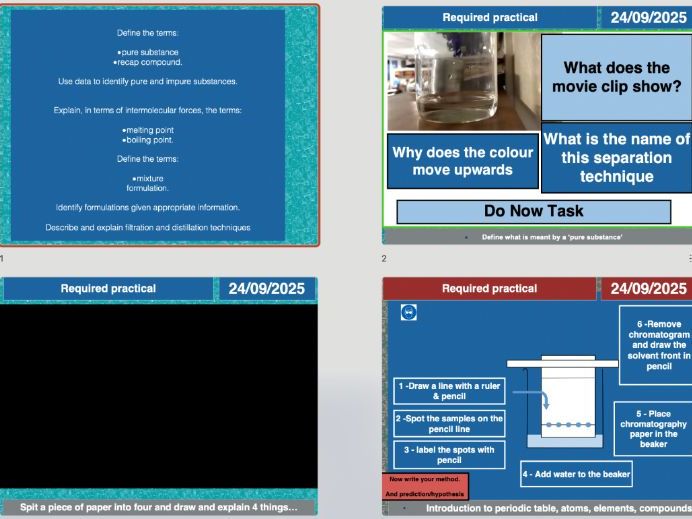
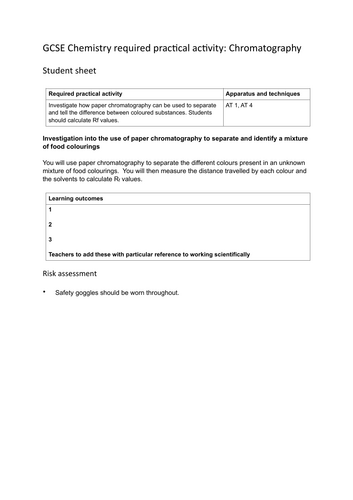
- Practical Aim
To separate mixtures using paper chromatography and identify unknown substances by comparing Rf values.
- Learning Objectives
Students will be able to:
Describe how paper chromatography separates mixtures.
Set up chromatography safely and correctly.
Calculate Rf values from chromatograms.
Compare chromatograms to identify unknown inks/dyes.
Interpret chromatograms in exam-style questions.
- Equipment List
Beaker
Chromatography paper
Pencil
Ruler
Capillary tube or dropping pipette
Solvent (e.g., water or ethanol depending on ink)
Watch glass / lid
Tape
Standard inks + unknown ink sample
- Method (Student-Friendly)
Draw a pencil line 1–2 cm from the bottom of the chromatography paper.
Add dots of each ink on the line using a capillary tube.
Place solvent in the beaker below the pencil line.
Hang the chromatography paper so that:
The bottom touches the solvent.
The ink dots do not go into the solvent.
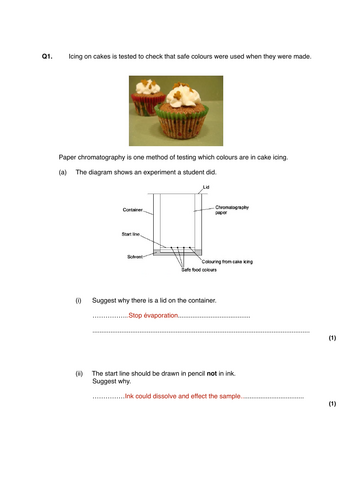
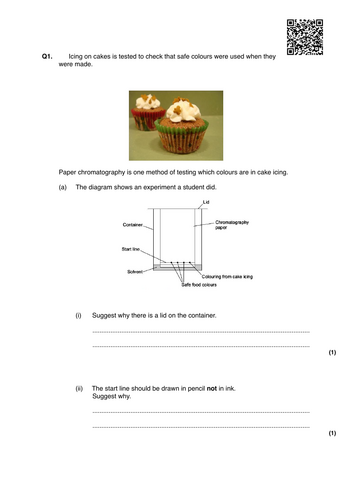
Cover the beaker with a watch glass to reduce evaporation.
Leave until the solvent reaches near the top.
Remove the paper and draw the solvent front line immediately.
Measure distances and calculate Rf = distance moved by spot / distance moved by solvent.
- Key Diagrams
(I will generate clean diagrams automatically in the Word/PDF — just ask.)
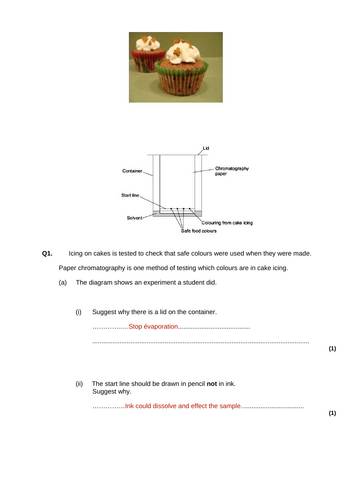
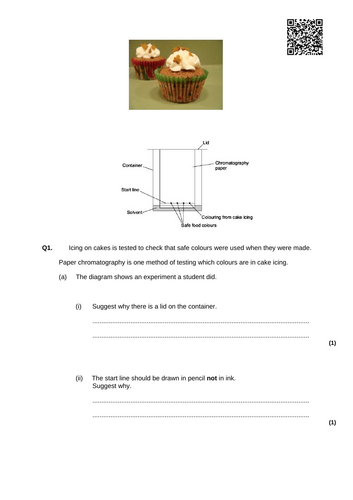
Setup of chromatography
Pencil line & baseline
Solvent front
Example chromatogram with labels
Rf calculation example
-
Results Table (Blank for Students)
Substance Distance moved by spot (cm) Distance moved by solvent front (cm) Rf value
Ink A
Ink B
Ink C
Unknown -
Analysis Questions
-
Why must the baseline be drawn in pencil, not pen?
-
Why must the solvent level be below the baseline?
-
What does it mean if two inks have the same Rf value?
-
Why is the beaker covered during the experiment?
-
How can chromatography show that a substance is pure?
-
Higher-Tier Questions
Two dyes have Rf values of 0.54 and 0.55. Explain whether this chromatography method is suitable for distinguishing them.
A student gets blurred spots. Give two possible reasons why.
Why does a polar solvent separate inks differently to a non-polar solvent?
- Exam-Style Calculation Questions
Example 1
Solvent front = 8.0 cm
Dye spot = 4.6 cm
Rf = 4.6 ÷ 8.0 = 0.575
Example 2
The unknown ink has an Rf of 0.72.
Inks A, B, C have Rf values:
A = 0.55, B = 0.72, C = 0.84
Which ink is the unknown? Explain your reasoning.
- Required Practical Exam Tips
Students must be able to:
Label diagrams of the setup.
Explain separation using different solubilities.
Calculate Rf values accurately.
Identify unknowns from chromatograms.
Explain sources of error.
Something went wrong, please try again later.
This resource hasn't been reviewed yet
To ensure quality for our reviews, only customers who have purchased this resource can review it
Report this resourceto let us know if it violates our terms and conditions.
Our customer service team will review your report and will be in touch.
£2.99