

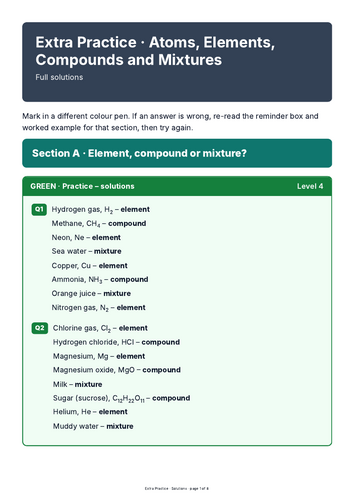

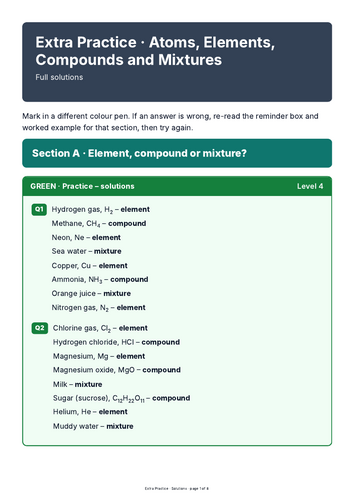
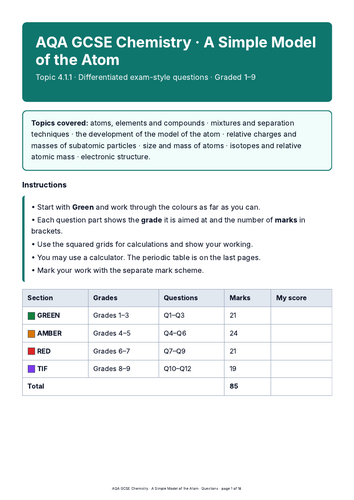
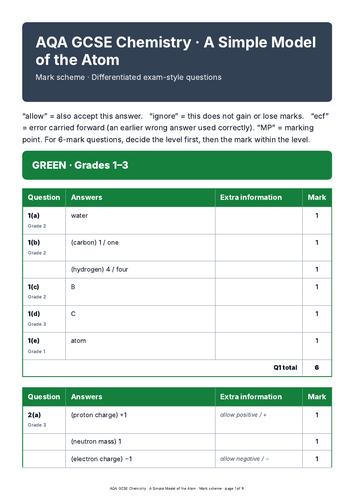
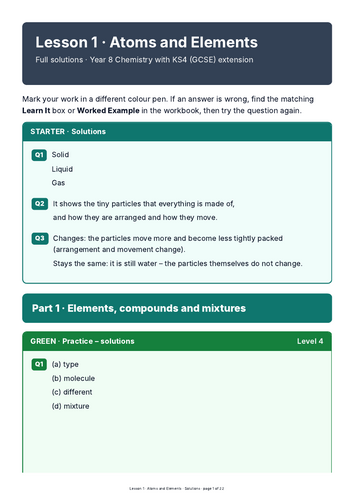
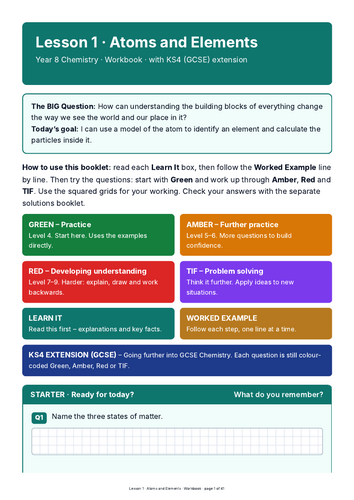
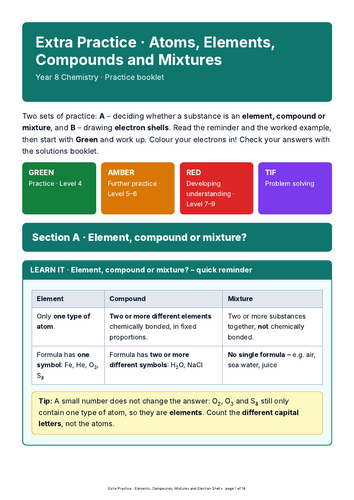
This is the first lesson in the Year 8 unit “Atoms, Elements and Mixtures of the Periodic Table”. Students learn that everything is made of tiny particles called atoms, and that an element is a substance made of only one type of atom. There are about 118 elements.
The lesson covers:
Chemical symbols: every element has a one‑ or two‑letter symbol. The first letter is always a capital and the second is lower case, which is why Co (cobalt) and CO (carbon monoxide) are different. Some symbols come from Latin names, such as Na for sodium (natrium) and Fe for iron (ferrum).
The structure of the atom: a central nucleus contains protons (positive) and neutrons (no charge). Electrons (negative) move around the nucleus in shells. Atoms are neutral because they have the same number of protons and electrons.
Drawing atoms: electrons fill the shells from the inside. The first shell holds 2, then up to 8 in each of the next shells. For example, carbon is 2, 4.
Atomic number and mass number: the atomic number is the number of protons, and it decides which element an atom is. The mass number is protons plus neutrons. Students calculate protons, neutrons and electrons, for example sodium‑23 has 11 protons, 12 neutrons and 11 electrons.
Chemical formulae: a formula shows which atoms are in a substance and how many of each. For example, H₂O has 2 hydrogen atoms and 1 oxygen atom.
By the end of the lesson, students should be able to:
identify the symbols of common elements
describe and draw the structure of an atom
use atomic number and mass number to work out the numbers of protons, neutrons and electrons
The lesson ends with an application task about labelling a museum exhibit on carbon‑12 and carbon‑14. This shows that atoms of the same element can have different numbers of neutrons.
The KS4 extension goes further into GCSE ideas: isotopes, relative atomic mass, ions, electron configuration, the history of the atomic model and relative formula mass.
Something went wrong, please try again later.
This resource hasn't been reviewed yet
To ensure quality for our reviews, only customers who have purchased this resource can review it
Report this resourceto let us know if it violates our terms and conditions.
Our customer service team will review your report and will be in touch.
£2.00