


Bespoke, fully editable lesson for Cambridge International AS & A Level Computer Science (9618): P3.08 Range, precision and rounding errors. Slides, worksheet and full answers.
Written for Paper 3 Advanced Theory, section 13 Data representation (syllabus 13.3.1, 13.3.4, 13.3.5). Everything is editable, so you can adapt it to your class.
What’s included- PowerPoint lesson (14 slides) with teacher notes on every slide
- Student worksheet (Word), ready to print or edit
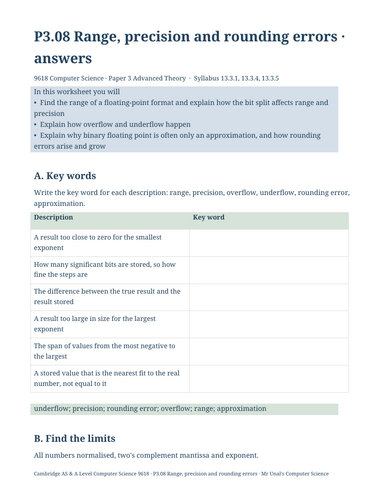
- Answer sheet (Word) with mark-scheme style answers for every question
By the end of the lesson students can:
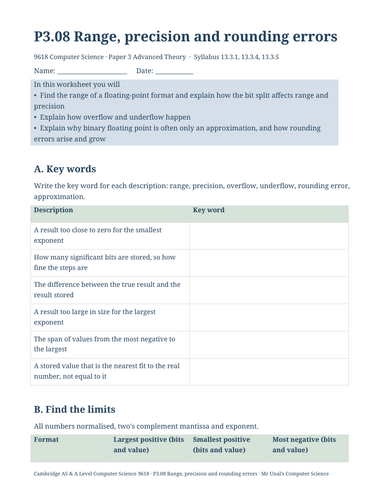
- Find the range of a floating-point format and explain how the bit split affects range and precision
- Explain how overflow and underflow happen
- Explain why binary floating point is often only an approximation, and how rounding errors arise and grow
Worksheet sections: A. Key words; B. Find the limits; C. Overflow, underflow or rounding?; D. Exam-style questions; E. Challenge
Every lesson includes- Learning goals and a starter question
- Clear explanations, diagrams and worked examples (Cambridge pseudocode, as in the 2027–2029 pseudocode guide, with Python alongside)
- A quick check and a “your turn” task linked to the worksheet
- Exam-style questions with marks, and an exit ticket
- PowerPoint (.pptx) and Word (.docx), fully editable
- Works in PowerPoint and Google Slides
- Calm, muted sixth-form design, consistent across the whole course
These are independent resources written for the Cambridge International AS & A Level Computer Science syllabus (9618) for examination in 2027, 2028 and 2029. They are not produced or endorsed by Cambridge University Press & Assessment. Syllabus point numbers are our own numbering of the syllabus statements.
Get this resource as part of a bundle and save up to 40%
A bundle is a package of resources grouped together to teach a particular topic, or a series of lessons, in one place.
Bundle
Cambridge A Level Computer Science 9618 – Paper 3 Part 1 (P3.01–P3.20) – Bundle (20 lessons)
A ready-to-teach bundle for **Cambridge International AS & A Level Computer Science (9618)**: Paper 3 Advanced Theory, part 1, lessons P3.01 to P3.20. Every lesson comes with: - **Editable PowerPoint slides**: goals, starter, explanations, diagrams, worked examples, a quick check, a task and an exit ticket, with teacher notes - **Student worksheet (Word)**: recall, applied practice and exam-style questions with marks - **Answer sheet (Word)**: full mark-scheme style answers Worth £99.80 if bought lesson by lesson. ## What's inside **Section 13 Data representation** - P3.01 User-defined data types - P3.02 Composite data types - P3.03 File organisation and access - P3.04 Hashing algorithms - P3.05 Floating-point format - P3.06 Converting floating-point numbers - P3.07 Normalising floating-point numbers - P3.08 Range, precision and rounding errors **Section 14 Communication and internet technologies** - P3.09 Protocols and the TCP/IP stack - P3.10 Application-layer protocols - P3.11 Circuit switching and packet switching **Section 15 Hardware and virtual machines** - P3.12 RISC and CISC - P3.13 Pipelining and registers - P3.14 Parallel processing - P3.15 Virtual machines - P3.16 Half adders and full adders - P3.17 Flip-flops - P3.18 Boolean algebra and De Morgan's laws - P3.19 Karnaugh maps **Section 16 System software** - P3.20 The OS as resource manager ## Why teachers use it - Mapped lesson by lesson to the syllabus, so coverage is easy to track - Cambridge pseudocode, as in the 2027–2029 pseudocode guide, with Python alongside - Fully editable: adapt to your class, timings and school template These are independent resources written for the Cambridge International AS & A Level Computer Science syllabus (9618) for examination in 2027, 2028 and 2029. They are not produced or endorsed by Cambridge University Press & Assessment. Syllabus point numbers are our own numbering of the syllabus statements.
£59.99
Bundle
Cambridge A Level Computer Science 9618 – Section 13 Data representation – Bundle (8 lessons)
A complete, ready-to-teach bundle for **Cambridge International AS & A Level Computer Science (9618)**: Section 13 Data representation, in 8 bespoke lessons. Every lesson comes with: - **Editable PowerPoint slides**: goals, starter, explanations, diagrams, worked examples, a quick check, a task and an exit ticket, with teacher notes - **Student worksheet (Word)**: recall, applied practice and exam-style questions with marks - **Answer sheet (Word)**: full mark-scheme style answers Worth £39.92 if bought lesson by lesson. ## What's inside - **P3.01** User-defined data types - **P3.02** Composite data types - **P3.03** File organisation and access - **P3.04** Hashing algorithms - **P3.05** Floating-point format - **P3.06** Converting floating-point numbers - **P3.07** Normalising floating-point numbers - **P3.08** Range, precision and rounding errors ## Why teachers use it - Mapped lesson by lesson to the syllabus, so coverage is easy to track - Cambridge pseudocode, as in the 2027–2029 pseudocode guide, with Python alongside - Fully editable: adapt to your class, timings and school template - Works for teaching, revision, cover lessons and homework These are independent resources written for the Cambridge International AS & A Level Computer Science syllabus (9618) for examination in 2027, 2028 and 2029. They are not produced or endorsed by Cambridge University Press & Assessment. Syllabus point numbers are our own numbering of the syllabus statements.
£29.99
Something went wrong, please try again later.
This resource hasn't been reviewed yet
To ensure quality for our reviews, only customers who have purchased this resource can review it
Report this resourceto let us know if it violates our terms and conditions.
Our customer service team will review your report and will be in touch.
£4.99