

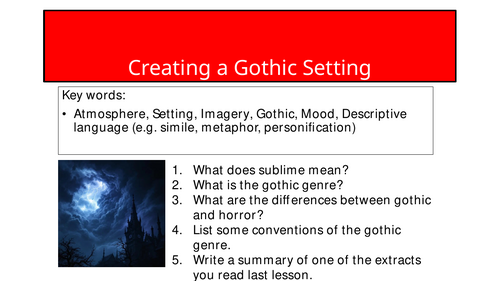

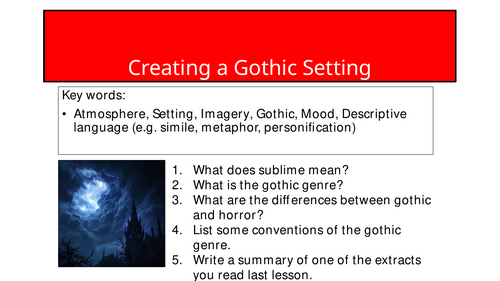
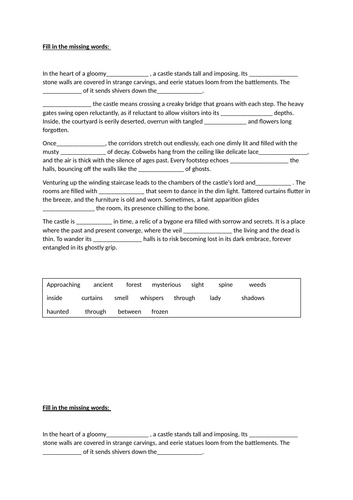
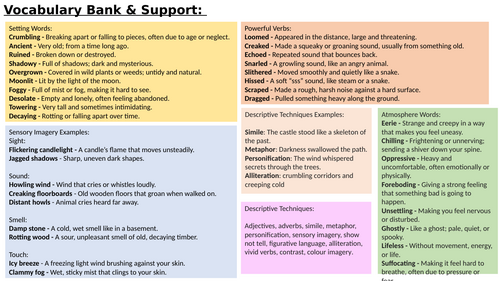
KS3 Lesson - A lesson built around Creating a Gothic Setting. Images and planning activities provided, an exemplar paragraph and gothic vocabulary and support sheet. Additional support for EAL/SEN students.
Get this resource as part of a bundle and save up to 72%
A bundle is a package of resources grouped together to teach a particular topic, or a series of lessons, in one place.
Bundle
Gothic Literature Mini SOW
An 11 lesson KS3 mini scheme of work exploring Gothic literature through a wide range of classic Gothic texts. Students explore Gothic settings, monsters, heroes, villains, Gothic archetypes, and more through extracts from a range of influential texts. The unit also introduces students to the development of Gothic literature and encourages them to compare the conventions of Gothic literature with those of horror. **Texts and extracts include:** Dracula by Bram Stoker Frankenstein by Mary Shelley The Strange Case of Dr Jekyll and Mr Hyde by Robert Louis Stevenson The Castle of Otranto by Horace Walpole Plus activities drawing on wider Gothic literature and conventions **Students develop their ability to:** Understand the key features and conventions of Gothic literature Explore Gothic tropes and archetypes Analyse Gothic characters, including heroes, heroines, villains and monsters Explore how writers create fear and tension Analyse language choices and their effects Explore how writers create Gothic settings and atmosphere Analyse structure and narrative choices Explore the significance of Gothic imagery and symbolism Use contextual knowledge to develop interpretations Support ideas with relevant textual evidence Develop analytical responses Apply Gothic conventions to their own creative writing **What's Included?** 11 detailed, ready to teach lessons A range of activities for each extract Repeat questions in every lesson linked to previous learning Discussion and collaborative tasks Annotated quotations Model paragraphs and analytical support Key context lessons and accompanying worksheets Comprehension and inference activities Analytical and evaluative questions A variety of creative writing activities Reflection and plenary activities for each lesson 1 reading assessment 2 creative writing lesson, which can also be used as a creative writing assessment A Gothic Fiction homework sheet of 24 homework tasks of varying difficulties. Pupils are to choose one task each week to complete that matches their confidence and ability. This unit is also available as part of a 21 lesson gothic fiction SOW, found here for only £12.99: https://www.tes.com/teaching-resource/resource-13496367
£8.50
Bundle
Gothic Literature KS3 SOW
An 21 lesson KS3 scheme of work (Including a lesson for the reading assessment) exploring Gothic literature through a wide range of classic Gothic texts. Students explore Gothic settings, monsters, heroes, villains, Gothic archetypes, and more through extracts from a range of influential texts. **Texts and extracts include:** Dracula, Jekyll and Hyde, Frankenstein, Carmilla, Rebecca, The Picture of Dorian Grey, The Tell Tale Heart, The Castle Of Otranto. Plus activities drawing on wider Gothic literature and conventions **Students develop their ability to:** Understand the key features and conventions of Gothic literature Explore Gothic tropes and archetypes Analyse Gothic characters, including heroes, heroines, villains and monsters Explore how writers create fear and tension Analyse language choices and their effects Explore how writers create Gothic settings and atmosphere Analyse structure and narrative choices Explore the significance of Gothic imagery and symbolism Use contextual knowledge to develop interpretations Support ideas with relevant textual evidence Develop analytical responses Apply Gothic conventions to their own creative writing **What's Included?** 21 detailed, ready to teach lessons A range of activities for each extract Repeat questions in every lesson linked to previous learning Discussion and collaborative tasks Annotated quotations Model paragraphs and analytical support Key context lessons and accompanying worksheets Comprehension and inference activities Analytical and evaluative questions A variety of creative writing activities Reflection and plenary activities for each lesson 1 reading assessment 2 creative writing lesson, which can also be used as a creative writing assessment **Due to copyright, the extract for Rebecca has not been included but a link to it is in the notes of the first slide of that lesson.**
£12.99
Something went wrong, please try again later.
This resource hasn't been reviewed yet
To ensure quality for our reviews, only customers who have purchased this resource can review it
Report this resourceto let us know if it violates our terms and conditions.
Our customer service team will review your report and will be in touch.
£2.20