


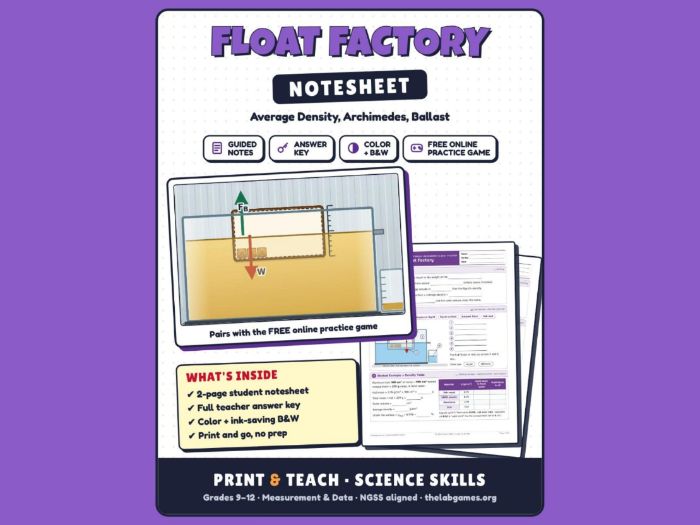
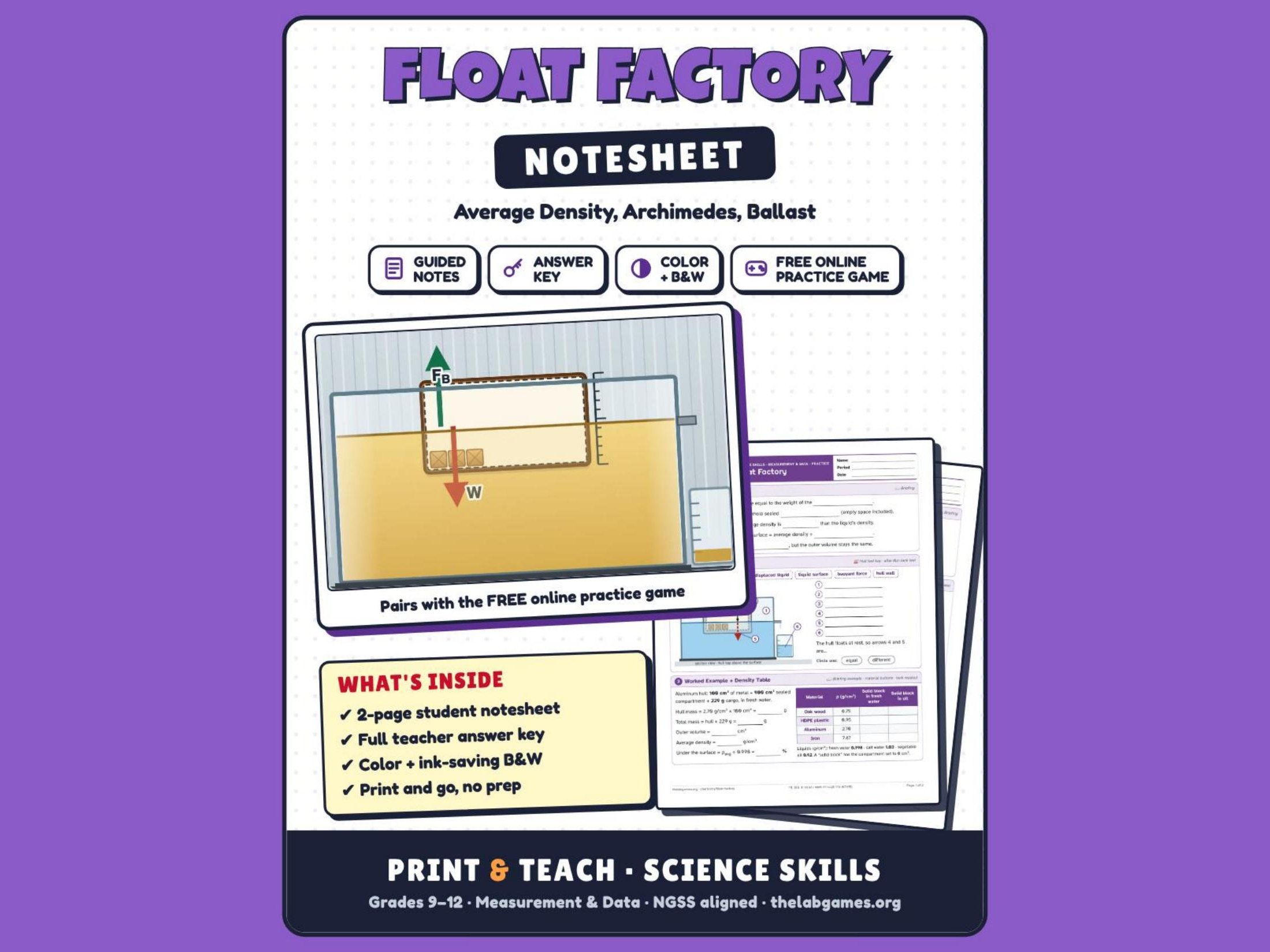
Help students see why a steel ship floats. This roomy, student-friendly 2-page notesheet walks students through buoyant force and displaced liquid, average density of a sealed hollow hull, the submerged fraction (average density ÷ liquid density), and ballast for neutral buoyancy. Students label a floating hull in a test tank, work through an aluminum-hull example, predict which solid materials float in water and in oil, and then solve four work orders like the ones in the game.
It pairs with Float Factory, a free online practice game at thelabgames.org where students design sealed hulls, hit a loaded waterline, move buoys between liquids and set submarine ballast. Use it in class, for absent-student makeups, or on sub days. A complete teacher key with every value worked out is included.
What’s Included
- Student notesheet (2 pages) in full color AND black & white
- Teacher answer key (red answers) in full color AND black & white
What Students Do
- Background fill-in: buoyant force and displaced liquid, average density of a sealed hull, when a vessel floats, the submerged fraction, and what ballast changes
- Label the Test Tank: liquid surface, hull wall, sealed compartment, buoyant force, weight and displaced liquid, and why the two force arrows are equal for a floating hull
- Worked Example + Density Table: hull mass, total mass, outer volume, average density and percent submerged for an aluminum hull, plus whether solid oak, HDPE, aluminum and iron float in fresh water and in vegetable oil
- Practice Work Orders: test an iron boat, design a compartment for a target waterline, compare one buoy in oil and salt water, and set submarine ballast for neutral buoyancy
- AP Physics 1 Extension: full-displacement buoyant force, extra cargo to an 85% rating, and gauge pressure at depth
- My Runs: a log for tracking practice scores
Skills & Standards
- Density, average density, buoyant force, Archimedes’ principle, floating and sinking, displaced volume, submerged fraction, ballast and neutral buoyancy, F_B = ρVg, gauge pressure p = ρgh, unit conversions (g to kg, cm³ to m³)
- Supports NGSS HS-PS2-1 and Science & Engineering Practice 5 (math and computational thinking)
- Grades 9–12 Biology, Chemistry, Physics and Earth Science with AP extensions
Great For
- Density and buoyancy lessons
- Absent-student makeups
- Sub plans
- Homework or stations
- AP Physics 1 fluids review
Something went wrong, please try again later.
This resource hasn't been reviewed yet
To ensure quality for our reviews, only customers who have purchased this resource can review it
Report this resourceto let us know if it violates our terms and conditions.
Our customer service team will review your report and will be in touch.
$2.49