

pptx, 5.52 MB
pptx, 5.52 MB
docx, 16.82 KB
docx, 16.82 KB
pdf, 311.96 KB
pdf, 311.96 KB
pdf, 818.75 KB
pdf, 818.75 KB
pdf, 485.81 KB
pdf, 485.81 KB
pdf, 6.24 MB
pdf, 6.24 MB
pdf, 17.69 MB
pdf, 17.69 MB
pdf, 598.16 KB
pdf, 598.16 KB
pdf, 334.76 KB
pdf, 334.76 KB

Welcome to Project Management. This is the 8th lesson of this module.
There are always more project proposals than there are available resources. The priority system needs to select projects that best contribute to the organization’s objectives, within the constraints of the resources available. If all projects and their respective resources are computer scheduled, the feasibility and impact of adding a new project to those in process can be quickly assessed. With this information the project priority team will add a new project only if resources are available to be formally committed to that specific project. This chapter examines methods of scheduling resources so the team can make realistic judgments of resource availability and project durations. The project manager uses the same schedule for implementing the project. If changes occur during project implementation, the computer schedule is easily updated and the effects easily assessed.

This lecture series is based on Erik W. Larson and Clifford F. Gray’s Book “Project Management, the Managerial Process” chapter by chapter.

You will find the content of this text highly practical, relevant, and current. The concepts discussed are relatively simple and intuitive. As you study each chapter we suggest you try to grasp not only how things work, but why things work. You are encouraged to use the text as a handbook as you move through the three levels of competency: I know. I can do. I can adapt to new situations.

The learning outcomes of this lesson include:
In this lecture, we focus on these four learning outcomes:
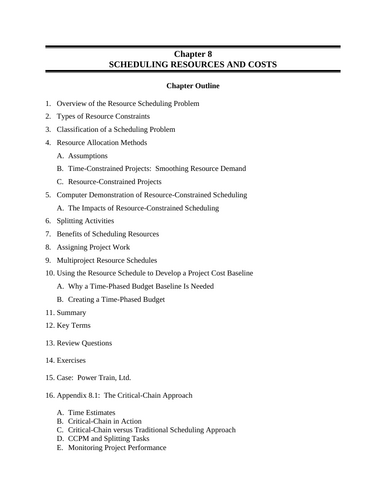
8-1 Understand the differences between time-constrained and resource- constrained schedules when doing project planning
8-2 Identify different types of resource constraints.
8-3 Describe how the smoothing approach is used on time-constrained projects.
8-4 Describe how the leveling approach is used for resource-constrained projects.
8-5 Understand how project management software creates resource constrained schedules.
8-6 Understand when and why splitting tasks should be avoided.
8-7 Identify general guidelines for assigning people to specific tasks.
8-8 Identify common problems with multiproject resource scheduling.
8-9 Explain why a time-phased budget baseline is needed.
8-10 Create a time-phased project budget baseline.

This is a comprehensive lesson plan for about 1.5 -2 hours including a well-prepared PowerPoint presentation, interactive exercises, in-depth case studies, and associated reading materials, designed to provide a holistic learning experience.

To download the full pack of the lesson materials, please visit:

Get this resource as part of a bundle and save up to 53%

A bundle is a package of resources grouped together to teach a particular topic, or a series of lessons, in one place.

Bundle

FULL COURSE WITH EXAMS Foundations of Project Management Lesson 1-12

Welcome to Project Management. Project management is both people and technical oriented. Project management involves understanding the cause-effect relationships and interactions among the sociotechnical dimensions of projects. Improved competency in these dimensions will greatly enhance your competitive edge as a project manager. The field of project management is growing in importance and at an exponential rate. It is nearly impossible to imagine a future management career that does not include management of projects. Résumés of managers will soon be primarily a description of the individual’s participation in and contributions to projects. Good luck on your journey through the text and on your future projects This lecture series is based on Erik W. Larson and Clifford F. Gray’s Book“Project Management: The Managerial Process”. The chapters are: Chapter 1 Modern Project Management Chapter 2 Organization Strategy and Project Selection Chapter 3 Organization: Structure and Culture Chapter 4 Defining the Project Chapter 5 Estimating Times and Costs Chapter 6 Developing a Project Plan Chapter 7 Managing Risk Chapter 8 Scheduling resources and cost Chapter 9 Reducing Project Duration Chapter 10 Leadership Chapter 11 Teams Chapter 12 Outsourcing Chapter 13 Monitoring Progress Chapter 14 Project closure Chapter 15 International Projects Chapter 16 Oversight Chapter 17 Agile PM You will find the content of this text highly practical, relevant, and current. The concepts discussed are relatively simple and intuitive. As you study each chapter we suggest you try to grasp not only how things work, but why things work. You are encouraged to use the text as a handbook as you move through the three levels of competency: I know. I can do. I can adapt to new situations. All lesson materials include detailed lesson plan, for about 1.5 hours, including This is a comprehensive lesson plan for about 1.5 hours includes a well-prepared PowerPoint presentation, with video links, interactive exercises, in-depth case studies, and associated reading materials, designed to provide a holistic learning experience. The Power Point presentations are fully animated with scripts and ready to deliver. They are also videos available to watch. They contain a mixture of topic information, examples, and activities/exercises for each topic in the specification for the learning outcomes. All lessons are suitable for about 1 hour of teaching time in which class exercises and homework are integrated into lessons where appropriate. We wish you all the best for the study, and should you have any further questions, please get in touch.

£16.99

Reviews

Something went wrong, please try again later.

This resource hasn't been reviewed yet

To ensure quality for our reviews, only customers who have purchased this resource can review it

Report this resourceto let us know if it violates our terms and conditions.
Our customer service team will review your report and will be in touch.