


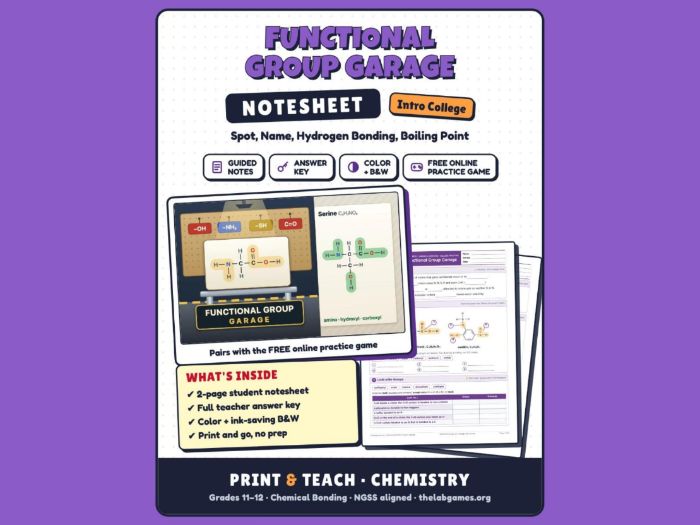
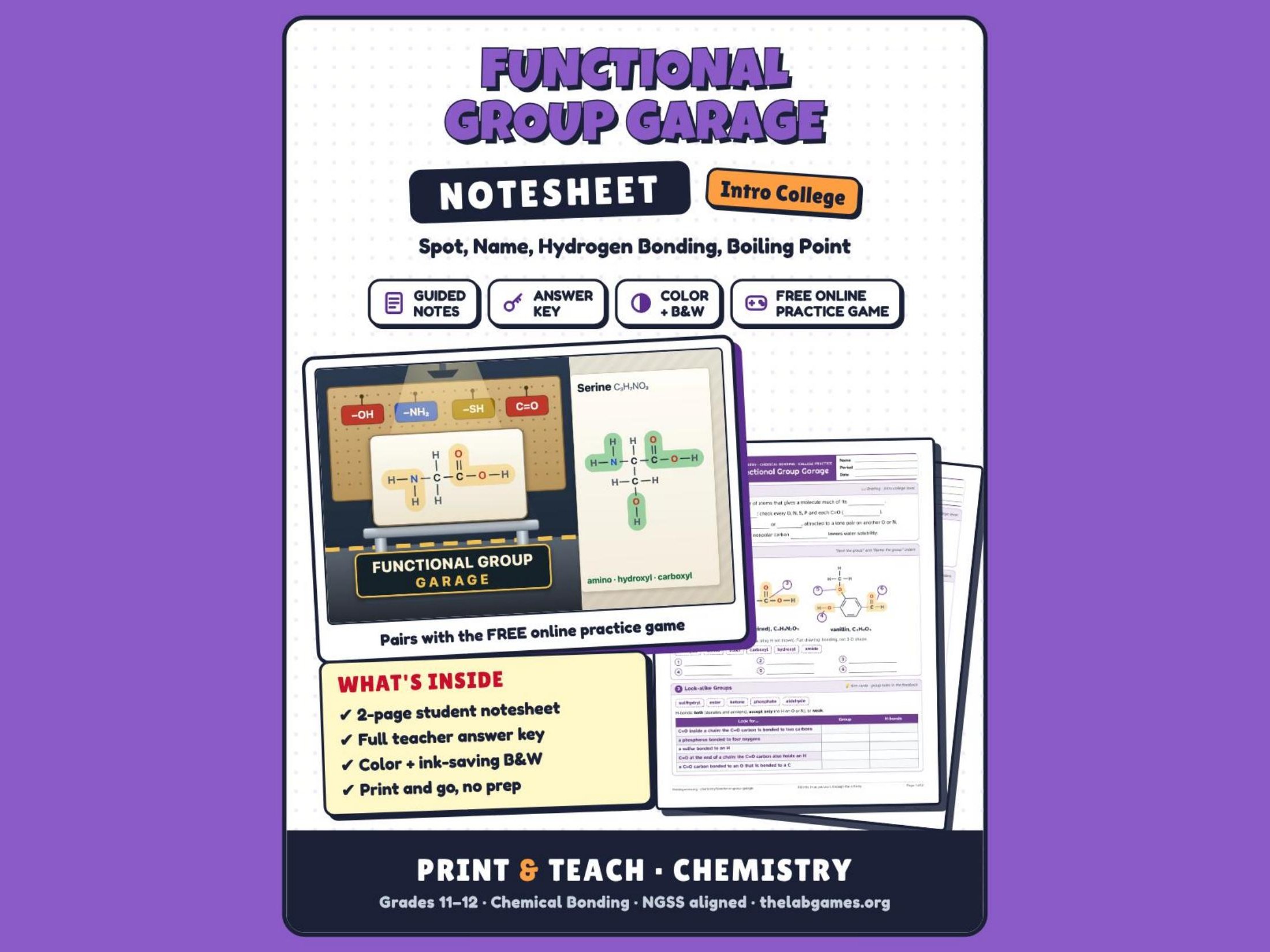
Teach students to read a molecule by its functional groups. In this roomy, student-friendly 2-page notesheet, students fill in the background on functional groups, bonding clues, hydrogen bonds and chain length, name six groups shaded on real structural formulas of glycylglycine (a dipeptide) and vanillin, and sort the look-alike groups (ketone, aldehyde, ester, phosphate, sulfhydryl) by their bonding and how they hydrogen-bond. On page 2 they work four orders from the activity: spot the ester on methyl ethanoate, name a hydroxyl on glycerol 3-phosphate and say how it hydrogen-bonds, and predict which molecule boils higher or dissolves better in water, with the reason and the handbook values.
It pairs with Functional Group Garage, a free online practice game at thelabgames.org where students tap groups on real molecules like glucose, amino acids and aspirin, name them, then predict boiling point and solubility. Use it in class, for absent-student makeups, or on sub days. A complete teacher key is included.
What’s Included
- Student notesheet (2 pages) in full color AND black & white
- Teacher answer key (red answers) in full color AND black & white
What Students Do
- Background fill-in: polarity, spotting a group from its bonding, what a hydrogen bond needs, and how a long carbon chain lowers solubility
- Name the Groups: name amino, amide (peptide bond), carboxyl, hydroxyl, ether and aldehyde groups shaded on glycylglycine and vanillin
- Look-alike Groups: name the group from its bonding rule and say whether it donates and accepts, only accepts, or barely forms hydrogen bonds
- Work Orders: spot a group by its part letter, name a group and its hydrogen bonding, and compare boiling points and water solubility with the best reason
- Key Ideas and My Runs: amino or amide, why S–H barely hydrogen-bonds, and a log for tracking practice scores
Skills & Standards
- Functional groups (hydroxyl, carbonyl: aldehyde and ketone, carboxyl, amino, amide, phosphate, sulfhydryl, ester, ether), structural formulas, hydrogen bond donors and acceptors, intermolecular forces, boiling point and water solubility
- Supports NGSS HS-PS1-3
- Grades 11–12 AP Chemistry and intro college (go-further extension)
Great For
- Organic chemistry and biomolecules units
- AP Biology Unit 1 and AP Chemistry Unit 3 extension
- Absent-student makeups
- Sub plans
- Test review
Something went wrong, please try again later.
This resource hasn't been reviewed yet
To ensure quality for our reviews, only customers who have purchased this resource can review it
Report this resourceto let us know if it violates our terms and conditions.
Our customer service team will review your report and will be in touch.
$2.49