


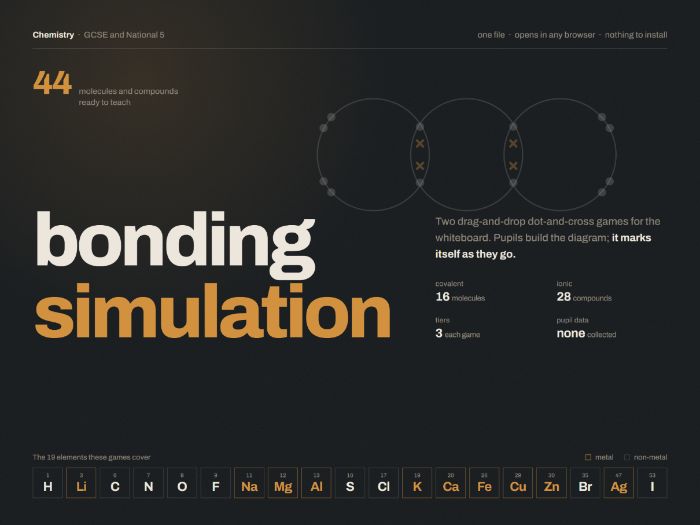
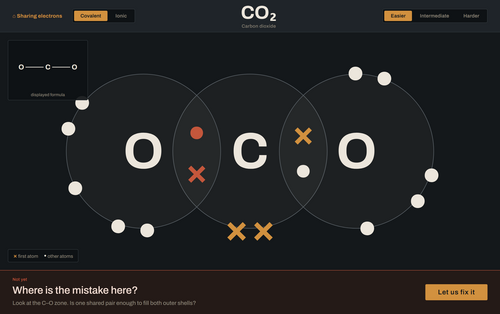
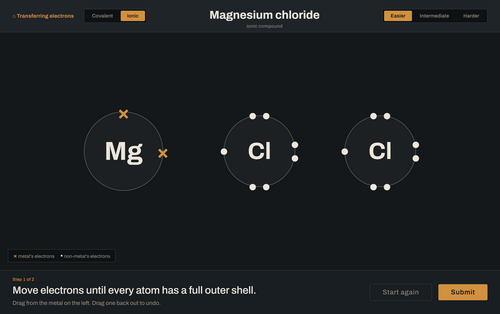
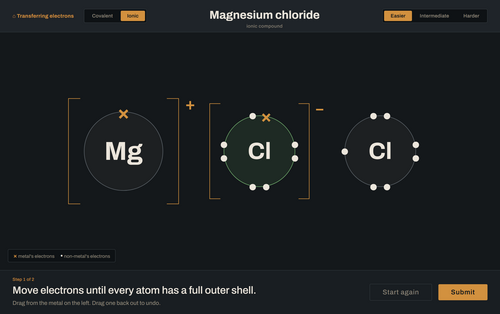
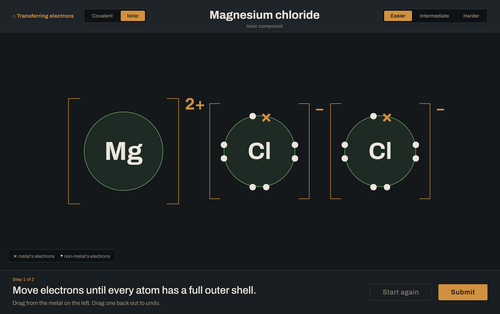
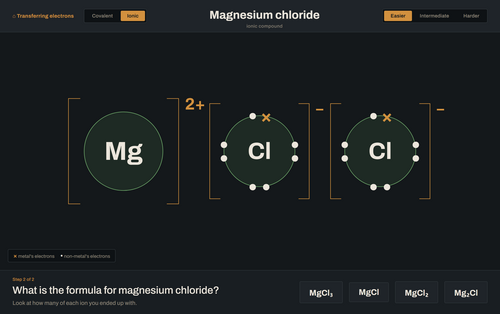
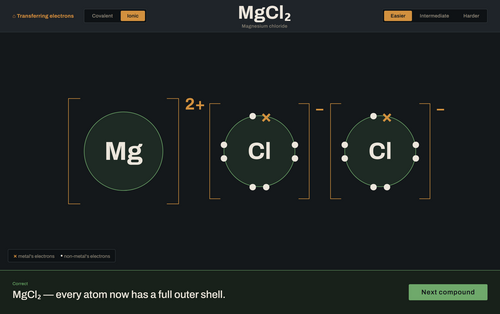
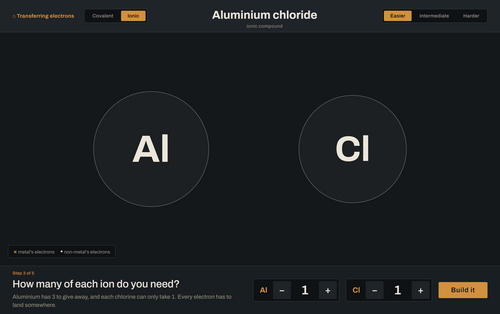
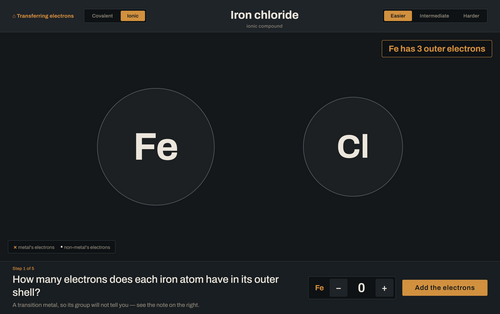
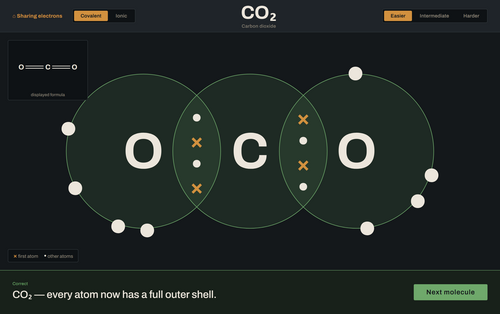
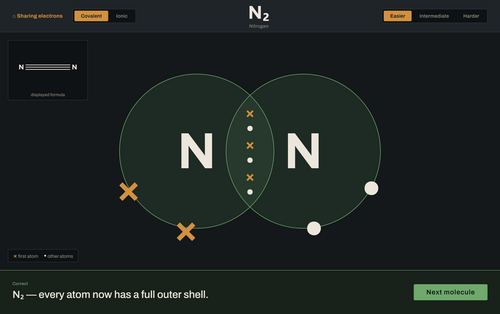
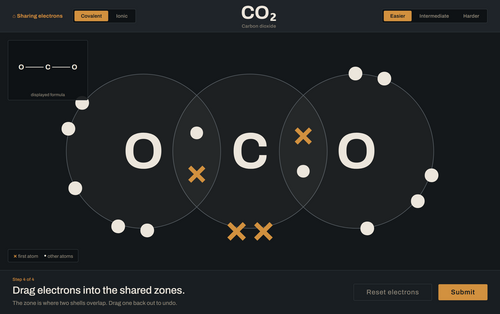
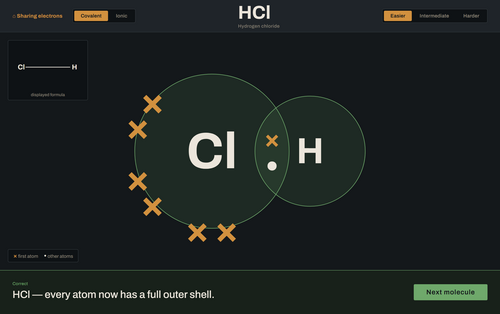
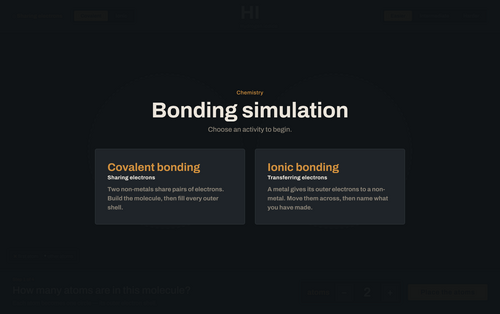
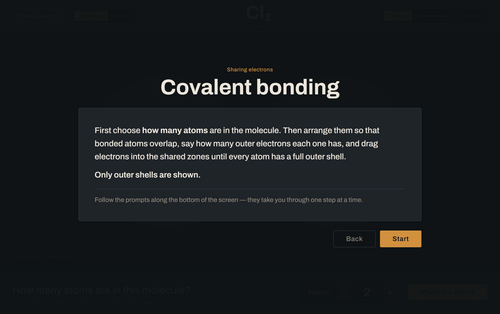


Two interactive dot-and-cross games your class plays on the whiteboard - one covalent, one ionic. Students drag the electrons themselves, and every wrong answer is met with a question rather than the answer, so the mistake stays on screen for the class to argue about.
HOW I USE IT
I model the first one myself, talking through why each electron goes where it does, then hand over and let them take control. That works two ways. Either a student comes up and drags the electrons while the rest of the room says whether they agree, or I participate and take instructions from the class. I use it at every stage of the topic. Building the first diagrams when we start learning about bonding, practising once it has been taught, and coming back months later for revision. The tiers mean the same file covers all three, so it is worth keeping in your bookmarks rather than using once.
WHAT’S IN IT
44 molecules and compounds across six difficulty tiers, including the commonly seen examples in GCSE papers. Within a tier the next example comes up at random, and it will not repeat one until it has used them all.
HOW IT TEACHES
Misconceptions can be played out and tackled in real time with immediate feedback and prompting. A student can put nine electrons on one chlorine and the game will let them, because the mistake needs to be visible for the class to discuss. Errors are diagnosed only on ‘Submit’, one at a time, and always as a question:
For example, “One chlorine has 9 electrons around it. How many can that outer shell actually hold?”
WHAT YOU DOWNLOAD
• Bonding games.html - the whole thing, one file
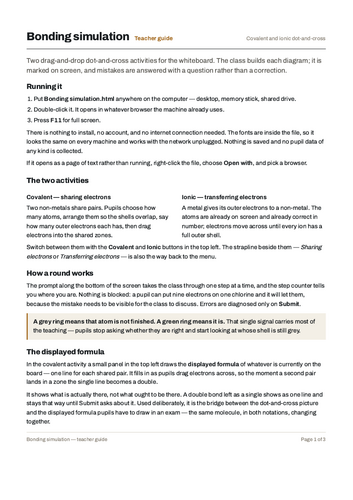
• A three-page teacher guide (PDF) with more in-depth info about the interactive resource.
YOURS TO KEEP
Once you have bought it, the file is yours. No subscription, no login, no licence key, no expiry. Nothing is hosted anywhere, so there is no service that can go down, get discontinued, change its terms or start charging monthly. It is a single file sitting on your computer or your own drive, and it opens the same way every time. It will still work whether or not you are online, and whether or not this shop is still here.
REQUIREMENTS
Any computer with a web browser. Windows, Mac or Chromebook; Chrome, Edge, Firefox or Safari. No installation, no account, no internet connection needed - it runs entirely offline. Nothing is saved and no pupil data is collected of any kind. Just download and double-click. If it opens as text, right click and click ‘open in browser’.
A NOTE ON THE CHEMISTRY
Two deliberate GCSE-level simplifications, so nothing surprises
you mid-lesson: iron is always shown as 3+ and copper as 2+ (both
form other ions in reality, but these keep Roman numerals out of
it), and ions are drawn the same size as their atoms.
For more practical-based resources, see my catalogue of KS3 and KS4 practical lessons here: https://www.tes.com/teaching-resources/shop/PrestonsPracticals
Something went wrong, please try again later.
This resource hasn't been reviewed yet
To ensure quality for our reviews, only customers who have purchased this resource can review it
Report this resourceto let us know if it violates our terms and conditions.
Our customer service team will review your report and will be in touch.
£4.50