


Stop guessing. Start solving limits with a method you can follow every time.
Limits are the foundation of calculus, and they are where many students first get stuck. They see 0/0, don’t know what to do, and give up. Limits Made Easy fixes that. It teaches one clear routine and shows exactly when to use each technique.
What’s inside
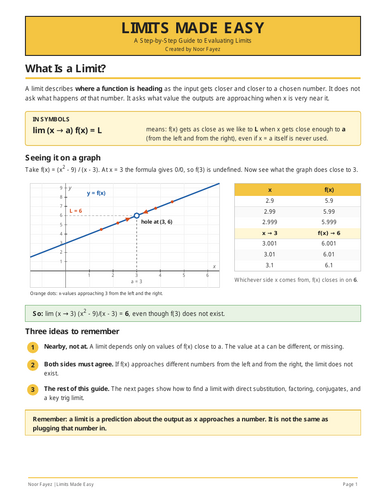
A clear first page. It explains what a limit actually means, with a graph and a table of values showing f(x) closing in on an answer even when the function is undefined at that point.
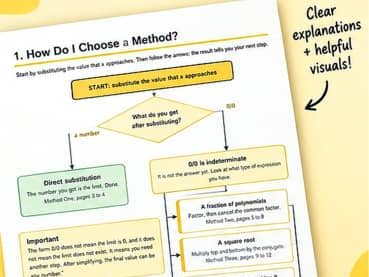
A decision flowchart. Substitute first. If you get a number, you’re done. If you get 0/0, the chart tells you whether to factor, use a conjugate, or use the trigonometric limit.
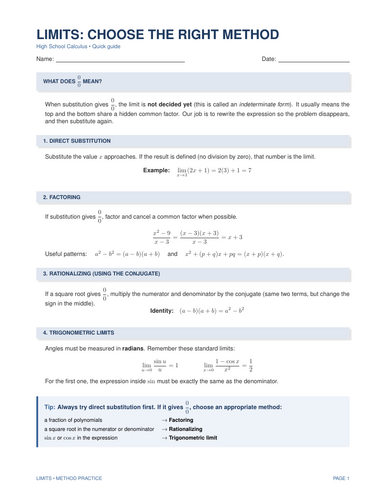
Four methods, taught in order. Each has a short rule and the idea behind it:
Direct substitution
Factoring
Rationalizing with a conjugate
The key trigonometric limit
8 worked examples. Every algebra move is its own step, with the reason it’s allowed. Each example also has a numeric check table, a “common mistakes” box, and the final answer.
12 practice problems. They start easy and build up, and they mix all four methods so you learn to choose the right one.
Fully detailed solutions. Every practice problem gets its own page. You can find the exact step where your work and the solution first differ.
A final checklist to review before any quiz or exam.
Why it helps
You learn to choose the method, not just follow one. The flowchart and the mixed practice build the habit of asking “what do I have, and what does it need?”
Fewer careless errors. The common-mistakes boxes cover the ones students make most. Examples are cancelling terms instead of factors, forgetting parentheses around negatives, and answering 0 just because the form was 0/0.
You can trust your answers. Each solution includes a table of real values on both sides of the limit point, so you can see the answer is right.
You learn from your own mistakes. The detailed solutions work as a tutor on the page.
Who it’s for
High school calculus and precalculus students, first-year college calculus students, and anyone reviewing limits before an exam. It’s also useful for tutors and teachers who want clear, ready-to-use worked solutions.
Something went wrong, please try again later.
This resource hasn't been reviewed yet
To ensure quality for our reviews, only customers who have purchased this resource can review it
Report this resourceto let us know if it violates our terms and conditions.
Our customer service team will review your report and will be in touch.
£3.00