pptx, 3.92 MB
pptx, 3.92 MB

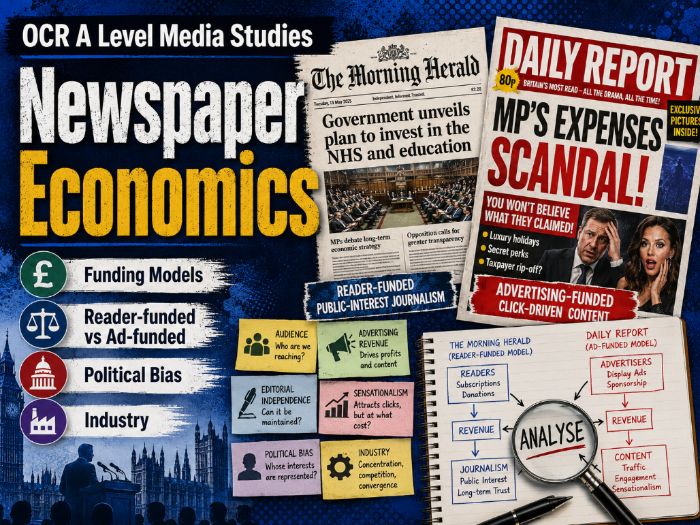
A complete OCR A-Level Media Studies lesson looking at how economic factors influence The Guardian and The Daily Mail.

This fully editable PowerPoint (.pptx) lesson focuses on economic factors in the newspaper industry, specifically comparing how the funding models of The Guardian and The Daily Mail shape content, presentation, political bias and editorial priorities.

Designed for OCR A-Level Media Studies Paper 1 Section A: News & Online, the lesson supports students in understanding how media industries and economic pressures influence the construction of newspaper content. It explores the differences between reader-funded journalism and advertising-funded journalism, linking these models to audience appeal, sensationalism, editorial independence and public-interest reporting.

Students compare the economic models of The Guardian and The Daily Mail, complete a newspaper budgeting scenario, evaluate headline choices and plan an exam-style response.

The lesson includes structured discussion tasks, model answers, planning prompts, exam-style scaffolding and full model paragraphs for both The Guardian and The Daily Mail.

This lesson covers:

OCR A-Level Media Studies
Paper 1 Section A: News & Online
Newspapers
Economic factors
Newspaper funding models
The Guardian
The Daily Mail
Reader-funded journalism
Advertising revenue
Newspaper sales
Digital strategies
Click-driven journalism
Editorial independence
Political bias
Sensationalism
Public-interest journalism
Media industries
Audience targeting
Newspaper presentation
Exam-style 10-mark response practice

What is included:

Fully editable PowerPoint (.pptx) lesson
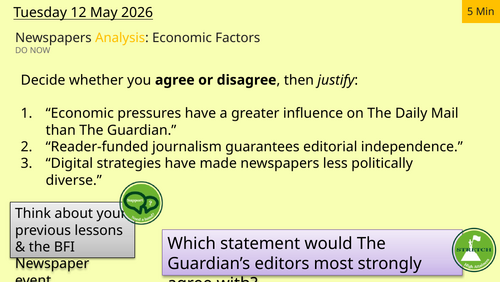
Do Now debate task on economic pressures and newspaper influence
Teacher feedback/model answer slide
Learning objectives
Comparison of The Guardian and The Daily Mail funding models
Key information table on funding differences
Newspaper editor budgeting scenario
Guardian-style reader-funded model facts
Daily Mail-style advertising-funded model facts
Model budget allocations for both newspaper models
Headline sorting task linked to funding models and economic pressures
Teacher feedback/model answers for headline analysis
Exam-style planning task comparing The Guardian and The Daily Mail
Planning prompts for Daily Mail front cover analysis
Planning prompts for Guardian front cover analysis
Model evidence and analysis for both newspapers
PEEL/PEE-style paragraph structure
Full model paragraph for The Guardian
Full model paragraph for The Daily Mail
Mini plenary true/false economic check with answers

Get this resource as part of a bundle and save up to 36%

A bundle is a package of resources grouped together to teach a particular topic, or a series of lessons, in one place.

Bundle

OCR A Level Newspapers Bundle

A complete OCR A-Level Media Studies Newspapers bundle covering News & Online, newspaper forms, mastheads, theory, contexts, economics, regulation and set text analysis. This bundle contains 7 fully editable PowerPoint lessons for the OCR A-Level Media Studies News & Online / Newspapers topic for Paper 1 Section A. The lessons are designed to build students’ knowledge step-by-step, beginning with an introduction to newspapers and ending with detailed set text analysis of The Guardian and The Daily Mail. The bundle supports students in understanding newspaper forms, tabloid and broadsheet conventions, mastheads, political bias, semiotics, audience interpretation, economic factors, regulation, press freedom and OCR set text analysis. It is suitable for Year 12 or Year 13 A-Level Media Studies and can be used as a full sequence of lessons, revision unit, intervention pack or exam preparation resource. The lessons include structured classroom tasks, retrieval practice, teacher feedback slides, model answers, sentence starters, exam-style questions, printable analysis resources and scaffolded writing support. Suggested teaching order Lesson 1: Introduction to Newspapers Introduces the OCR A-Level Newspapers / News & Online topic. Students explore newspaper types, tabloids, broadsheets, political affiliation, regulation, online news and the role of newspapers in shaping public opinion. Lesson 2: Newspaper Mastheads Focuses on newspaper front page conventions and masthead analysis. Students explore how mastheads communicate brand identity, audience positioning, political ideology and representation through typography, colour, logo, tone and layout. Lesson 3: Semiotics & Social Contexts Applies Barthes’ semiotics to newspaper front pages. Students analyse signs, denotation, connotation, anchorage and myth, while linking newspaper media language to political and social contexts. Lesson 4: Stuart Hall and Reception Theory Explores Hall’s Reception Theory and applies dominant/preferred, negotiated and oppositional readings to newspapers. Students consider how audiences decode political messages differently depending on values, identity and ideology. Lesson 5: Economic Factors Compares the funding models of The Guardian and The Daily Mail. Students explore reader-funded journalism, advertising revenue, editorial independence, click-driven content, sensationalism and public-interest reporting. Lesson 6: Newspaper Regulation Explores newspaper regulation, press freedom, IPSO, Ofcom, Leveson, phone hacking, Hillsborough reporting, MPs’ expenses and Edward Snowden/WikiLeaks. Students evaluate whether newspapers need greater regulation to protect the public. Lesson 7: Newspaper Set Text Analysis Final lesson in the sequence, focusing directly on OCR set text analysis of The Guardian and The Daily Mail. Students apply knowledge of media language, representation, political/social contexts, audience, purpose, ownership and political bias. This lesson also includes a printable PDF front page analysis resource. What is included? 7 fully editable PowerPoint (.pptx) lessons Printable PDF front page analysis resource Do Now retrieval activities Teacher feedback/model answer slides Lesson objectives Key terminology explanations Tabloid and broadsheet comparison Newspaper convention tasks Masthead analysis activities Political affiliation tasks Semiotics and Barthes theory application Reception Theory and Stuart Hall application Dominant, negotiated and oppositional reading tasks Economic factors and funding model comparison Reader-funded vs advertising-funded journalism tasks Regulation and press freedom case studies IPSO, Ofcom and Leveson content Case-study evidence for phone hacking, Hillsborough, MPs’ expenses and Snowden/WikiLeaks Source analysis tasks Sentence starters and writing frames Exam-style questions Model paragraphs and extended model responses Mini plenaries and self-assessment tasks Key topics covered OCR A-Level Media Studies Paper 1 Section A: News & Online Newspapers The Guardian Daily Mail Newspaper set texts Tabloids and broadsheets Red-top tabloids Mid-market tabloids Quality newspapers Newspaper mastheads Media language Representation Political context Social context Audience and purpose Political bias Ideology Barthes’ semiotics Stuart Hall’s Reception Theory Denotation and connotation Myth and anchorage Dominant/preferred reading Negotiated reading Oppositional reading Economic factors Funding models Reader-funded journalism Advertising revenue Editorial independence Sensationalism Newspaper regulation Press freedom IPSO Ofcom Leveson Inquiry Phone hacking scandal Hillsborough reporting MPs’ expenses scandal Edward Snowden/WikiLeaks OCR exam preparation This bundle can be used as: A complete A-Level Newspapers teaching sequence A Paper 1 Section A: News & Online unit A revision bundle for The Guardian and The Daily Mail A Year 12 or Year 13 newspaper topic pack A theory application sequence A media language and representation unit A media industries and regulation revision pack A structured OCR exam preparation resource A cover or intervention sequence for A-Level Media Studies This bundle includes fully editable PowerPoint (.pptx) lessons and a printable PDF front page analysis resource. This resource is independently created and is not endorsed by OCR.

£28.00

Reviews

Something went wrong, please try again later.

This resource hasn't been reviewed yet

To ensure quality for our reviews, only customers who have purchased this resource can review it

Report this resourceto let us know if it violates our terms and conditions.
Our customer service team will review your report and will be in touch.