


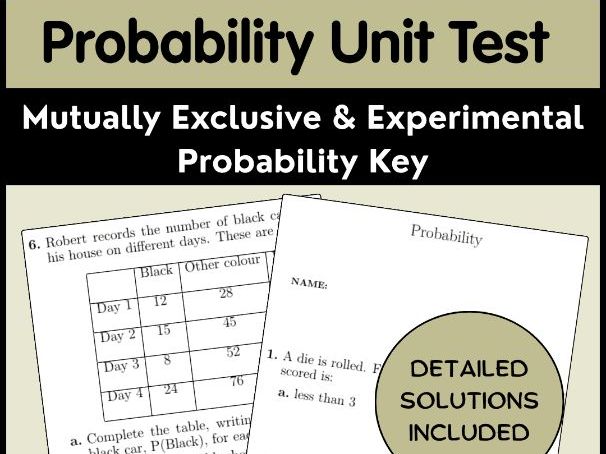
Premium math test on theoretical and experimental probability. Features a 35-mark scaffolded quiz framework with sample space diagrams and worked keys!
Develop your students’ advanced numerical confidence, statistical tracking precision, and logical literacy with this complete Theoretical and Experimental Probability Assessment Test! Perfectly curated for Key Stage 3 Mathematics tracking, early secondary math interventions, and GCSE Foundation or Higher tier revision, this resource scaffolds chance parameters flawlessly across a crisp 35-mark testing framework.
Resource Structure and Topic Marks:
• Part 1 and 2: Theoretical Chance and Number Properties (8 Marks) - Consolidates entry-level mechanics. Questions challenge learners to evaluate single-event outcomes over die rolls and numbered box selections, testing mathematical subsets (primes, factor pairs, squares, multiples) fluently before recording simplified fractions.
• Part 3: Inverse Proportional Inventory Modeling (4 Marks) - Diagnostic fields checking word-problem comprehension. Students solve an equation backwards to find the exact number of counters added to a bag to alter the baseline fractional split to a set target.
• Part 4: Mutually Exclusive Sets Logic (12 Marks) - Evaluates a student’s ability to manipulate multiple logic parameters concurrently across a robust 12-line matrix, determining whether paired attributes (colour classifications, divisibility boundaries, odd/even terms) represent mutually exclusive events or overlapping sets.
• Part 5: Sample Space Diagrams and Grids (8 Marks) - Outlines systematic list tracking, prompting students to construct a matching outcome cross-grid combining independent food and drink profiles before calculating specific compound and negative probability constraints.
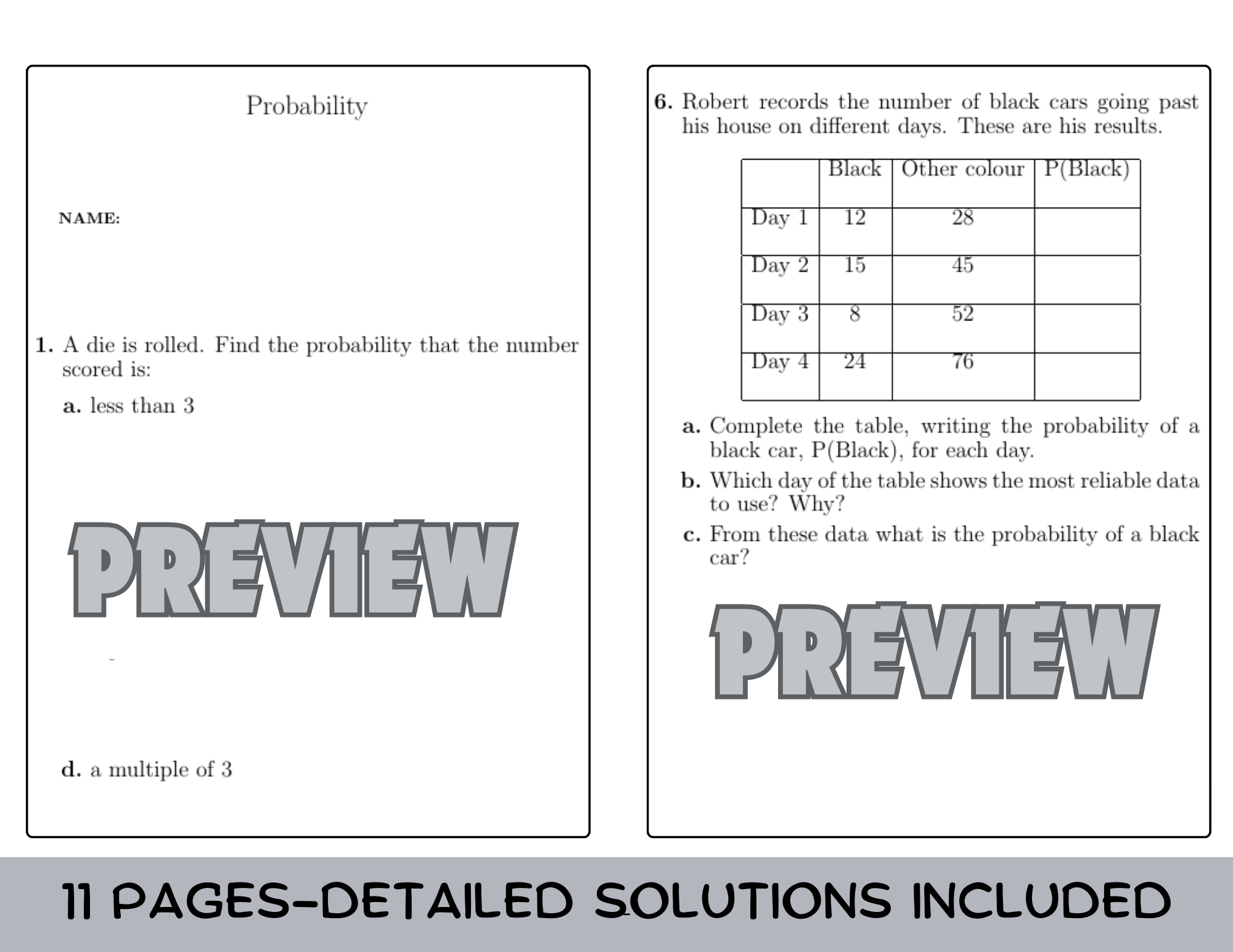
• Part 6: Experimental Relative Frequency Tracks (3 Marks) - Demanding tasks forcing learners to compute relative frequencies across a data logging table, evaluate experimental reliability thresholds based on sample size parameters, and extract the total aggregate experimental chance metric smoothly.
• Comprehensive Solutions Booklet: A complete line-by-line matching layout answer booklet outlines exact calculated solutions, fractional reductions, cross-tables, logic justifications, and point allocations for painless marking or student self-evaluation.
Curriculum Alignment:
• Compute theoretical single and independent compound event calculations fluently across varying number systems and structural constraints
• Differentiate confidently between mutually exclusive and non-exclusive event pairs using clear structural logic sets
• Record, evaluate, and interpret long-run experimental relative frequencies, justifying statistical reliability through sample size criteria
• Primary Key Stage 2 Year 6 extension and Secondary Key Stage 3 math tracking
If you find this resource assessment helpful, please leave a review!
Something went wrong, please try again later.
This resource hasn't been reviewed yet
To ensure quality for our reviews, only customers who have purchased this resource can review it
Report this resourceto let us know if it violates our terms and conditions.
Our customer service team will review your report and will be in touch.
£1.50