


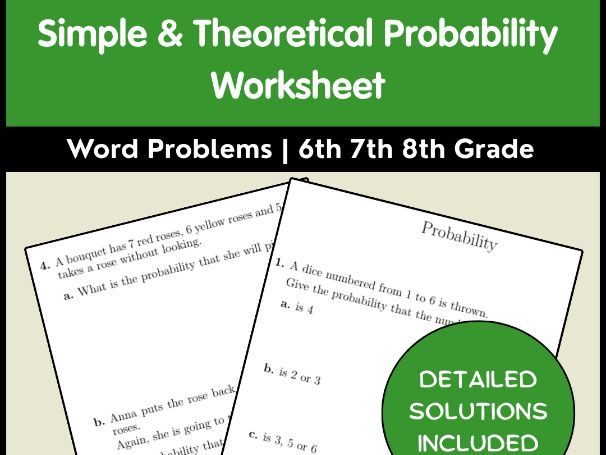
Looking for a no-prep maths worksheet to help your pupils master probability? This theoretical and simple probability worksheet is perfect for Year 7, Year 8, and Key Stage 3 (KS3) classrooms. It includes structured practice problems covering dice, numbered outcomes, coloured counters, and advanced reverse-probability word problems, plus a complete step-by-step solutions sheet. Use it for homework, independent practice, extension tasks, or cover work!
Master Simple and Theoretical Probability with Real-World Problems!
Help your Key Stage 3 (KS3) pupils build a solid foundation in data handling and statistics with this ready-to-print Simple & Theoretical Probability Worksheet.
This resource is intentionally scaffolded to take pupils from basic probability concepts to complex mathematical reasoning. It covers a wide range of language and logic conditions, including “or”, “at least”, “multiples”, “factors”, and “not” scenarios, culminating in an advanced reverse-probability word problem!
What’s Included?
• Scaffolded Practice Problems: 4 comprehensive sections that build confidence systematically.
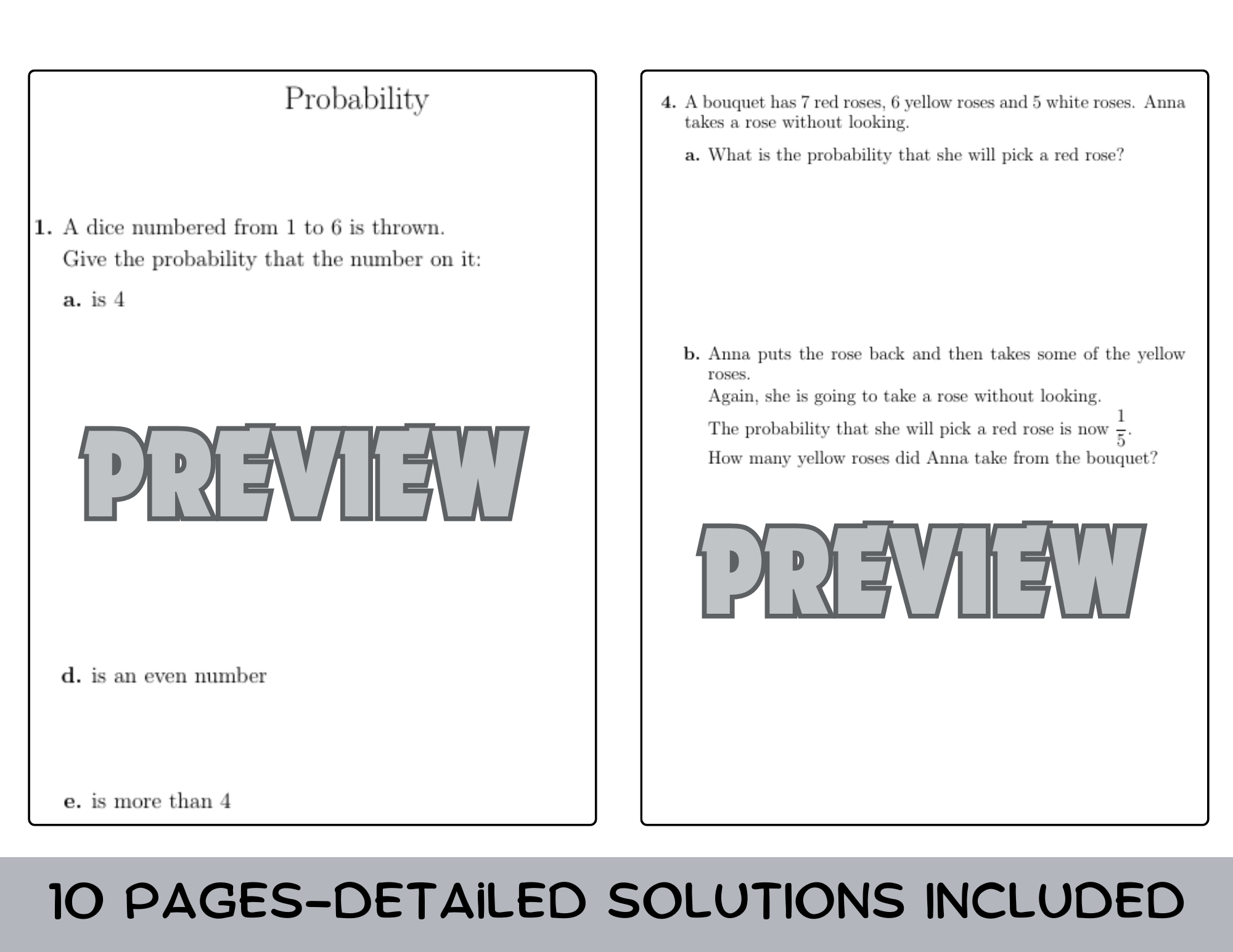
• Section 1 (Dice Probabilities): 15 targeted questions analyzing a standard 6-sided die, focusing on even, prime, factors, and numeric inequality outcomes.
• Section 2 (Numbered Selection): Finding probabilities from a sample space of 1 to 10 using multiples and constraints.
• Section 3 (Coloured Counters Bag): Solving compound “or” statements and inverse “not” events.
• Section 4 (Advanced Word Problem): A multi-step critical thinking problem requiring pupils to find how many items were removed to change a probability outcome.
• Complete Step-by-Step Solutions Sheet: A full answer key showing fraction tracking and calculations, making marking quick or allowing for pupil self-assessment.
Curriculum Alignment:
• UK National Curriculum: Suitable for Year 7, Year 8, and Year 9 Maths (Probability). Aligns with standard objectives to record outcomes systematically, calculate the probability of simple random events, and understand that the probabilities of all mutually exclusive outcomes sum to 1.
Something went wrong, please try again later.
This resource hasn't been reviewed yet
To ensure quality for our reviews, only customers who have purchased this resource can review it
Report this resourceto let us know if it violates our terms and conditions.
Our customer service team will review your report and will be in touch.
£1.50