


Pythagoras and Trigonometry in 3D: Exam Questions
These presentation show students how to solve real IGCSE exam questions on Pythagoras’ Theorem and trigonometry in 3D, including finding the angle between a line and a plane.
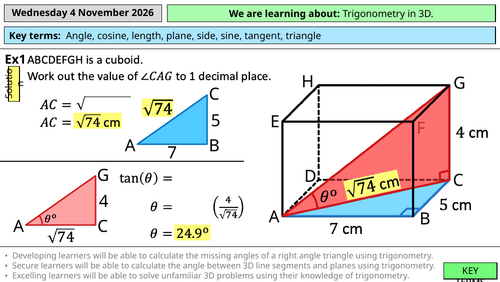
Each question is worked through one step at a time. Students first see a large, clear 3D diagram. Then the right-angled triangle needed for that step is shaded inside the shape. Next, that triangle is drawn out in 2D. Only then does the working appear, one line at a time, with a short explanation of each step.
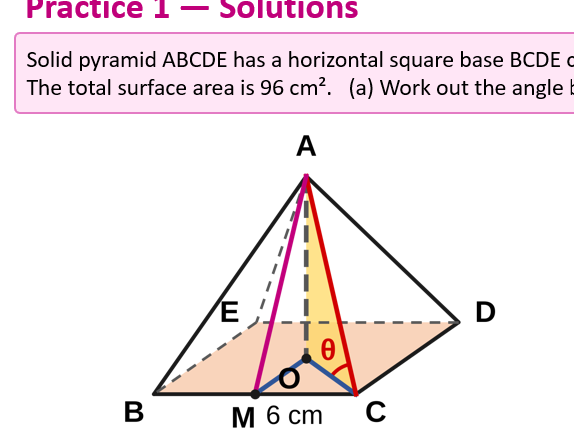
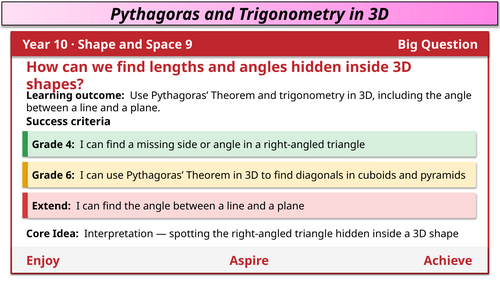
In this lesson students apply Pythagoras’ Theorem and trigonometry to problems in three dimensions. They learn to spot the right-angled triangles hidden inside 3-D shapes such as cuboids, prisms and pyramids, and to draw each triangle in 2-D before using Pythagoras or SOH CAH TOA. Students then find the angle between a line and a plane by dropping a perpendicular to the plane and using the projection (the “shadow”) of the line. The lesson builds from 2-D right-angled triangles, to diagonals in 3-D shapes, to multi-step IGCSE exam questions — including the June 2019 cube question and a pyramid question where the height must first be found from the total surface area.
Something went wrong, please try again later.
This resource hasn't been reviewed yet
To ensure quality for our reviews, only customers who have purchased this resource can review it
Report this resourceto let us know if it violates our terms and conditions.
Our customer service team will review your report and will be in touch.
£1.20