


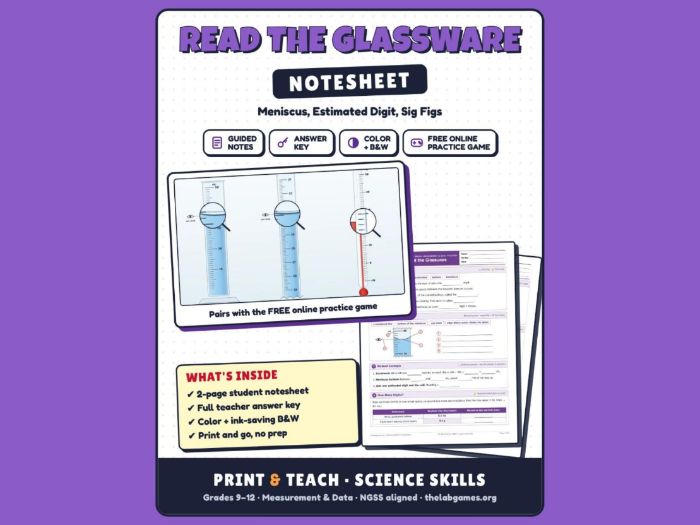
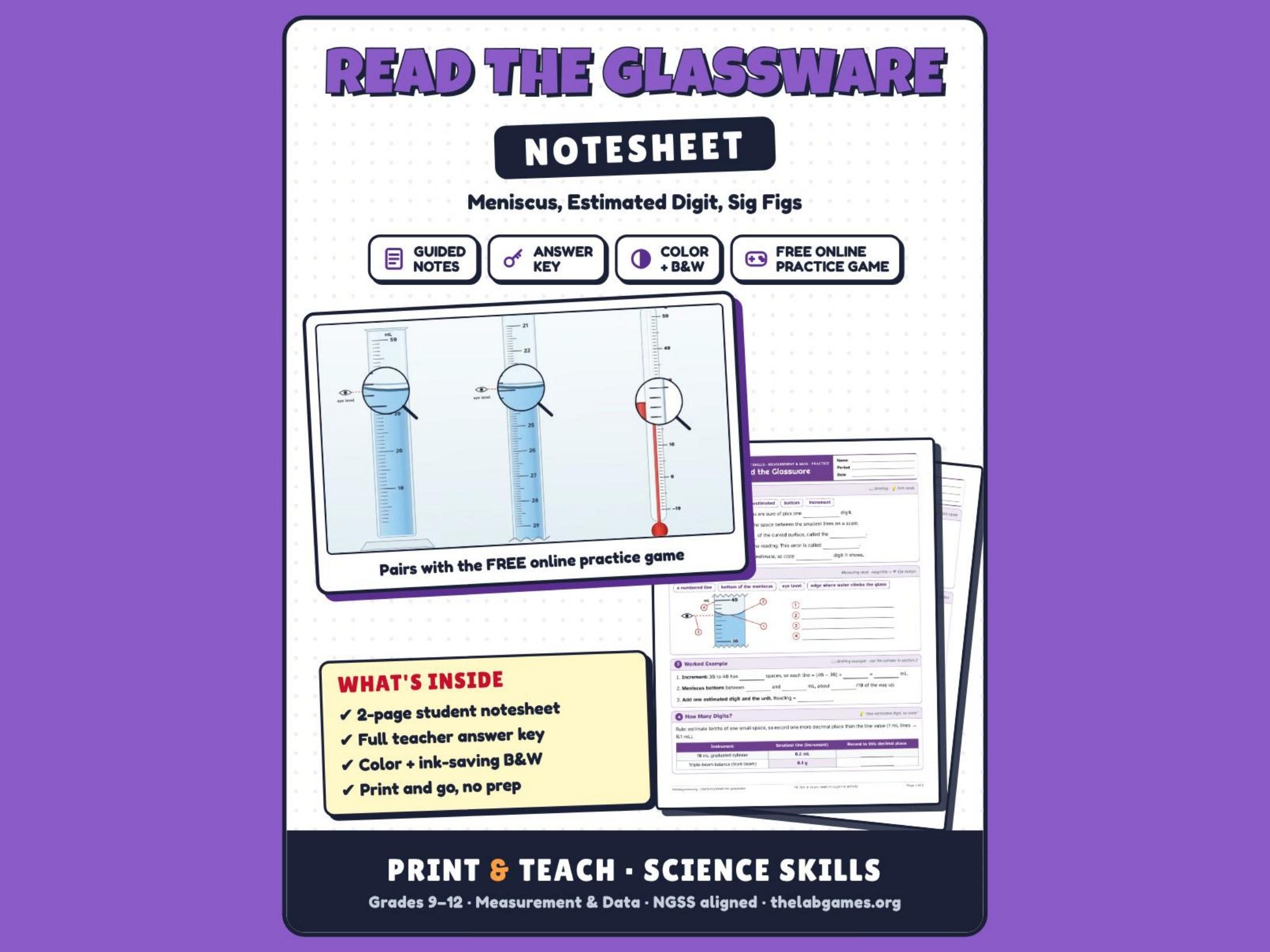
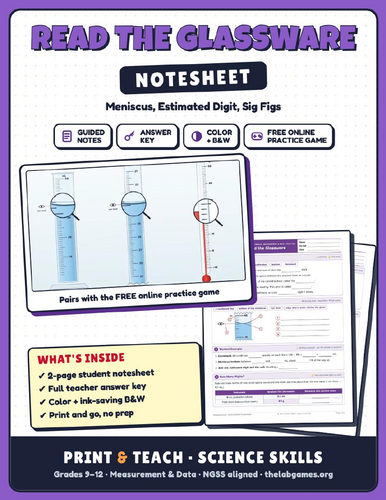
Teach students to read lab instruments to the right digit. This roomy, student-friendly 2-page notesheet walks students through certain digits plus one estimated digit, finding the increment of a scale, reading the bottom of a meniscus at eye level, and avoiding parallax. Students label a close-up of a graduated cylinder, follow a worked example to 36.4 mL, and decide how many decimal places each instrument reads to before trying four practice readings: a 10 mL cylinder, a buret that reads top-down, a thermometer with only every 5th line numbered, and a millimeter ruler.
It pairs with Read the Glassware, a free online practice game at thelabgames.org where students run a lab’s measuring desk and read cylinders, burets, rulers, thermometers and balances with a zoom and magnifier. Because measurement is used in every lab science, it fits Biology, Chemistry, Physics and Earth Science classes. Use it in class, for absent-student makeups, or on sub days. A complete teacher key with every reading worked out is included.
What’s Included
- Student notesheet (2 pages) in full color AND black & white
- Teacher answer key (red answers) in full color AND black & white
What Students Do
- Background fill-in: estimated digit, increment, meniscus, parallax and copying a digital display
- Graduated cylinder diagram: label the meniscus bottom, the climbing edge, the eye-level line of sight and a numbered line
- Worked example: find the increment, find the last sure line, then add one estimated digit and the unit
- How Many Digits table: the decimal place to record for a cylinder, a buret and a triple-beam balance
- Practice orders: read a 10 mL cylinder, a buret, a thermometer (find the increment) and a ruler, with the unit
- Key ideas: copy a digital balance, add triple-beam riders, the direction of parallax error, and a reading right on a line
- My Runs: a log for tracking practice scores
Skills & Standards
- Measurement, uncertainty, significant figures, estimated digit, increment, meniscus, parallax, graduated cylinder, buret, thermometer, ruler, triple-beam and digital balances
- Supports NGSS SEP 3 (Planning and Carrying Out Investigations) and SEP 5 (Using Mathematics and Computational Thinking)
- Grades 9–12 Biology, Chemistry, Physics and Earth Science
Great For
- The first week of any lab science
- Lab-skills review before a lab practical
- Absent-student makeups
- Sub plans
- Stations or homework
Something went wrong, please try again later.
This resource hasn't been reviewed yet
To ensure quality for our reviews, only customers who have purchased this resource can review it
Report this resourceto let us know if it violates our terms and conditions.
Our customer service team will review your report and will be in touch.
$2.49