


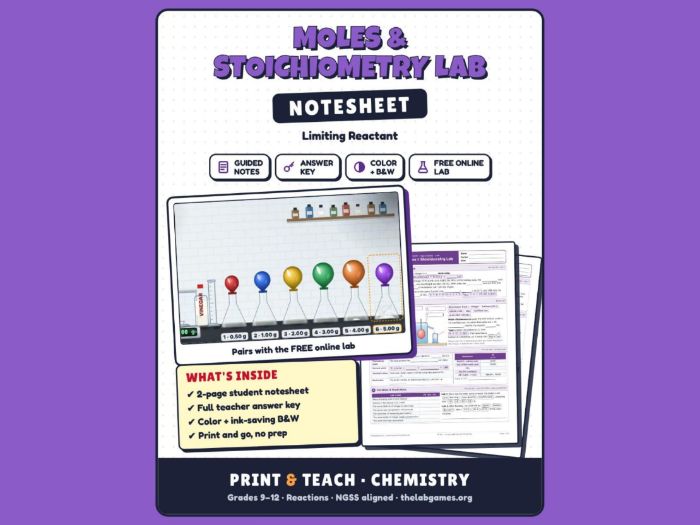
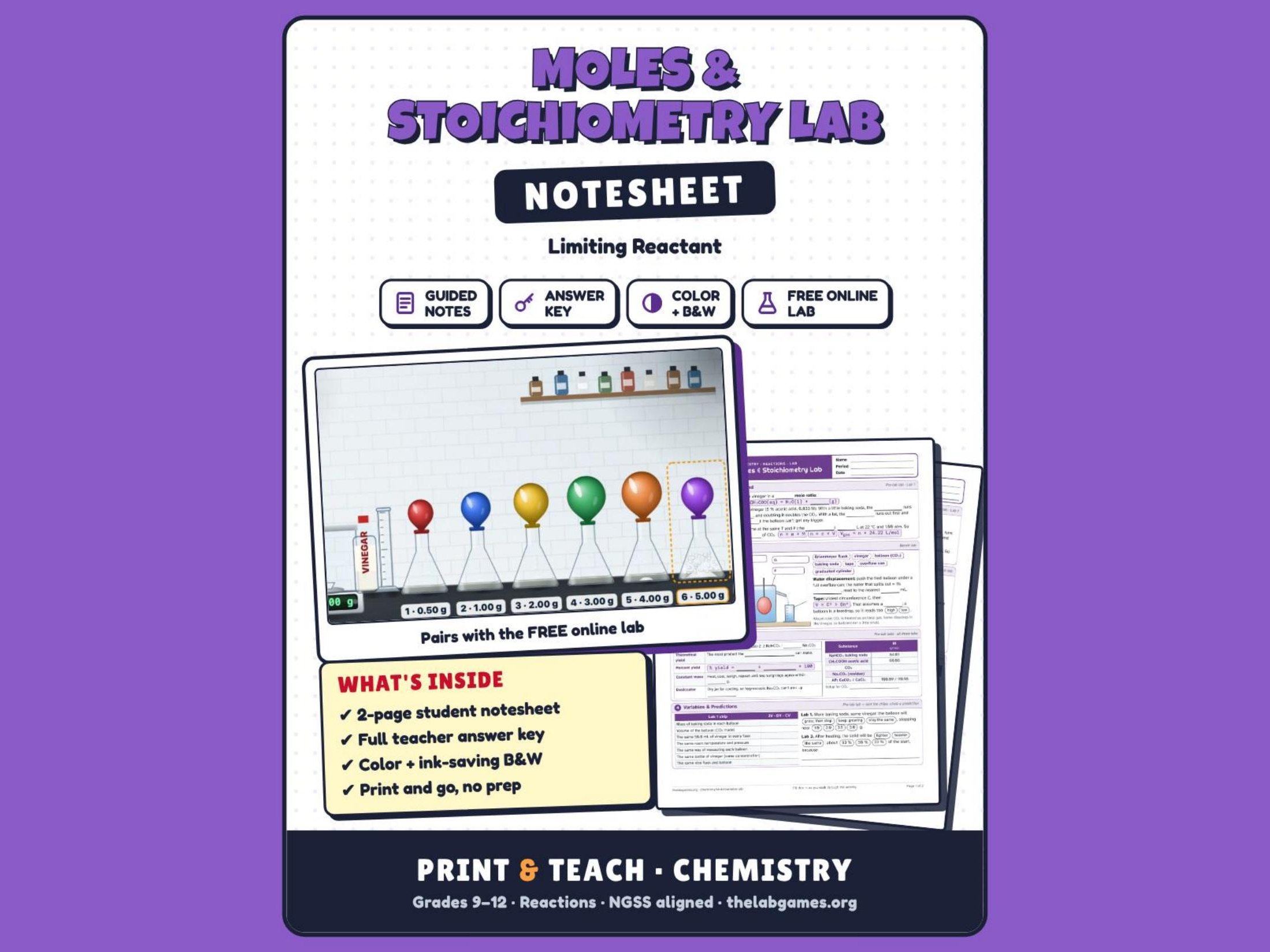
Students follow the Balloon Limit investigation: six flasks of the same vinegar get more and more baking soda, and students measure each balloon of CO₂, graph volume against mass, and find where the line levels off because the limiting reactant switches. They use the 1 : 1 mole ratio and molar volume to predict the switch point and maximum volume, answer analysis questions, and write a claim-evidence-reasoning conclusion. Shorter sections cover heating baking soda to constant mass (percent yield) and an AP gravimetric analysis of CaCl₂.
This 2-page notesheet pairs with the free online Moles & Stoichiometry Lab at thelabgames.org. It works for class lab days, absent-student makeups and sub days.
What’s Included
- Student notesheet (2 pages) in full color AND black & white
- Teacher answer key (red answers) in full color AND black & white
What Students Do
- Complete fill-in pre-lab notes on the mole ratio, limiting and excess reactants and molar volume
- Label the bench (flask, balloon, baking soda, tape, overflow can, graduated cylinder) and explain water displacement vs the tape method
- Fill in key vocabulary (theoretical and percent yield, constant mass, desiccator) and molar masses
- Sort variables as IV, DV or controlled and circle predictions for Labs 1 and 2
- Record six balloons in a data table and plot CO₂ volume vs mass of baking soda
- Calculate the switch point, maximum CO₂ volume, percent of theory, leftover baking soda and (AP) moles from PV = nRT
- Answer four analysis questions
- Lab 2: record heating-to-constant-mass weighings and calculate theoretical and percent yield
- AP Lab: calculate % CaCl₂ from a precipitate and predict how three errors push the result
- Write a claim, evidence and reasoning response for the balloon lab
Skills & Standards
- Mole ratios, limiting and excess reactants, theoretical and percent yield, molar volume of a gas, conservation of mass
- Graphing and interpreting a plateau; measurement error (systematic vs random)
• Ngss Hs-Ps1-7, Hs-Ps1-2
- AP Chemistry: gravimetric analysis, net ionic equations, ideal gas law
- Grades 9–12 Chemistry and AP Chemistry
Great For
- Lab days with the online Moles & Stoichiometry Lab
- Absent-student lab makeups
- Sub days
- Stoichiometry unit review
- AP lab prep
Something went wrong, please try again later.
This resource hasn't been reviewed yet
To ensure quality for our reviews, only customers who have purchased this resource can review it
Report this resourceto let us know if it violates our terms and conditions.
Our customer service team will review your report and will be in touch.
$2.49