

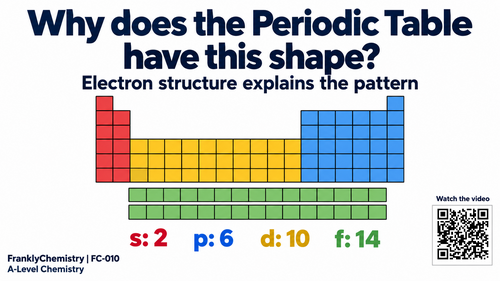

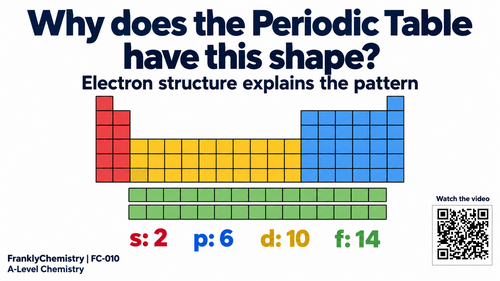
Why does the Periodic Table have two columns on the left, six on the right, ten in the middle and two rows underneath?
This approximately 6½-minute FranklyChemistry video uses animated blocks to build the table from hydrogen to uranium, showing how its shape follows the underlying electron structure.
Students will explore:
• How subshell capacities explain the widths of the s, p, d and f blocks
• Why 4s becomes occupied before 3d
• Why periods contain 2, 8, 18 or 32 elements
• Why the f block is normally printed underneath
• How recurring outer-electron arrangements explain similar chemical properties
• Why helium belongs with the noble gases despite its s-subshell configuration
Designed primarily for A-Level Chemistry students, with useful extension material for GCSE students. Suitable for classroom explanation, independent study, flipped learning or revision.
Students should have some familiarity with shells, subshells and orbitals. The animation presents a simplified block-filling pattern, acknowledging exceptions in individual electron configurations.
FC-010 follows the FranklyChemistry video on how electrons occupy orbitals.
And understanding is what chemistry is all about.
Something went wrong, please try again later.
This resource hasn't been reviewed yet
To ensure quality for our reviews, only customers who have downloaded this resource can review it
Report this resourceto let us know if it violates our terms and conditions.
Our customer service team will review your report and will be in touch.
£0.00