


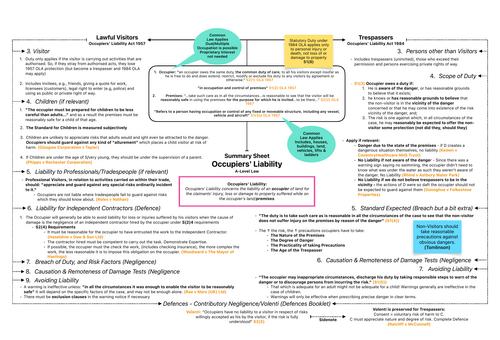
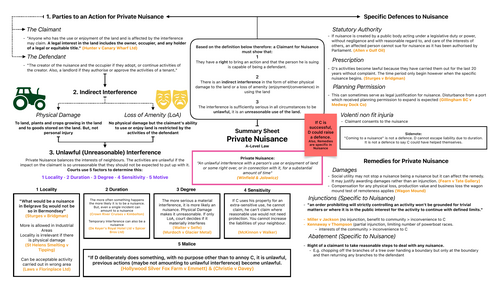
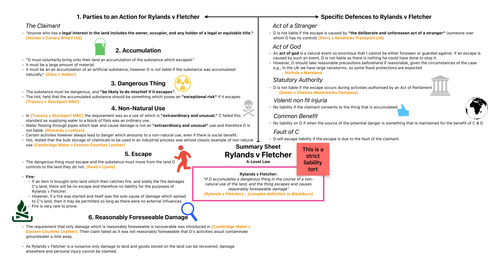
Concise, clear summary covering all key elements of Substantive Law topics for A-Level Paper 2, designed to aid understanding and exam success.
Full explanation:
This series of summary sheets offers a comprehensive yet accessible overview of the essential areas of Substantive Law for A-Level Law Paper 2. Each sheet focuses on clarity, structure, and application, helping students master complex legal principles, key cases, and evaluative skills essential for higher-level analysis and exam success.
Topics:
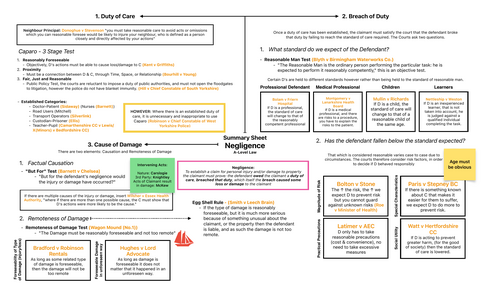
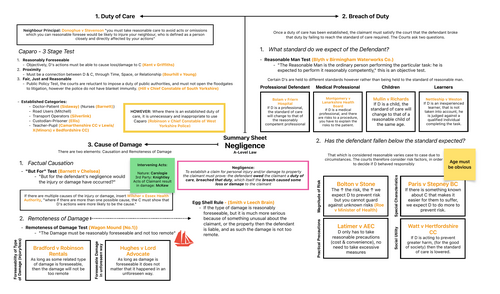
- Negligence – Explores the duty of care, breach, and causation principles, including leading cases such as Donoghue v Stevenson and Caparo v Dickman. Considers policy factors and the balance between fairness and practicality in establishing liability.
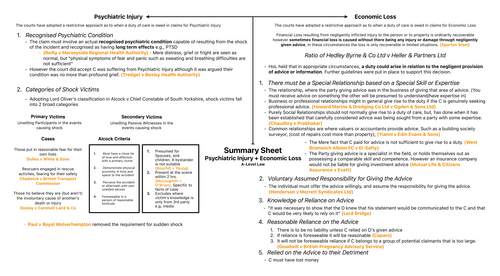
- Psychiatric Injury – Examines how the law distinguishes between primary and secondary victims, key cases such as Alcock v Chief Constable of South Yorkshire, and the ongoing debate around the restrictive nature of this area of tort law.
- Economic Loss – Analyses the limited circumstances under which economic loss can be recovered, including negligent misstatements (Hedley Byrne v Heller) and the challenges of defining duty in pure economic loss claims.
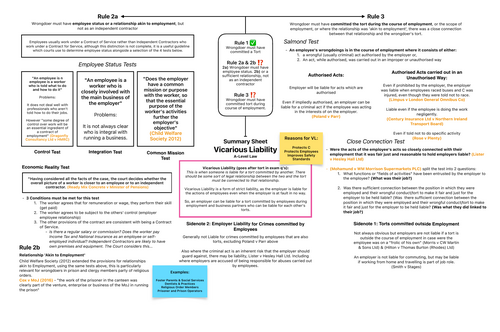
- Vicarious Liability – Explains how employers may be held liable for the torts of employees, considering control tests, relationships akin to employment, and modern interpretations following Cox v Ministry of Justice and Mohamud v Morrison Supermarkets.
- Occupiers’ Liability – Outlines the statutory duties owed to lawful visitors and trespassers under the Occupiers’ Liability Acts 1957 and 1984, including how courts interpret ‘occupier’ and ‘premises’ in varying contexts.
- Private Nuisance – Covers private and public nuisance, balancing of rights between landowners, and remedies available. Key cases such as Hunter v Canary Wharf illustrate the importance of foreseeability, reasonableness, and locality.
- Rylands v Fletcher – Details this strict liability principle for escapes of dangerous things, its modern limitations, and how it interacts with nuisance and negligence concepts in contemporary tort law.
Something went wrong, please try again later.
This resource hasn't been reviewed yet
To ensure quality for our reviews, only customers who have purchased this resource can review it
Report this resourceto let us know if it violates our terms and conditions.
Our customer service team will review your report and will be in touch.
£20.00