docx, 996.91 KB
docx, 996.91 KB
pptx, 4.83 MB
pptx, 4.83 MB

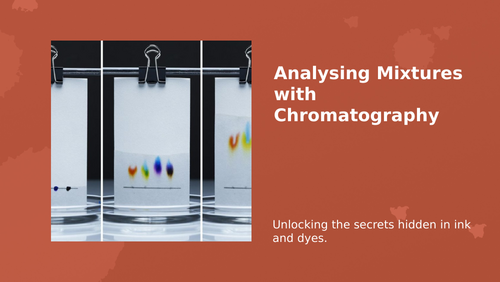
This Year 7 Science lesson introduces pupils to the fourth key separation technique: chromatography. Building on their understanding of filtration, crystallisation and distillation, students learn how chromatography separates mixtures of coloured substances based on how far they travel with a solvent. The lesson strengthens pupils’ understanding of mixtures, solubility and scientific investigation.

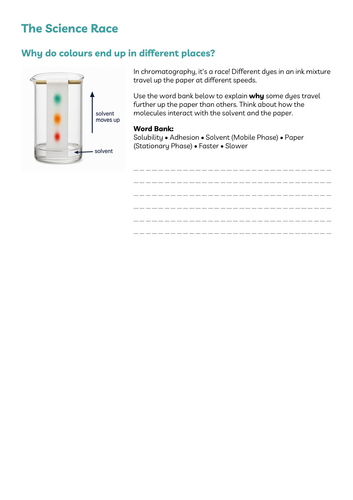
Learners explore how the solvent moves up the chromatography paper, why different dyes travel at different speeds, and how to interpret a simple chromatogram. They examine real‑world uses of chromatography, including food testing, forensic science and ink analysis. Pupils label diagrams, make predictions, and analyse chromatograms to deepen their scientific reasoning.

A fully editable PPT and worksheet are included, supporting modelling, diagram interpretation and structured explanation.

Learning Objective:
To explain how chromatography separates mixtures of coloured substances.

Success Criteria:

  • Describe how the solvent moves up the paper.
  • Explain why different dyes travel different distances.
  • Interpret a simple chromatogram.

Get this resource as part of a bundle and save up to 58%

A bundle is a package of resources grouped together to teach a particular topic, or a series of lessons, in one place.

Bundle

The Four Separation Techniques Lesson Pack

This **Year 7 Science Bundle** brings together a complete sequence of six high‑quality, ready‑to‑teach lessons covering the four core separation techniques: **filtration**, **crystallisation**, **simple distillation** and **chromatography**. Designed to build secure foundational knowledge for KS3 Chemistry, this bundle develops pupils’ understanding of mixtures, particle behaviour and scientific processes through clear modelling, practical examples and structured explanation tasks. Each lesson includes a **fully editable PPT and worksheet**, with retrieval practice, diagram work, literacy support and application questions. The unit progresses from single techniques to comparison and real‑world problem‑solving, ensuring strong conceptual understanding and long‑term retention. --- ## **What’s Included in the Bundle** - **Lesson 1: Filtration** Students learn how filtration separates insoluble solids from liquids, identify key equipment and apply the method to real‑life examples. - **Lesson 2: Crystallisation** Learners explore how heating a solution forms crystals, why solutes remain after evaporation and where crystallisation is used in industry. - **Lesson 3: Simple Distillation** Pupils label a distillation setup, explain evaporation and condensation, and understand how distillation produces pure water. - **Lesson 4: Chromatography** Students investigate how chromatography separates coloured substances, interpret chromatograms and explore real‑world uses such as food testing. - **Lesson 5: Comparing All Four Techniques** Learners compare filtration, crystallisation, distillation and chromatography, matching each method to the mixture it separates. - **Lesson 6: Applying Separation Techniques** Pupils apply their knowledge to real‑world scenarios, selecting and justifying the correct technique using scientific vocabulary. --- ## **Why This Bundle Works** - **Clear progression** from single techniques to comparison and application - **Strong scientific literacy** through diagram labelling, key vocabulary and structured explanations - **Retrieval‑rich design** to strengthen long‑term memory - **Real‑world examples** to deepen understanding and relevance - **Fully editable resources** suitable for specialists and non‑specialists

£5.00

Reviews

Something went wrong, please try again later.

This resource hasn't been reviewed yet

To ensure quality for our reviews, only customers who have purchased this resource can review it

Report this resourceto let us know if it violates our terms and conditions.
Our customer service team will review your report and will be in touch.