


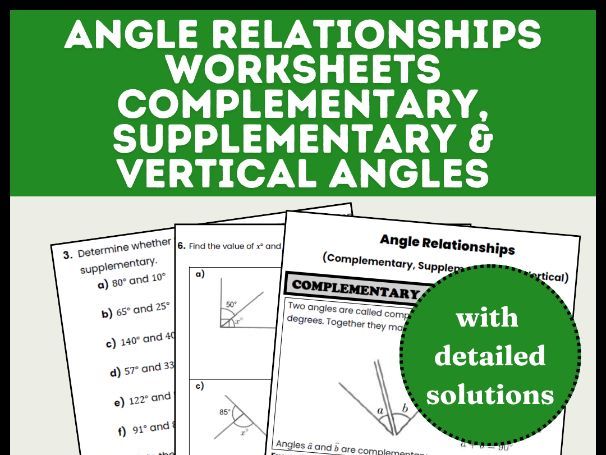
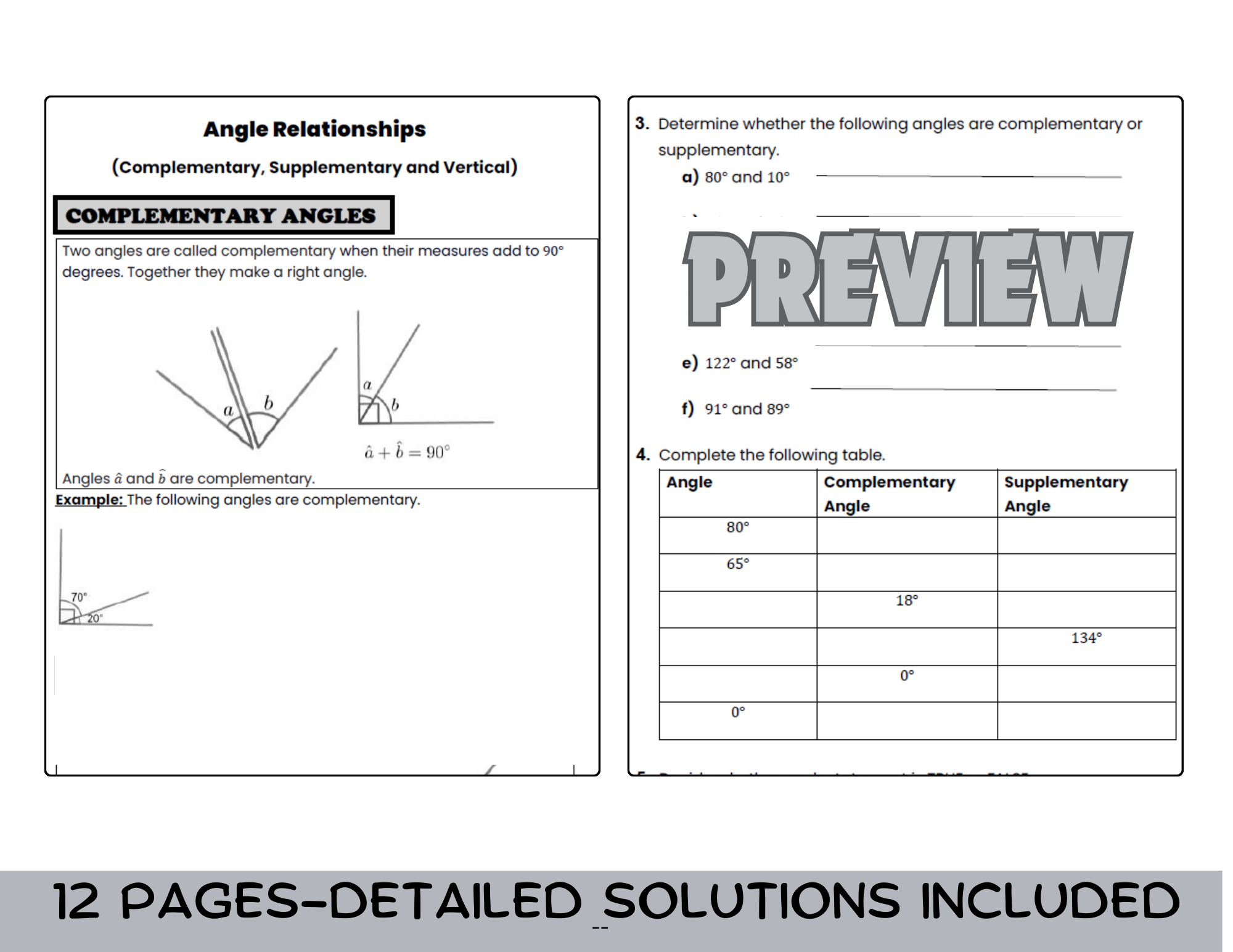
A worksheet on complementary angles, supplementary angles, and vertical angles. It includes introductory notes with the definitions of these types of angles. The exercises require to identify complementary, supplementary and vertical angles, find the complementary and supplementary angles of a given angle and write and solve equations to find missing complementary and supplementary angles. Detailed solutions are included. Good to be used as an introductory worksheet for this topic.
Ready-to-print KS3 Maths worksheets pack! Includes structured practice pages and full step-by-step solutions for complementary, supplementary, and vertically opposite angles.
Master fundamental geometric rules with these comprehensive, ready-to-print maths practice worksheets!
Designed perfectly for Key Stage 3 (KS3) students (Years 7, 8, and 9), this introductory pack provides structured, scaffolded practice for students learning to identify angle facts and calculate missing measurements. Whether you need an introductory lesson, independent classwork, homework tasks, revision packs, or emergency cover lessons, these printable pages are completely ready to go.
What’s Included in This Pack?
• Vocabulary & Concept Guides: Clear visual references explaining definitions and handy memory tricks (like “C” for Corner/90° and “S” for Straight/180°).
• Identification Exercises: Multiple-choice and true/false problems to solidify conceptual understanding of vertical, supplementary, and complementary relationships.
• Missing Angle Calculations: Guided practice solving for missing values across numerical and algebraic geometric diagrams.
• Data Tables: Fill-in-the-blank practice sheets calculating precise mathematical complements and supplements.
• Angles around a Point: Extension problems looking at full-turn angle rules adding up to 360°.
• Full Step-by-Step Solutions: Complete, detailed teacher answer sheets are included for every single problem to allow for quick marking or student self-assessment!
Curriculum Alignment
• KS3 National Curriculum: Apply conventional terms and notations for points, lines, parallel lines; derive and illustrate properties of triangles, quadrilaterals, circles, and other planar figures; use standard geometric definitions.
• Functional Skills Maths: Basic geometry components involving angles on a straight line, at a point, and right angles.
Something went wrong, please try again later.
This resource hasn't been reviewed yet
To ensure quality for our reviews, only customers who have purchased this resource can review it
Report this resourceto let us know if it violates our terms and conditions.
Our customer service team will review your report and will be in touch.
£1.80