


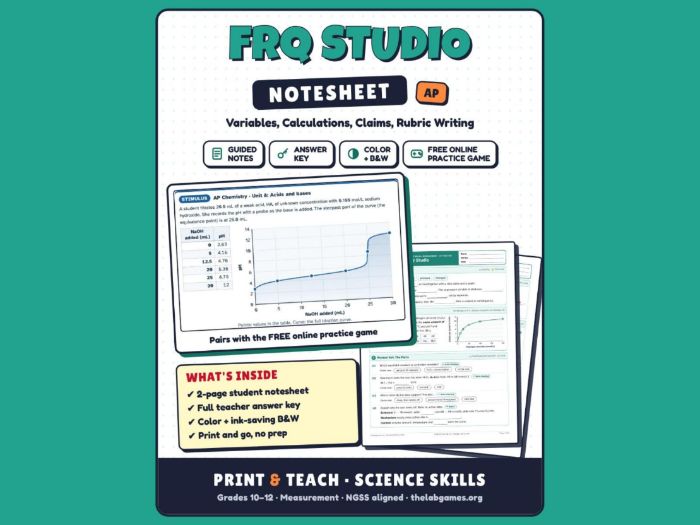
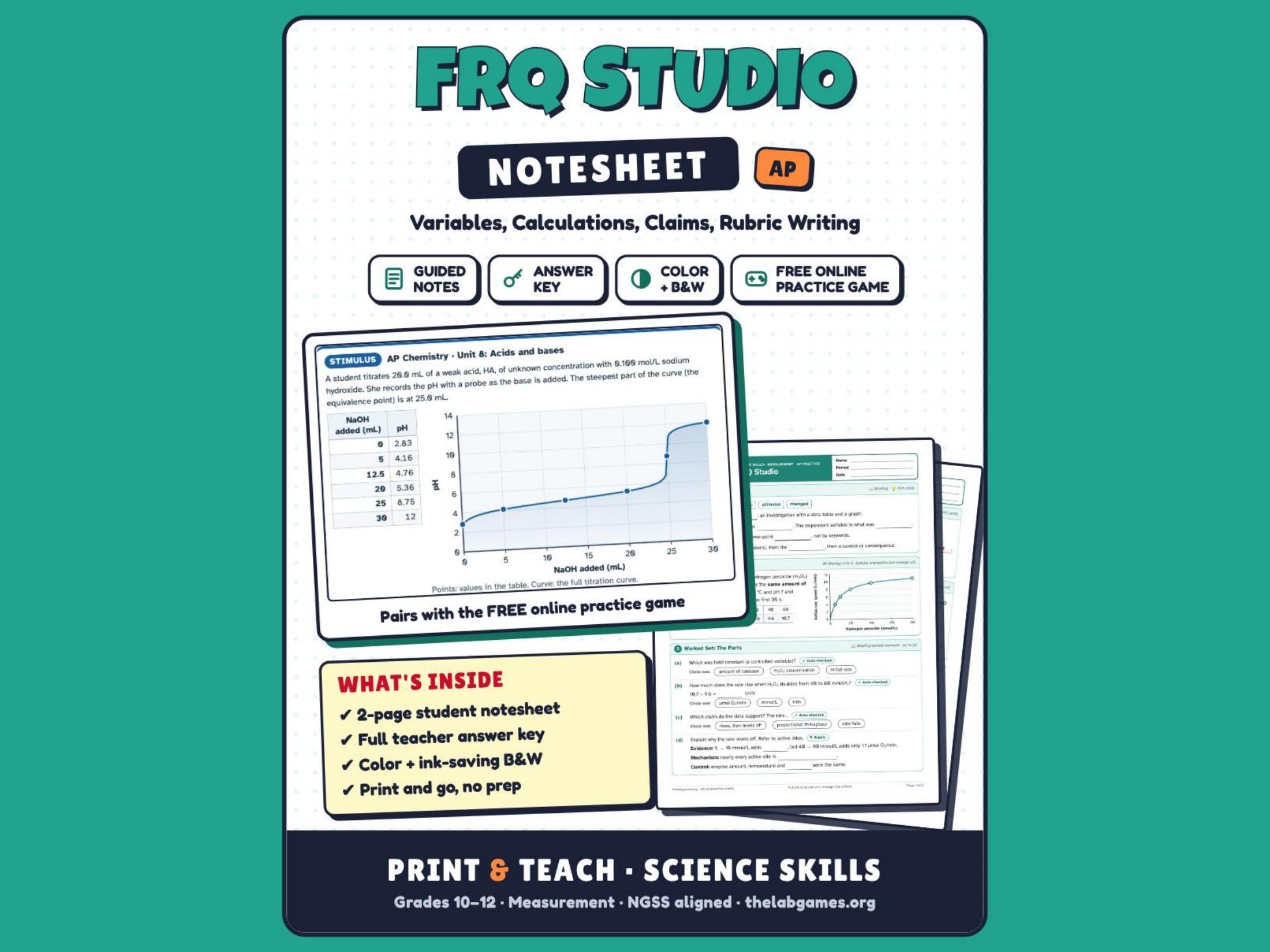
Practice the moves that earn free-response points. In this roomy, student-friendly 2-page notesheet, students fill in how a free-response set works (stimulus, independent and dependent variables, rubric scoring, evidence then mechanism then control), then follow a fully worked AP Biology set on catalase and hydrogen peroxide: read the stimulus table and graph, identify the controlled variable, calculate a change with its unit, pick the claim the data support, and build a written explanation from evidence, mechanism and control. On page 2 they work an AP Chemistry set on their own: an X ⇌ Y equilibrium with a data table and graph, the independent variable, K with its unit, the supported claim about when equilibrium is reached, and a written explanation using forward and reverse rates, followed by a rubric self-check.
It pairs with FRQ Studio, a free online AP practice activity at thelabgames.org with original free-response sets for AP Biology, AP Chemistry, AP Environmental Science and AP Physics 1. Use it in class, for absent-student makeups, or on sub days. A complete teacher key is included, with a model answer and the rubric points checked off.
What’s Included
- Student notesheet (2 pages) in full color AND black & white
- Teacher answer key (red answers) in full color AND black & white
What Students Do
- How a Set Works: stimulus, independent vs. dependent variables, rubric scoring, evidence-mechanism-control
- Worked Set (AP Biology, catalase): stimulus table and graph; controlled variable, a calculation with units, the supported claim and a framed written explanation
- Your Turn (AP Chemistry, equilibrium): stimulus table and graph; independent variable, K and its unit, the supported claim, a written explanation and a three-point rubric self-check
- My Runs: a log for tracking sets and the rubric point to aim for next time
Skills & Standards
- Free-response strategy, identifying variables, calculating from data with units, evaluating claims against data, writing explanations with evidence and mechanism, enzyme saturation, dynamic equilibrium and K
- Supports NGSS SEP 3 (Planning and Carrying Out Investigations), SEP 4 (Analyzing and Interpreting Data) and SEP 6 (Constructing Explanations and Designing Solutions)
- Grades 10–12 AP Biology (with one AP Chemistry set)
Great For
- AP exam free-response practice
- Absent-student makeups
- Sub plans
- Homework or stations
- Teaching how rubrics work
Something went wrong, please try again later.
This resource hasn't been reviewed yet
To ensure quality for our reviews, only customers who have purchased this resource can review it
Report this resourceto let us know if it violates our terms and conditions.
Our customer service team will review your report and will be in touch.
$2.49