


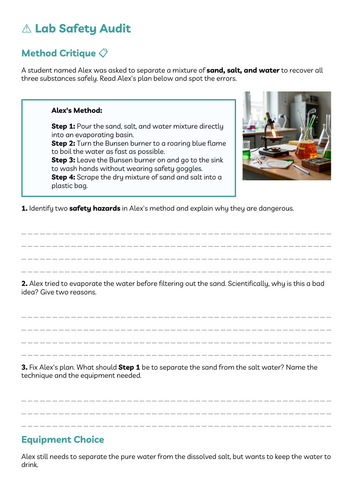
This Year 7 Science lesson consolidates pupils’ understanding of all four separation techniques—filtration, crystallisation, simple distillation and chromatography—by applying them to real‑world problem‑solving scenarios. After learning each method in isolation, students now bring their knowledge together to tackle practical challenges, justify their choices and explain the science behind their decisions. This lesson strengthens scientific reasoning, retrieval and application skills.
Learners revisit the purpose of each technique, then work through a series of mixtures (e.g., sand and water, salt solution, food dyes, seawater) to decide which method is most suitable. They justify their choices using key vocabulary such as soluble, insoluble, evaporation, condensation and solvent. Pupils also evaluate why certain techniques would not work, deepening their conceptual understanding.
A fully editable PPT and worksheet are included, supporting retrieval, application and extended explanation.
Learning Objective:
To apply separation techniques to solve real‑world problems and justify scientific choices.
Success Criteria:
- Identify the components in a mixture.
- Select the most suitable separation technique for each scenario.
- Justify the choice using scientific vocabulary and clear reasoning.
Some visuals in this resource were made with AI to help bring ideas to life and support student understanding.
Something went wrong, please try again later.
This resource hasn't been reviewed yet
To ensure quality for our reviews, only customers who have purchased this resource can review it
Report this resourceto let us know if it violates our terms and conditions.
Our customer service team will review your report and will be in touch.
£2.00