pptx, 2.07 MB
pptx, 2.07 MB
PNG, 292.41 KB
PNG, 292.41 KB

The aims of this lesson are to explain how weapons developed during the Cold War in the aftermath of World War 2.

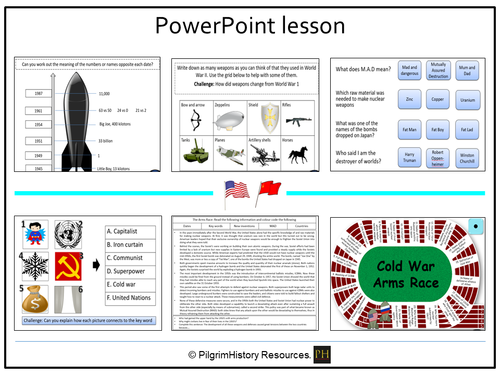
The new destructive power of the atomic bomb is shown in a great video link and students colour code a worksheet (differentiated) with challenge questions to describe and explain the development of the arms race.

Facts and figures are also given which students have to interpret, as well as key word tasks and source analysis, with help given if required.

The plenary is literally an arms ‘race’ complete with interactive dice and bombs as board pieces.

The central enquiry of this and subsequent lessons is to ask why did civilians fear for their lives? Students will map out their ideas each lesson (which can be plotted in different colours or dates to show the progress of their learning and centred around the key question) and build up a picture of how these and different countries in the world responded and acted in this new nuclear age.

The resource comes in PowerPoint format if there is a wish to adapt and change and is differentiated.

I have also included suggested teaching strategies to deliver the lesson.

Get this resource as part of a bundle and save up to 24%

A bundle is a package of resources grouped together to teach a particular topic, or a series of lessons, in one place.

Bundle

KS3 Cold War Complete History Bundle

A complete, fully resourced 11 lesson KS3 Cold War scheme of work designed to make a complex topic accessible, engaging and enquiry‑driven. Students explore the key events, ideologies and flashpoints of the Cold War while developing strong historical skills and preparing for GCSE. This unit is built around the central enquiry: Why did civilians fear for their lives during the Cold War? Each lesson revisits this question, helping students build understanding over time and make meaningful connections across the period. Pupils will learn: * the origins of tension in 1945 and the clash between capitalism and communism * the significance of containment, buffer zones, MAD, and the domino theory * how the superpowers competed through the Arms Race, Space Race, and global proxy wars * the causes and consequences of major crises including the Berlin Blockade, Berlin Wall, Korean War, Vietnam War, and Cuban Missile Crisis * how propaganda, technology and global politics shaped everyday fear Students complete a wide range of activities including source analysis, narrative accounts, structured explanations, and GCSE‑style tasks. Each lesson includes clear teaching strategies and fully adaptable worksheets and PowerPoints. This bundle also includes two free sample lessons and a Cold War key words display The 11 lessons are broken down into the following: L1 The defeat of Germany in 1945 (free lesson) L2 Introduction to the Cold War L3 The Arms Race L4 The Berlin Blockade and Berlin Airlift L5 The Berlin Wall L6 The Korean War L7 The Cuban Missile Crisis L8 Man on the Moon L9 The Vietnam War L10 Cold War sports L11 Mikhail Gorbachev (+ Key word History display) Any reviews would be greatly appreciated.

£22.00

Reviews

5

Something went wrong, please try again later.

jakesharpe35

2 years ago
5

Amazing resources as always. Informative and clear to follow with great lesson activities that stretch and engage students in equal measure. Amazing history lessons!

Ralpgh12345

6 years ago
5

Superb resources

Report this resourceto let us know if it violates our terms and conditions.
Our customer service team will review your report and will be in touch.