


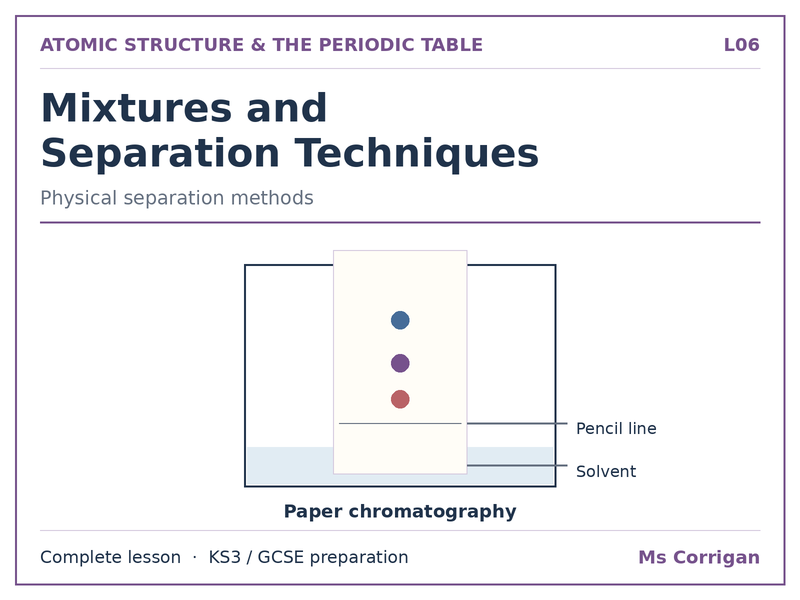

Created by an experienced Head of Science, this fully resourced, editable 55-minute chemistry lesson explores mixtures and the physical techniques used to separate substances, developing students’ practical understanding and scientific reasoning.
Designed for KS3 and GCSE preparation, the lesson incorporates evidence-informed teaching strategies, scaffolded learning and stretch opportunities for mixed-ability classes. It has been developed with both specialist and non-specialist science teachers in mind.
Learning objectives:
- Define a mixture and distinguish between pure substances and mixtures.
- Explain why mixtures can be separated using physical processes.
- Describe filtration, crystallisation, simple distillation, fractional distillation and chromatography.
- Identify appropriate separation techniques based on the physical properties of substances.
- Interpret scientific apparatus diagrams.
- Apply knowledge of separation techniques to unfamiliar situations and justify scientific decisions.
What’s included:
- Editable PowerPoint with detailed teacher guidance in the notes section of every slide.
- First, Next, Then (FNT) retrieval starter.
- Clear scientific definitions and illustrated explanations.
- Scientific apparatus diagrams and visual representations.
- Mini-whiteboard activities and diagnostic assessment.
- Thinking Hard activities with green feedback slides.
- Collaborative group activities developing scientific discussion and reasoning.
- Student recording sheet and corresponding answers.
- Independent consolidation and stretch activities.
- Practical demonstration opportunities and preparation guidance.
- Women in Science feature exploring Erika Cremer’s pioneering contributions to gas chromatography.
- Real-world applications of separation techniques.
- Cross-curricular connections and interesting scientific facts.
- A little humour from Science Doggo!
- Formative assessment opportunities.
- Teacher delivery and resource preparation guidance.
Carefully designed to address common misconceptions, develop disciplinary knowledge and strengthen students’ ability to select, explain and evaluate scientific methods.
This lesson provides a strong foundation for GCSE Chemistry, particularly separation techniques, chromatography, chemical analysis and practical examination questions.
Part of a complete 10-lesson teaching unit
This lesson is also available as part of my complete Atomic Structure and the Periodic Table teaching unit, which includes ten fully resourced lessons, a comprehensive scheme of work, animations, assessments, teacher guidance and technician preparation resources.
View the complete unit here:
https://www.tes.com/teaching-resource/-13699763
Something went wrong, please try again later.
This resource hasn't been reviewed yet
To ensure quality for our reviews, only customers who have purchased this resource can review it
Report this resourceto let us know if it violates our terms and conditions.
Our customer service team will review your report and will be in touch.
£3.49