


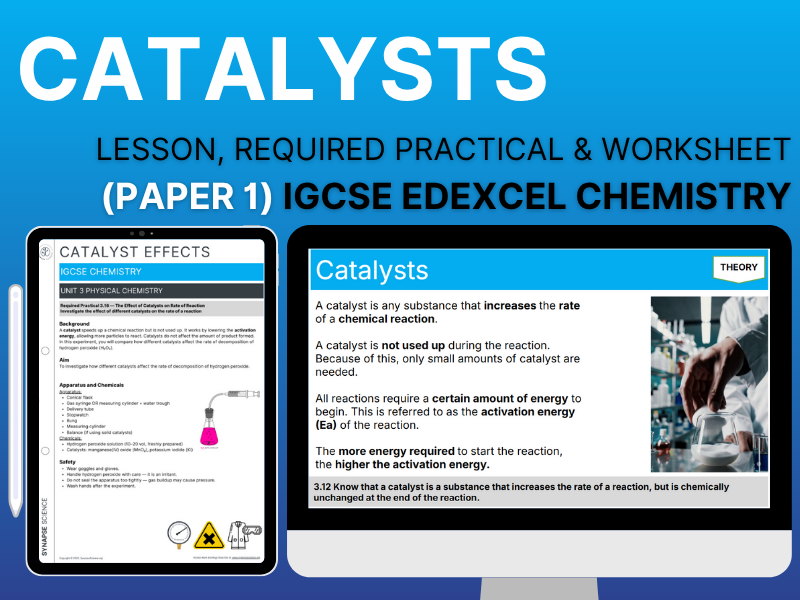
Catalysts – Lesson, Required Practical & Worksheet
Edexcel IGCSE Chemistry | Unit 3 | Physical Chemistry
This Synapse Science resource covers Unit 3.12–3.13 and Required Practical 3.16 from the Edexcel IGCSE Chemistry specification. Students learn the role of catalysts in increasing reaction rate, how they lower activation energy, and investigate the catalytic decomposition of hydrogen peroxide using different solids.
Includes editable slides, theory questions, and a full required practical with graphing and conclusion tasks.
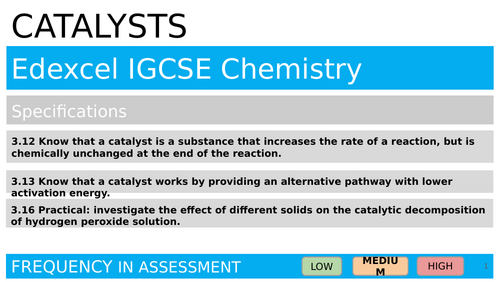
Specification Points Covered- 3.12: Know that a catalyst increases the rate of a reaction but is chemically unchanged at the end
- 3.13: Know that a catalyst provides an alternative pathway with lower activation energy
- 3.16: Practical – Investigate the effect of different solids on the catalytic decomposition of hydrogen peroxide solution
- Lesson Slides – Editable PowerPoint introducing catalysts, activation energy, and real-world examples
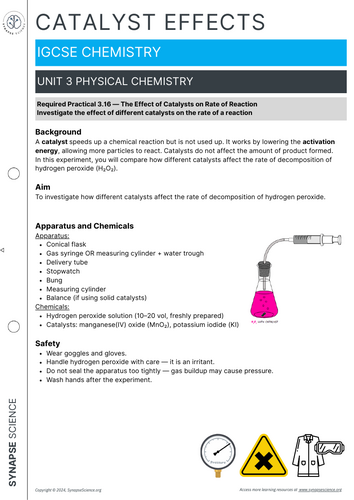
- Required Practical Worksheet – Full investigation: MnO₂ vs KI on H₂O₂ decomposition
- Observation Table & Graph Task – Plot oxygen volume over time and compare catalysts
- Teacher & Technician Notes – Setup, safety (H₂O₂), expected results, and model conclusion
- Engaging real-world links: biological, industrial, and automotive catalysts
- Graphing task to reinforce experimental data analysis
- Assessment rubric: Developing → Securing → Exceeding
- Consistent Synapse Science design – ready for classroom or homework use
- Fully aligned with Edexcel Paper 1 Chemistry
Edexcel IGCSE Chemistry, Catalysts, Activation Energy, Manganese Dioxide, Potassium Iodide, Required Practical, Physical Chemistry, Synapse Science, Reaction Rate, Graphing Task, Worksheet
Something went wrong, please try again later.
This resource hasn't been reviewed yet
To ensure quality for our reviews, only customers who have purchased this resource can review it
Report this resourceto let us know if it violates our terms and conditions.
Our customer service team will review your report and will be in touch.
£3.00