


Comparing two datasets needs TWO measures (average + range) and TWO sentences — and the direction depends on context. OCR GCSE Foundation, Year 10 Unit 7 Lesson 10.
The most common mark loss isn’t arithmetic — it’s writing “A is higher” when the question is about times (where higher = slower). This lesson drills both the two-measure habit and the context-reading skill.
What’s included:
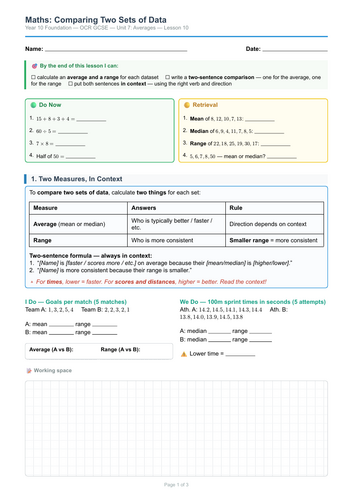
- I Do (goals per match — higher = better) and We Do (sprint times — lower = faster) — deliberately context-flipped
- Two independent practice tasks spanning the diagnostic spectrum: Task A “wins both” (Armand beats Renaud on both average AND consistency), Task B “mixed” (Riley sleeps more, Sam is more consistent — pupils must hold the tension and use however)
- Three-misconception Spot the Mistake — one-sentence thinking (forgets the range), context-direction error (“A is higher” for times), and the inverted range-consistency relationship (“larger range = more consistent”)
- Going Deeper: construct two lists with matching medians but contrasting ranges, plus the conceptual why range alone isn’t enough
- Exit Ticket with even n = 8 — median = average of 4th and 5th values, catches pupils still using the odd-n convention
Teacher key (3 pages):
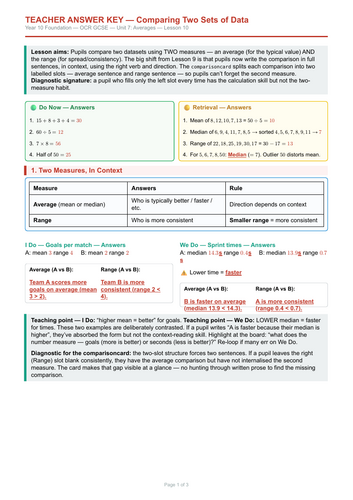
- Full answers across all 5 comparisons
- Diagnostic patterns: pupils who only get “wins both” cases right have defaulted to bigger number = better
- Marking shortcuts: numbers without context-verb = ½ marks; context-verb without numbers = ½ marks; both needed for full credit
- Marking summary table with the “direction flip” cases called out explicitly
smartle. @Smartle-Maths
Something went wrong, please try again later.
This resource hasn't been reviewed yet
To ensure quality for our reviews, only customers who have purchased this resource can review it
Report this resourceto let us know if it violates our terms and conditions.
Our customer service team will review your report and will be in touch.
£3.01