


Teach ionic bonding to IB DP Chemistry with a complete teaching guide plus 50 editable classroom slides, two flagship games and exam-style practice.
Why games
Most bonding resources explain the model, then add an activity if there is time. This one is built the other way round. The games are the teaching, they are serious pedagogy not entertainment.
Students become the ions before they are asked to name them. They cross the room to find a partner whose charge balances theirs, tie themselves together with rope to feel what it means to be a polyatomic ion moving as one unit, and build a lattice by hand before anyone writes “coordination number” on the board. By the time the vocabulary arrives, they have already done the thing it describes.
Four micro-games run inside the explanation itself, two to five minutes each. Every game ends with debrief prompts in official IB command-term language, so the play translates into the wording students meet on paper, and each carries an honest “where the model runs out” box.
Who it’s for
IB Diploma Programme Chemistry teachers covering Structure 2.1, The Ionic Model, on the syllabus for first assessment 2025. No additional higher level content in this subtopic, so SL and HL use the whole resource. Maps closely onto A level and KS5 chemical bonding.
What’s included
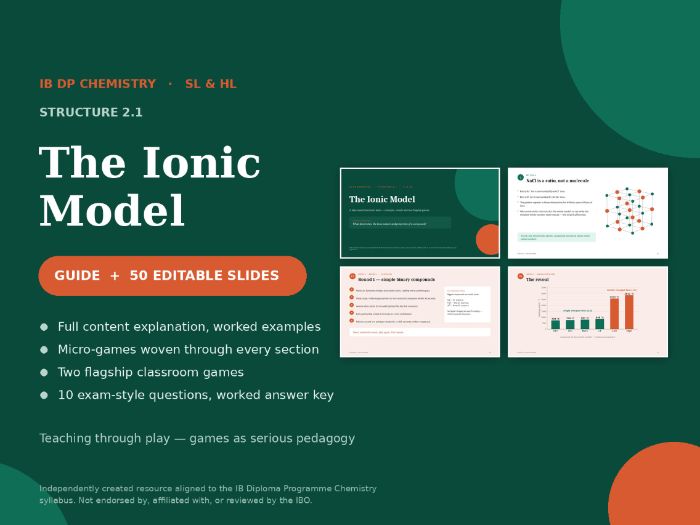
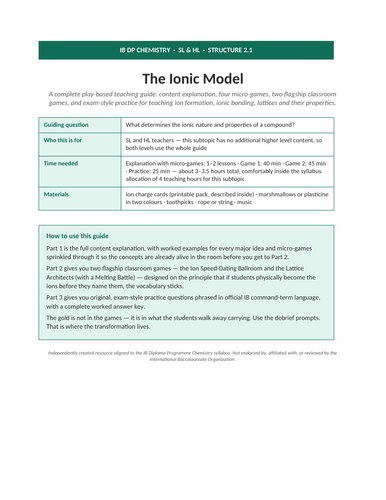
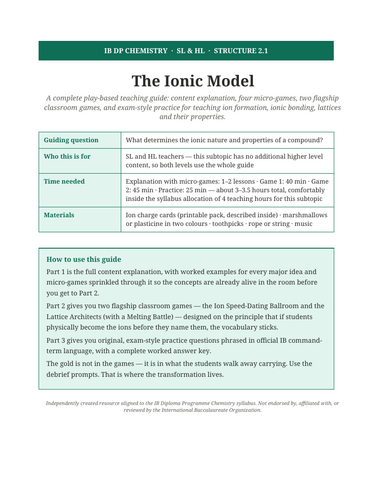
Teaching guide, 20 pages, as PDF and editable Word:
- Full explanation — ion formation, bonding, formulas and naming, polyatomic ions, lattices, properties, lattice enthalpy
- A worked example after every key concept
- Four micro-games, cross-topic hooks, TOK prompts, glossary
- Ten original exam-style questions with a fully worked answer key
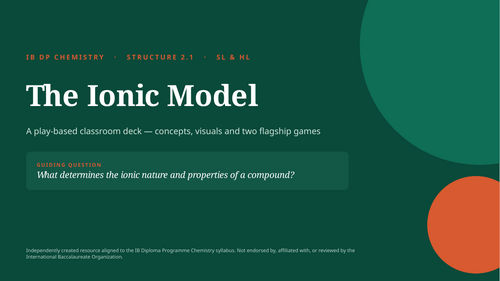
Classroom slides, 50 slides, editable PowerPoint:
- One idea per slide, diagrams doing the work
- Speaker notes on 45 slides — answers, misconceptions, what to say
- Every game’s rules laid out round by round, ready to project
- Fully editable for your own classroom
The two flagship games
The Ion Speed-Dating Ballroom (40 min) — students wear ion charge cards and form neutral compounds before the music stops. Three rounds take them from binary compounds through variable-charge transition metals to polyatomic ions. Includes a referee cheat-sheet of every valid pairing.
The Lattice Architects (45 min) — teams build 3D lattices from marshmallows and toothpicks, count coordination numbers, then compete in a Melting Battle, arguing from ion charge and ionic radius before the real melting points are revealed from a sealed envelope.
Both come with facilitator’s notes on the misconceptions they surface, and scale down for one-to-one tutoring.
Written by a practising IB DP Chemistry teacher and tutor. All content original. More subtopics released regularly.
Independently created resource aligned to the IB Diploma Programme Chemistry syllabus. Not endorsed by, affiliated with, or reviewed by the International Baccalaureate Organization.
Something went wrong, please try again later.
This resource hasn't been reviewed yet
To ensure quality for our reviews, only customers who have purchased this resource can review it
Report this resourceto let us know if it violates our terms and conditions.
Our customer service team will review your report and will be in touch.
£9.00