


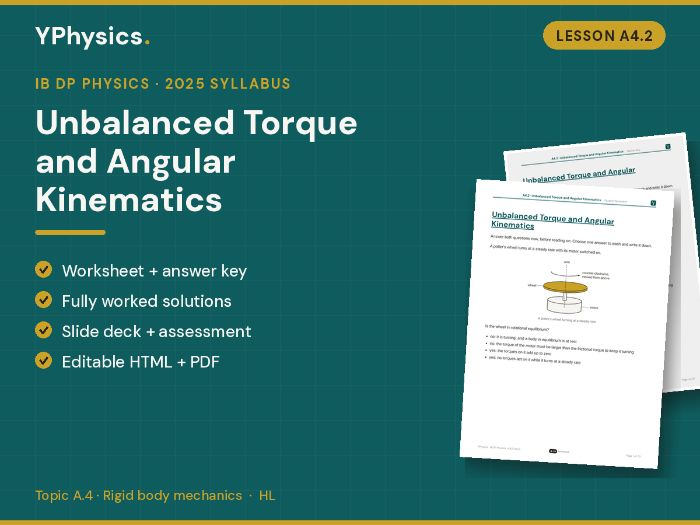
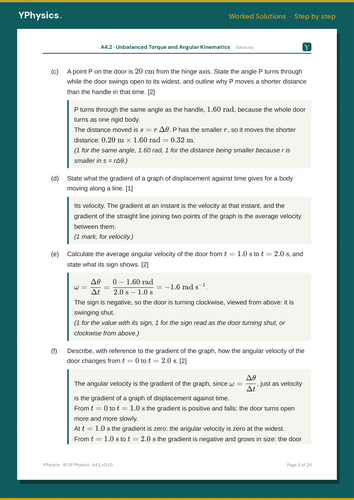
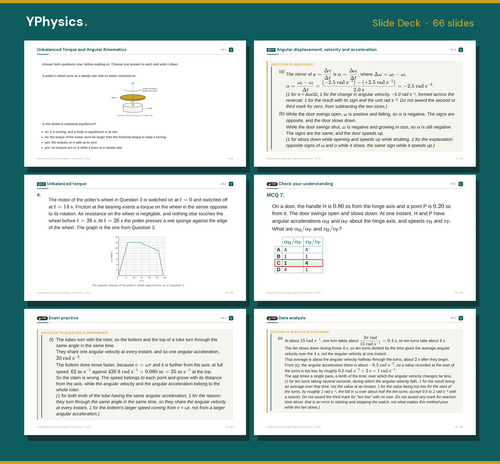
IB DP Physics lesson pack on angular velocity, angular acceleration and unbalanced torque, Topic A.4 Rigid body mechanics, HL only, first assessment 2025. The class builds angular kinematics from linear kinematics, then finds what an unbalanced torque does to a turning body. Editable worksheet, 66-slide lesson deck, teacher key, worked solutions and a questions-only assessment, supplied as self-contained HTML plus colour and black-and-white PDF.
What students learn
- Angular displacement, velocity and acceleration, each built from its linear twin before a definition box names it.
- ω = Δθ/Δt and α = Δω/Δt, from graph gradients too, signed for the sense of turning.
- Why zero angular velocity does not mean zero angular acceleration.
- Zero resultant torque means a constant angular velocity, which may be zero.
- An unbalanced torque gives an angular acceleration in its own sense, not always the sense of turning.
IB skills (Tool 3: Mathematics, with Inquiry 3):
- Determine rates of change (practised).
- Interpret features of graphs (practised).
- Draw lines or curves of best fit (practised).
- Extrapolate and interpolate graphs (practised).
- Identify and discuss sources and impacts of random and systematic errors (practised).
What’s included:
- Student Worksheet - 25 pages
- Teacher Key - 37 pages
- Worked Solutions - 24 pages
- Assessment - 18 pages
- Lesson deck - 66 slides
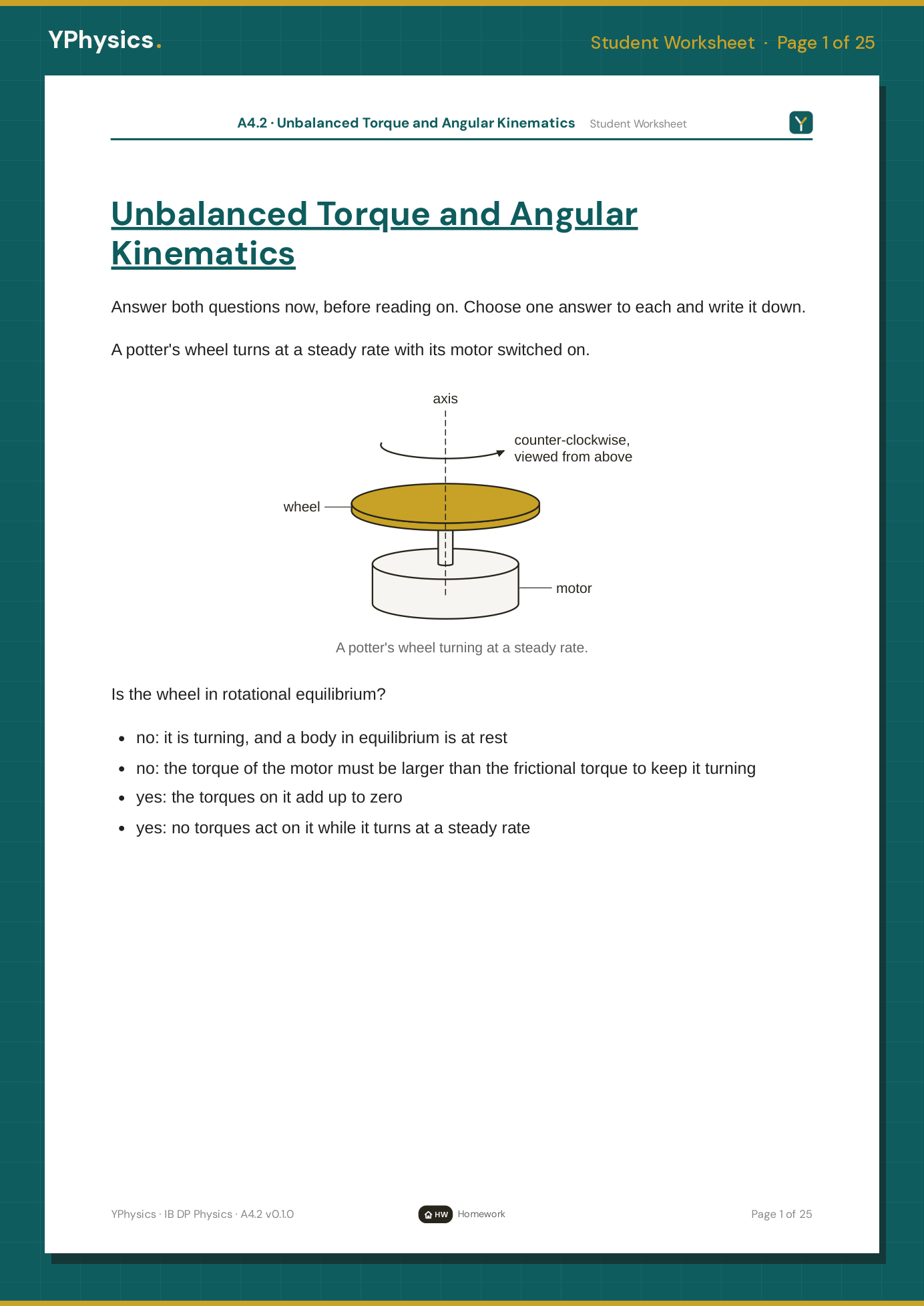
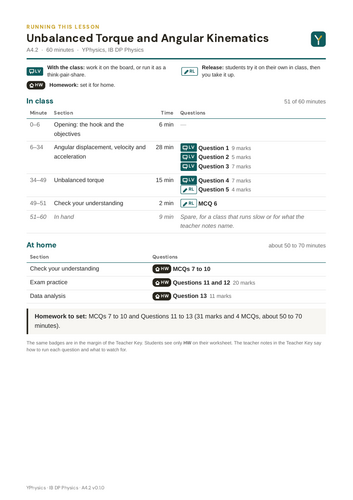
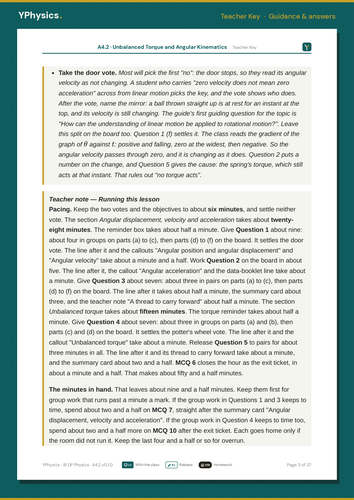
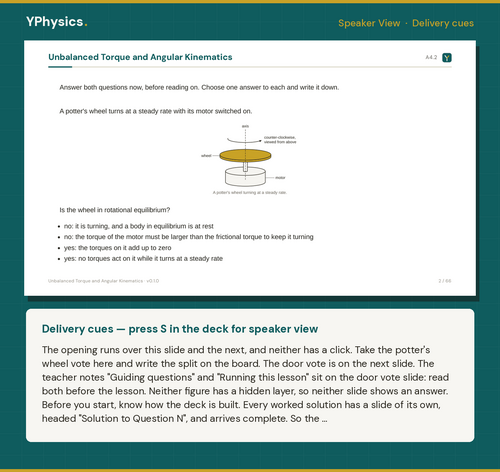
Eight structured questions and five multiple-choice items: 63 marks across 37 parts, and fourteen figures. Two opening votes, a potter’s wheel turning steadily and a spring door at the instant it stops, are settled by Questions 4 and 1. The class works five questions, 32 marks, in the lesson, then a multiple-choice exit ticket. The rest goes home, including two exam-style questions and an eleven-mark data question in the Paper 1B pattern: a ceiling fan slowing down, with a curve of best fit to draw and extend.
It is the second lesson of the topic. The torque half stays qualitative: a larger resultant torque gives a larger angular acceleration, and τ = Iα and the equations for uniform angular acceleration come later in the topic. Angular velocity is signed, counter-clockwise or clockwise, with no vector treatment. Torque, radians and v = ωr are recalled, not retaught. SI units, IB notation and IB command terms throughout. Suitable for grades 11-12 (ages 16-19) as a lesson, cover lesson, homework or revision.
Related resources:
- Torque and Rotational Equilibrium, the previous lesson
- Gradients and Areas Under Graphs, the skill pack behind every gradient here
- Tables, Charts and Graphs, the skill pack behind extending a curve
- Measuring the Acceleration of Free Fall, where error sources are taught (free)
A rating helps other teachers find this.
Something went wrong, please try again later.
This resource hasn't been reviewed yet
To ensure quality for our reviews, only customers who have purchased this resource can review it
Report this resourceto let us know if it violates our terms and conditions.
Our customer service team will review your report and will be in touch.
£9.00