docx, 32.07 KB
docx, 32.07 KB
docx, 30.26 KB
docx, 30.26 KB
  • A fully resourced, dyslexia-friendly end-of-unit revision lesson covering the entire KS3 Small Basic programming unit (Lessons 1–6).

  • Includes an engaging PowerPoint, two differentiated worksheets (student + answer version), and guided tasks using the FREE online Small Basic compiler.

  • Designed to build mastery through practical challenges in sequence, selection, iteration, subroutines, and arrays.

  • Students revisit and apply:

    • Sequence (ordering instructions)
    • IF / ELSE and multi-branch logic
    • FOR loops and WHILE loops
    • Subroutines (Sub…EndSub)
    • Arrays and indexed data
    • Random number generation (Math.GetRandomNumber)
  • Highly engaging challenge-based structure:
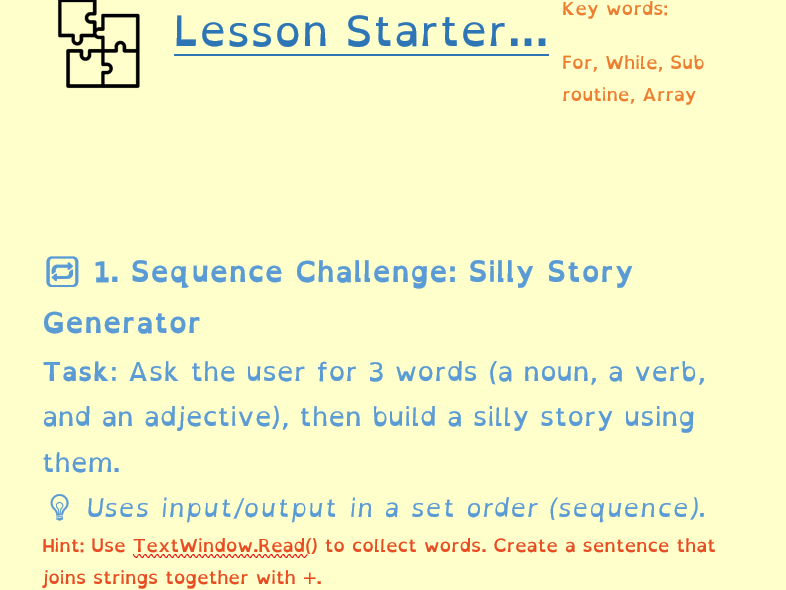
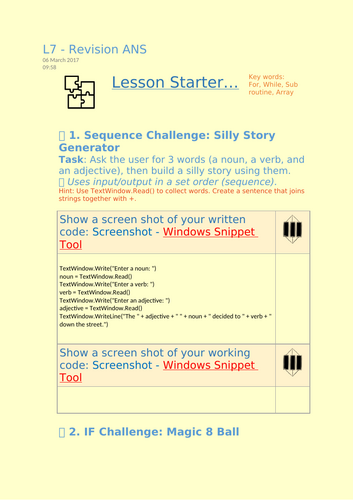
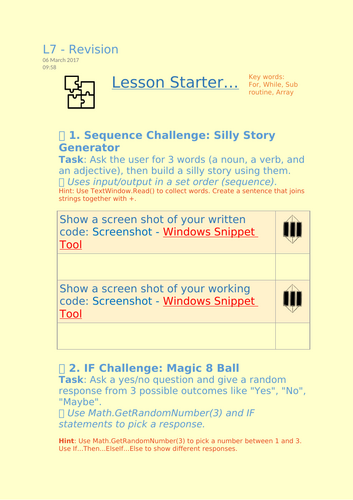
    Sequence Challenge – Silly Story Generator
    Students collect words and build a silly sentence using concatenation.

    IF Challenge – Magic 8 Ball
    Uses random selection and IF/ELSEIF/ELSE to generate predictions.

    WHILE Loop Challenge – Number Guessing Game
    Students apply Boolean logic to create a replaying loop until correct.

    FOR Loop Challenge – Countdown or Times Tables
    Two differentiated options: rocket countdown or a times-table generator.

    Subroutine Challenge – Fortune Teller
    Students design and call a custom GetFortune() subroutine.

    Array Challenge – Shopping List Printer
    Students store 5 items and output them with a FOR loop.

  • The lesson includes:

    • Screenshot evidence boxes for each programming task
    • Model solutions (teacher version included)
    • Clear hints, scaffolding and step-by-step explanations
    • Dyslexia-friendly layouts with pastel backgrounds, simple fonts and readable spacing
  • Perfect as:

    • An end-of-topic revision lesson
    • A low-stakes assessment lesson
    • A summative practical project
    • A cover lesson for any teacher, specialist or non-specialist
  • Learning objectives:

    • Consolidate understanding of all key KS3 programming constructs
    • Apply knowledge independently to solve coding problems
    • Debug, modify and extend programs creatively

This revision lesson ensures students can confidently use the full range of Small Basic skills—excellent preparation for Python at KS3/KS4.

Get this resource as part of a bundle and save up to 14%

A bundle is a package of resources grouped together to teach a particular topic, or a series of lessons, in one place.

Bundle

KS3 Small Basic – Complete 7 Lesson Programming Scheme + Bonus Game Project (Dyslexia-Friendly PowerPoints & Worksheets)

* A complete, fully resourced 7-lesson KS3 programming scheme using Microsoft Small Basic and the FREE online compiler — now upgraded with a BONUS Rock–Paper–Scissors game project. * Every lesson includes a dyslexia-friendly PowerPoint, differentiated worksheets, model solutions, scaffolding, and screenshot-evidence sections. * Ideal for specialists and non-specialists. Zero installation required, perfect for ICT suites, laptops, and Chromebooks. =========================================== LESSON BREAKDOWN =========================================== Lesson 1 – Starting Small Basic (Objects, Operations & Properties) Students run their first program and explore how operations and properties change output. Lesson 2 – Variables, Concatenation & Calculations Students define variables, perform arithmetic, and calculate areas of shapes using formulas. Lesson 3 – IF, ELSE & Nested Conditions Learners debug logic, build branching programs, and create interactive joke generators. Lesson 4 – FOR Loops, WHILE Loops & Randomness Students master iteration, countdowns, loop conditions, and random number operations. Lesson 5 – Subroutines & Calculator Builder Students create Sub…EndSub procedures and develop a full calculator application. Lesson 6 – Arrays & Lists Learners build mini-databases using arrays and create a fully functioning shopping list program. Lesson 7 – Full Revision Challenge Six practical challenges revisit sequence, selection, loops, subroutines, arrays and randomness. =========================================== BONUS LESSON 8 – Rock–Paper–Scissors Game =========================================== A fun, creative final project where students build a complete Rock–Paper–Scissors game using: * Random number generation * IF / ELSEIF selection logic * User input * Validation and replay structure Students will: - Ask the user for their choice - Generate a computer choice (1–3) - Use IF logic to determine the winner - Display results clearly - Extend the program with loops, scoring systems, or extra rules Perfect as a capstone project, assessment, or celebratory “end of unit” activity. =========================================== KEY FEATURES =========================================== * Uses the FREE online Small Basic editor * Dyslexia-friendly design throughout (pastel backgrounds, accessible fonts) * Differentiated challenges in every lesson * Screenshot-evidence tasks for assessment * Covers ALL KS3 programming fundamentals: - Sequence - Variables - Selection - Iteration - Subroutines - Arrays - Randomness - Input/Output =========================================== WHY THIS BUNDLE? =========================================== This is a complete half-term programming scheme with **NO marking**, **NO installs**, and **everything fully explained**. Teachers love how accessible it is. Students love the games, challenges and creativity. Perfect preparation for Python at KS3 or GCSE.

£14.99

Reviews

Something went wrong, please try again later.

This resource hasn't been reviewed yet

To ensure quality for our reviews, only customers who have purchased this resource can review it

Report this resourceto let us know if it violates our terms and conditions.
Our customer service team will review your report and will be in touch.