


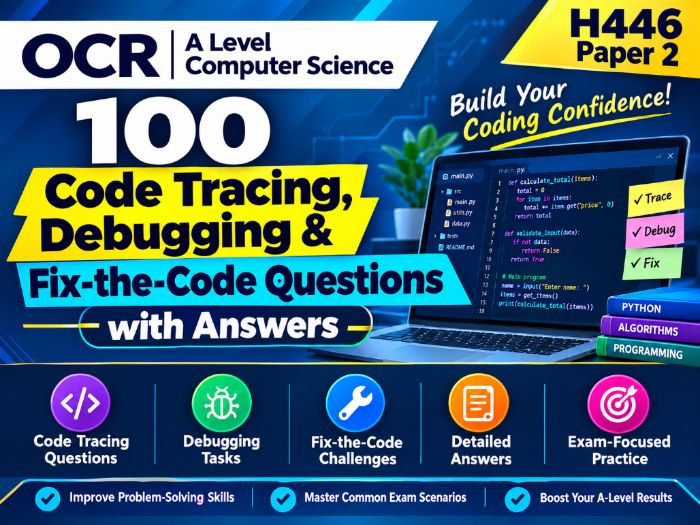

Paper 2 rewards students who can read unfamiliar code, trace it accurately and fix it. This workbook trains exactly those skills.
100 original questions with full worked answers, trace tables and examiner-style mark schemes. The sequence is READ → TRACE → FIND → EXPLAIN → FIX → TEST → IMPROVE → MASTER, so students build skills step by step instead of just rereading theory.
What you get
100 original questions in 10 progressive sections:
code reading and output prediction
tracing
Boolean logic
loops
arrays and strings
functions and recursion
find the bug
fix the code
testing
advanced master challenges
Complete answers for every question, with completed trace tables and a mark scheme (548 marks in total).
Weak vs strong model answers on the extended questions, so students see exactly what earns the marks.
7 mini diagnostics (40 questions) with answers, to check progress between sections.
The Ultimate Debugging Challenge: an unscored program with interacting bugs and a full model solution.
Toolkit pages:
How to Trace Code Without Losing Marks
the 7-Step Debugging Method
Testing Mastery (normal, boundary, invalid, erroneous)
Think Like a Debugger (edge cases)
algorithm efficiency and Big-O
programming style
Exam technique, 10 common misconceptions, a progress tracker, an error log and a mastery checklist.
Topics practised: linear and binary search (iterative and recursive), bubble, insertion and merge sort, recursion, 2D arrays, queues, file processing, validation, Boolean logic, scope, parameters (by value and by reference), test data and time complexity.
Why teachers and tutors like it
Every question carries a star difficulty rating, a question-type label and a stated skill.
Debugging answers follow one six-step routine: Identify, Classify, Explain, Correct, Test, Verify.
Mark schemes give separate marks for locating, classifying, explaining, correcting and testing, so students learn why a “fixed” answer can still lose marks.
Printable, with a clean navy and teal layout and answers kept in their own section.
Suitable for: A-Level students, teachers, tutors, revision groups, intervention, homework, cover lessons and independent study.
Format: PDF (157 pages) and an editable Word version. OCR-style pseudocode throughout, with Python notes where behaviour differs.
This is an original, independent practice resource designed to support students studying OCR A-Level Computer Science H446. It is not produced, endorsed or approved by OCR. All questions, programs and examples are original.
Something went wrong, please try again later.
This resource hasn't been reviewed yet
To ensure quality for our reviews, only customers who have purchased this resource can review it
Report this resourceto let us know if it violates our terms and conditions.
Our customer service team will review your report and will be in touch.
£5.99