OCR A-Level Magazines & Big Issue Bundle
Resource Bundle


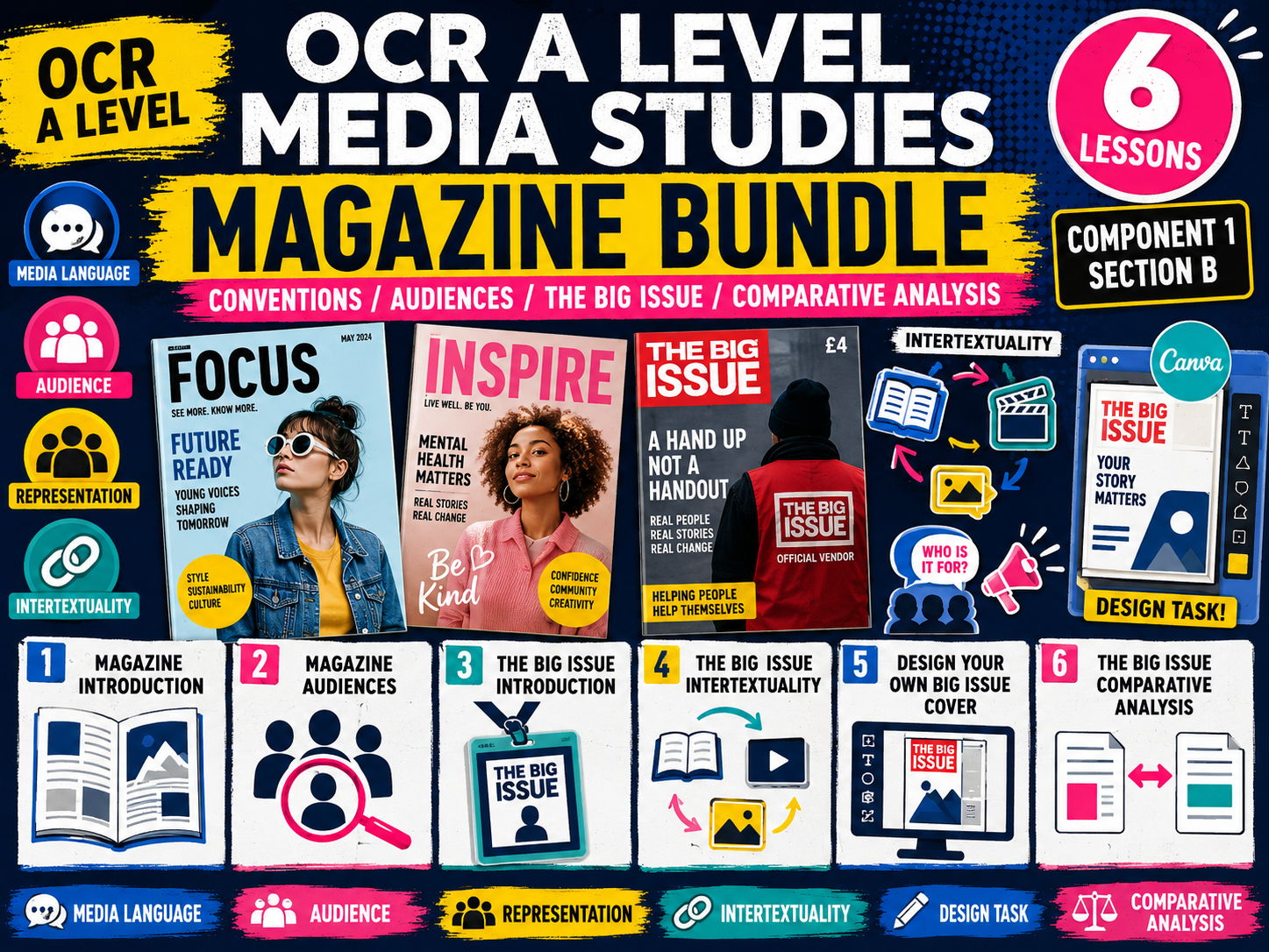

A complete OCR A-Level Media Studies magazine bundle covering magazine conventions, audiences, The Big Issue, intertextuality, representation, comparative analysis and practical front cover design.
This bundle contains 6 fully editable PowerPoint (.pptx) lessons for OCR A-Level Media Studies Component 1, Section B: Media Messages, focusing on magazines, media language and representation.
The lessons are designed to build knowledge logically, starting with magazine conventions and audience theory before moving into The Big Issue as the set magazine text. Students explore mastheads, cover lines, typography, colour, layout, denotation, connotation, target audience, Maslow, Reception Theory, Uses and Gratifications, social enterprise, pluralistic representation, intertextuality and comparative analysis.
The bundle includes editable PowerPoint lessons, worksheet resources, guidance documents, modelling, key terminology, printable-style activities, practical design tasks, exam-style questions, sentence starters, word banks and peer feedback opportunities.
This resource is ideal for Year 12 or Year 13 OCR A-Level Media Studies students studying magazines in Component 1: Media Messages, Section B.
Suggested teaching order
Lesson 1: Magazine Introduction
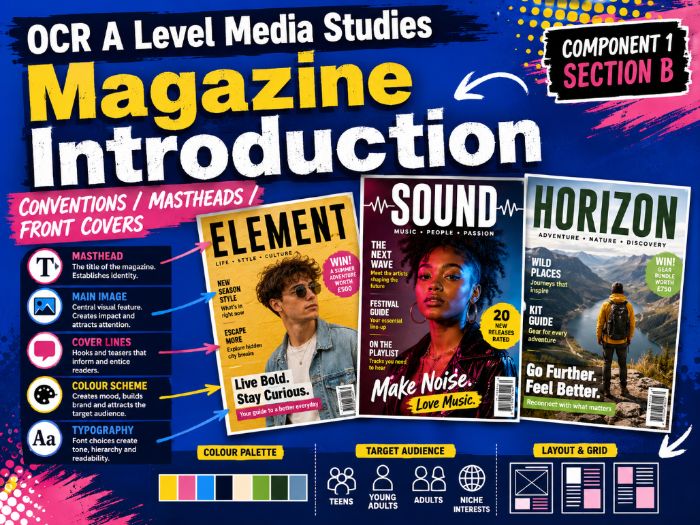
Introduces magazine conventions, consumer magazine types, general interest and specialist magazines, mastheads, main images, cover lines, typography, colour schemes, puff, pug, direct gaze and skyline/banner. Students analyse magazine covers and create their own front cover sketch.
Lesson 2: Magazine Audiences
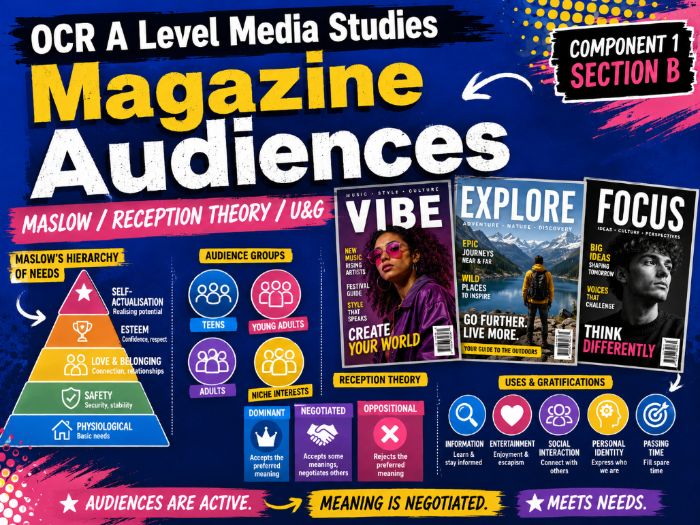
Explores why audiences read magazines using Maslow’s Hierarchy of Needs, Stuart Hall’s Reception Theory and Uses and Gratifications. Students analyse different audience responses to magazine covers and compare lifestyle magazines.
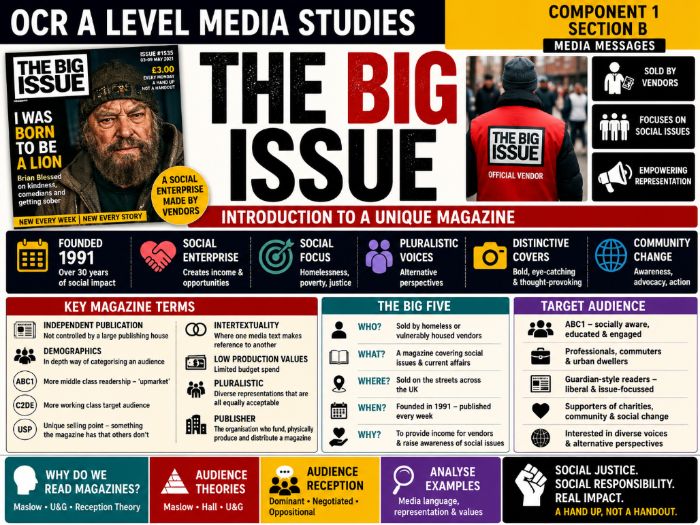
Lesson 3: The Big Issue Introduction
Introduces The Big Issue, its social enterprise model, street vendors, social justice ethos, independent publication status, ABC1 target audience, pluralistic representation and political/social values. Students complete keyword tasks, audience profiling and front cover analysis.
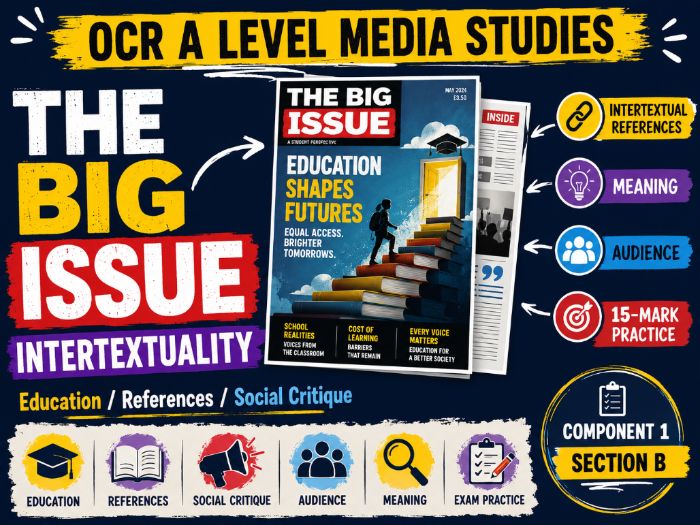
Lesson 4: The Big Issue Intertextuality
Focuses on the Big Issue “Class Action: What’s School For?” education cover and its use of intertextuality. Students explore references to Grange Hill, Pink Floyd’s The Wall, Harry Potter, The Handmaid’s Tale, Jean Brodie, Ozzy Osbourne, Benedict Cumberbatch, Flashman and the Finnish education system. Includes a worksheet and 15-mark exam practice.
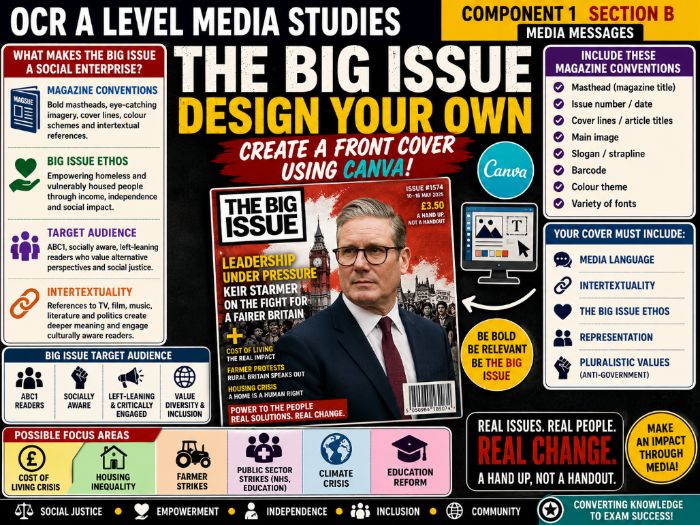
Lesson 5: Design Your Own Big Issue Cover
A practical production lesson where students design their own Big Issue-style front cover using Canva. Students apply media language, intertextuality, representation, pluralistic values, social enterprise ethos and target audience knowledge to a contemporary political/social issue.
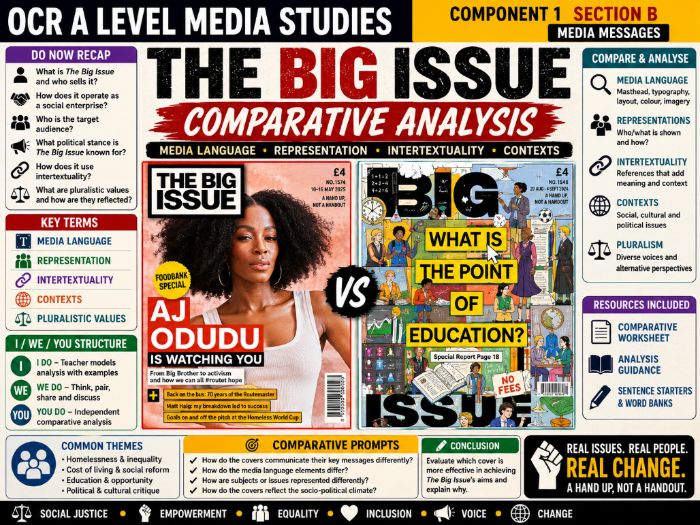
Lesson 6: The Big Issue Comparative Analysis
A structured comparative analysis lesson using two Big Issue front covers. Students compare media language, representation, intertextuality, social/political contexts and pluralistic values. Includes a comparative worksheet PDF and a guidance document with sentence starters, word banks, prompts and conclusion support.
What is included?
6 fully editable PowerPoint (.pptx) lessons
Supporting worksheet resources
Comparative worksheet PDF
Intertextuality worksheet
Student guidance document
Magazine terminology and conventions tasks
Do Now retrieval tasks
Teacher feedback/model answer slides
Key theory slides
Magazine cover analysis tasks
Big Issue set text context
Practical Canva design task
Comparative analysis structure
Sentence starters
Word banks
Exam-style questions
Peer feedback tasks
Key topics covered
OCR A-Level Media Studies
Component 1: Media Messages
Section B: Magazines
Magazine conventions
Media language
Representation
Audience
The Big Issue
Social enterprise model
Street vendors
ABC1 audience
Pluralistic representation
Intertextuality
Social, cultural and political contexts
Masthead
Main image
Cover lines
Typography
Layout
Colour scheme
Denotation and connotation
Maslow’s Hierarchy of Needs
Stuart Hall’s Reception Theory
Uses and Gratifications
Comparative analysis
Exam practice
This bundle can be used as:
A complete OCR A-Level magazine teaching sequence
A Component 1 Section B magazine unit
A Big Issue set text teaching pack
A media language and representation unit
A revision or intervention bundle
A cover lesson sequence with supporting worksheets
A Year 12 or Year 13 exam preparation resource
This bundle includes fully editable PowerPoint (.pptx) lessons and supporting worksheet/resource documents.
This resource is independently created and is not endorsed by OCR.
Something went wrong, please try again later.
This resource hasn't been reviewed yet
To ensure quality for our reviews, only customers who have purchased this resource can review it
Report this resourceto let us know if it violates our terms and conditions.
Our customer service team will review your report and will be in touch.