


A focused OCR A-Level Media Studies revision lesson applying Stuart Hall’s Reception Theory to Stranger Things Season 1 Episode 1 for the LFTVD exam question.
This fully editable PowerPoint (.pptx) lesson is designed as a recap, revision or theory add-on lesson for OCR A-Level Media Studies Paper 2: Evolving Media, Section B – Long Form Television Drama.
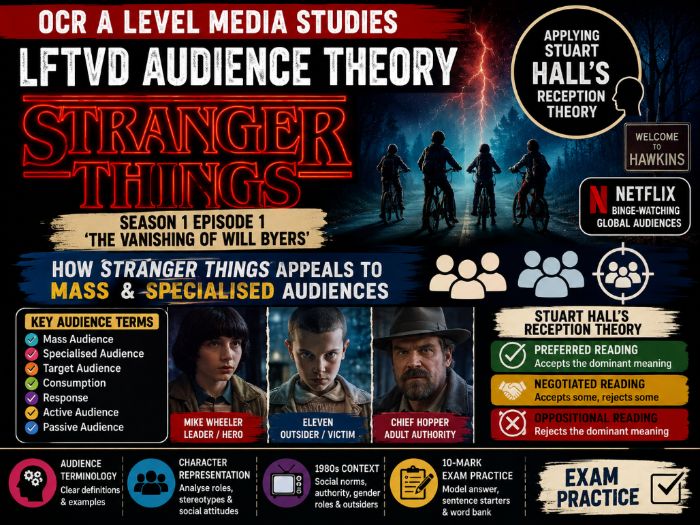
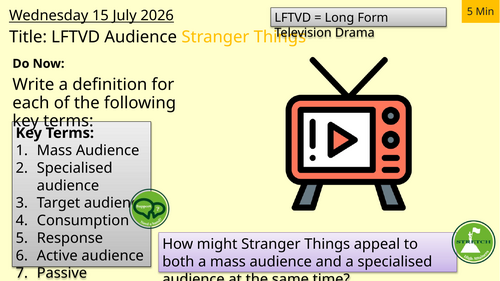
The lesson focuses on how Stranger Things appeals to both a mass audience and a specialised audience, while also exploring how different audiences may interpret character representations in different ways. Students begin by defining key audience terminology including mass audience, specialised audience, target audience, consumption, response, active audience and passive audience.
Students then recap key context for Stranger Things, including the creators The Duffer Brothers, the hybrid genre of sci-fi, horror, supernatural and mystery, the 1983 Hawkins setting, and Netflix’s global streaming/binge model.
The lesson moves into character types and representation, with students analysing how Stranger Things uses roles such as leader/hero, outsider/victim and adult authority to reflect or challenge social attitudes from the 1980s. Students consider how character representations link to age, gender, ethnicity, class, stereotypes and audience appeal.
The main theory focus is Stuart Hall’s Reception Theory, with students exploring how different audiences might produce preferred, negotiated and oppositional readings of characters such as Mike Wheeler, Eleven and Chief Hopper. The lesson asks students to consider how a modern Netflix audience may respond differently to these characters compared to an audience in the 1980s.
The lesson builds towards an exam-style response: Analyse how far Stranger Things Episode 1 uses character representations to appeal to different audiences. Refer to Hall’s Reception Theory in your answer. It includes a 1980s social contexts fact sheet, sentence starters, word bank, model response, judgement prompt and self-assessment criteria.
This lesson covers
OCR A-Level Media Studies
Paper 2: Evolving Media
Section B: Long Form Television Drama
LFTVD
Stranger Things
Stranger Things S1E1
The Vanishing of Will Byers
Stuart Hall
Reception Theory
Preferred reading
Negotiated reading
Oppositional reading
Audience appeal
Mass audience
Specialised audience
Target audience
Netflix
Binge-watching
Character representation
Mike Wheeler
Eleven
Chief Hopper
Leader/hero
Outsider/victim
Adult authority
1980s social attitudes
Gender roles
Authority
Outsiders
Stereotypes
10-mark exam practice
What is included?
Fully editable PowerPoint (.pptx) lesson
Do Now audience terminology recap
Teacher feedback/model answers
Key context slide on Stranger Things
Something went wrong, please try again later.
This resource hasn't been reviewed yet
To ensure quality for our reviews, only customers who have purchased this resource can review it
Report this resourceto let us know if it violates our terms and conditions.
Our customer service team will review your report and will be in touch.
£5.00