


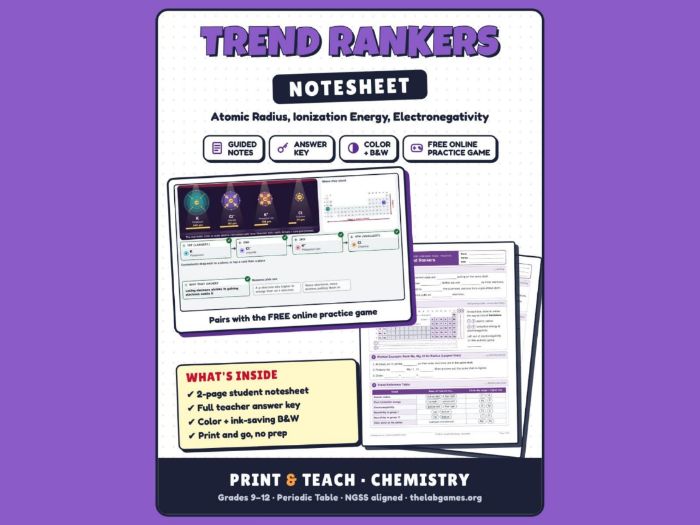
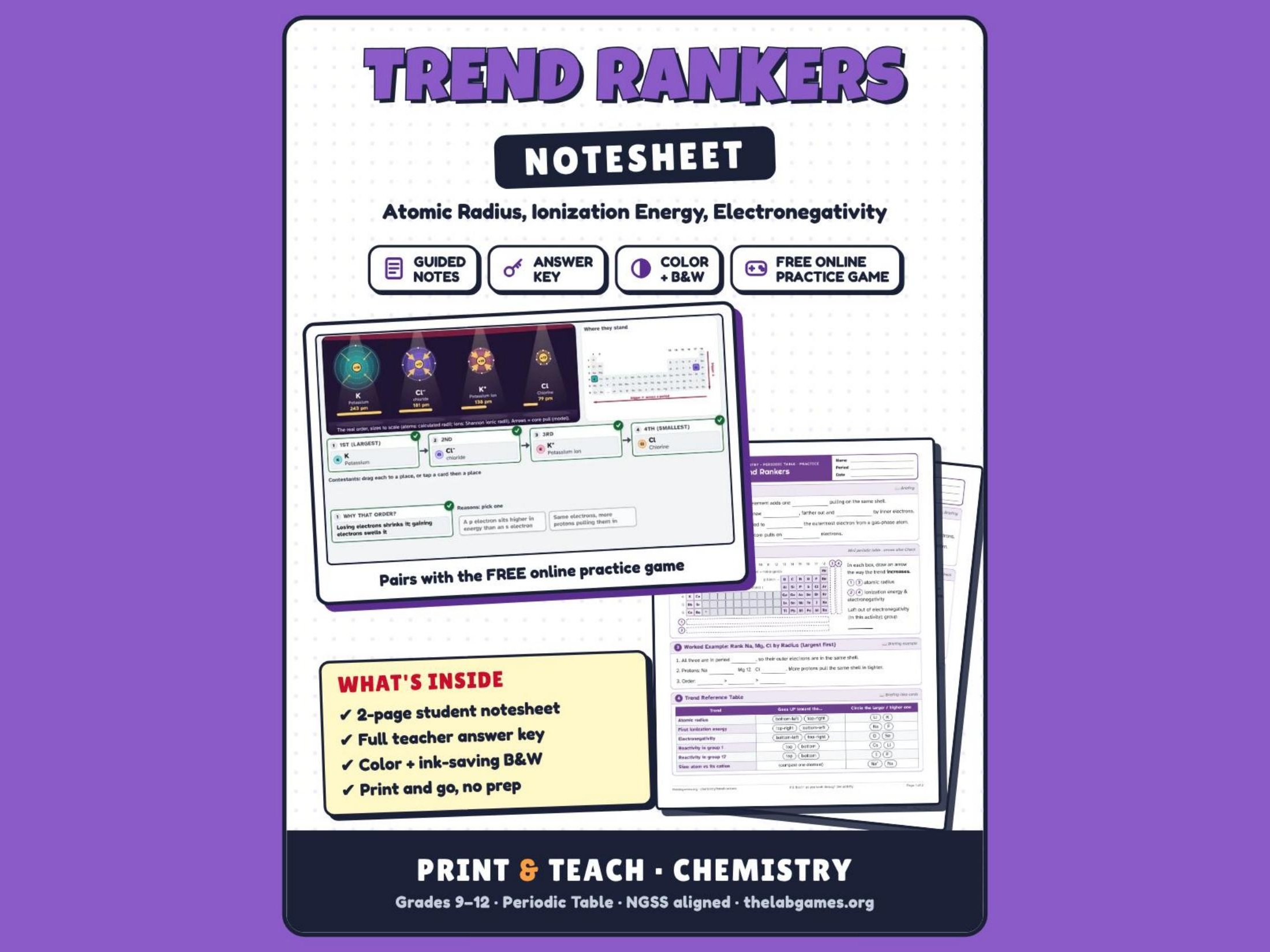
Help students rank elements by periodic trends and explain why the trends happen. This roomy, student-friendly 2-page notesheet walks students through the two big ideas behind the trends (more protons pulling on the same shell across a period, and a new shielded shell down a group), drawing trend arrows on a periodic table sketch, a worked example ranking Na, Mg and Cl by atomic radius, and a trend reference table. Students then rank sets of elements by atomic radius, first ionization energy, electronegativity and halogen reactivity, and AP students rank a set with an ionization energy exception and an isoelectronic series of ions.
It pairs with Trend Rankers, a free online practice game at thelabgames.org where students judge the Periodic Talent Show and rank elements and ions using real element data. Use it in class, for absent-student makeups, or on sub days. A complete teacher key with every order checked against the game’s own data is included.
What’s Included
- Student notesheet (2 pages) in full color AND black & white
- Teacher answer key (red answers) in full color AND black & white
What Students Do
- Background fill-in: protons across a period, new shielded shells down a group, and what ionization energy and electronegativity mean
- Draw the Trend Arrows: draw the direction atomic radius, ionization energy and electronegativity increase on a periodic table sketch with the s, p and d blocks, and name the group left out of electronegativity
- Worked Example: rank Na, Mg and Cl by atomic radius using period and proton count
- Trend Reference Table: circle where each trend increases (including group 1 and group 17 reactivity) and pick the larger or higher of two elements, plus an atom vs its cation
- Practice Rankings: rank three elements by atomic radius, first ionization energy and electronegativity, and rank the halogens by reactivity with a reason
- AP Chemistry Level: rank Al, Mg, P and Si by first ionization energy and explain the Mg > Al dip, then rank an isoelectronic series of ions by size
- My Runs: a log for tracking practice scores
Skills & Standards
- Periodic table, periods and groups, s, p and d blocks, atomic radius, first ionization energy, electronegativity, shielding, cations and anions, group 1 and group 17 reactivity, first ionization energy exceptions, isoelectronic series
- Supports NGSS HS-PS1-1
- Grades 9–12 Chemistry (with AP Chemistry extension problems)
Great For
- Periodic table units
- Absent-student makeups
- Sub plans
- Homework or stations
- Test review
Something went wrong, please try again later.
This resource hasn't been reviewed yet
To ensure quality for our reviews, only customers who have purchased this resource can review it
Report this resourceto let us know if it violates our terms and conditions.
Our customer service team will review your report and will be in touch.
$2.49