

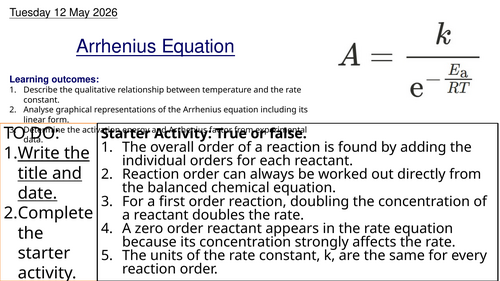

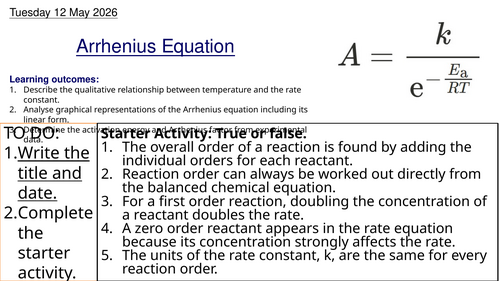
This PowerPoint lesson covers the Arrhenius equation for IBDP Chemistry HL (first examination 2025), helping students understand how temperature affects the rate constant and how activation energy can be determined from experimental data. It provides a clear, structured explanation of one of the most important mathematical relationships in chemical kinetics and is ideal for building both conceptual understanding and exam confidence.
The Arrhenius equation links the rate constant, k, to temperature, T, activation energy, Eₐ, and the Arrhenius factor, A. It explains why reactions usually happen faster at higher temperatures and why reactions with lower activation energies are generally faster. This lesson helps students understand that the rate constant is not fixed for all conditions, but changes mainly with temperature and activation energy, making it a key idea for explaining differences in reaction speed.
This fully editable PowerPoint (.pptx) is designed for HL teaching, revision or flipped learning within the IB Diploma Programme. The lesson introduces the meaning of each term in the Arrhenius equation, explains what the Arrhenius factor represents in terms of collision frequency and orientation, and shows how the exponential term relates to the fraction of particles with enough energy to react. Students are then guided through the linear form of the Arrhenius equation, the construction and interpretation of an Arrhenius plot, and the use of the graph’s gradient and intercept to determine activation energy and A. The resource also includes the two-temperature form of the equation, allowing activation energy to be calculated directly from two values of k without plotting a graph.
The lesson includes a retrieval starter, key definitions, worked explanations, graph analysis, unit reminders and practice questions with answers. It is especially useful for preparing students for IB exam questions involving kinetics calculations, Arrhenius plots and the interpretation of temperature effects on reaction rate.
File type included: editable PowerPoint (.pptx)
Last updated: 2026 – improved graph interpretation, clearer support for activation energy calculations, and enhanced practice tasks aligned to IB HL assessment objectives.
Something went wrong, please try again later.
This resource hasn't been reviewed yet
To ensure quality for our reviews, only customers who have purchased this resource can review it
Report this resourceto let us know if it violates our terms and conditions.
Our customer service team will review your report and will be in touch.
£2.00