


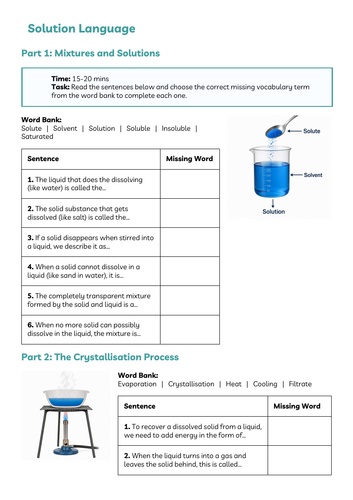
This Year 7 Science lesson builds on pupils’ understanding of mixtures by introducing the second key separation technique: crystallisation. Through clear modelling, guided explanations and visual examples, students learn how dissolved solids can be separated from solutions by evaporating the solvent. The lesson strengthens pupils’ understanding of particle behaviour and links scientific processes to real‑world applications.
Learners explore how heating a solution leads to the formation of crystals, why the solute remains when the solvent evaporates, and how crystallisation is used in everyday contexts such as salt production and making sugar crystals. Pupils label diagrams, sequence the steps of the process and apply their knowledge to practical scenarios.
A fully editable PPT and worksheet are included, supporting explanation, modelling and retrieval.
Learning Objective:
To explain how crystallisation separates a dissolved solid from a solution.
Success Criteria:
- Describe how heating a solution forms crystals.
- Explain why the solvent evaporates but the solute remains.
- Give an example of a substance made using crystallisation.
**Some visuals in this resource were made with AI to help bring ideas to life and support student understanding.
Something went wrong, please try again later.
This resource hasn't been reviewed yet
To ensure quality for our reviews, only customers who have purchased this resource can review it
Report this resourceto let us know if it violates our terms and conditions.
Our customer service team will review your report and will be in touch.
£2.00