


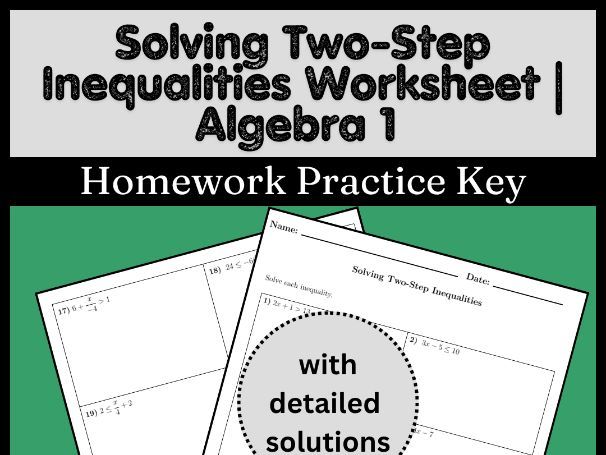
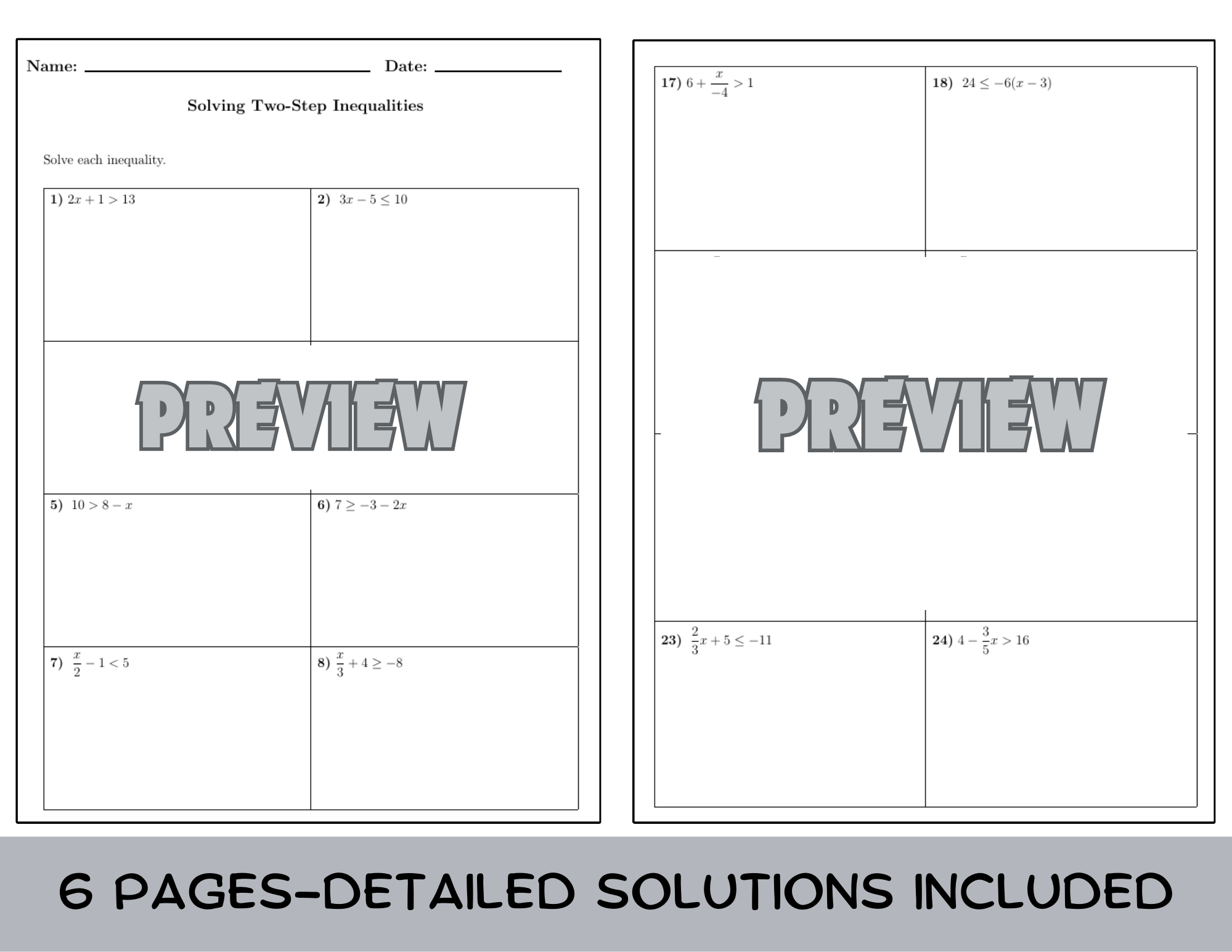
A no prep worksheet on solving two-step inequalities. There are 24 problems and detailed solutions are included.
Are your students forgetting to flip the inequality sign when multiplying or dividing by a negative number? Take the stress out of your marking and give your students structured algebraic practice with this print-and-go two-step inequalities worksheet.
This resource features 24 carefully scaffolded questions that transition smoothly from basic integer operations to challenging problems with fractional terms, negative variables, and expanding brackets. It is the perfect addition to your Key Stage 3 (KS3), Key Stage 4 (KS4), or GCSE maths lessons on linear inequalities.
What’s Included in This Resource?
- 24 Scaffolded Questions: A comprehensive practice sheet that walks students through simple two-step setups all the way to complex fractional inequalities.
- Built-In Workspace Grids: Every question is placed inside its own clean, box-style grid, giving students plenty of room to lay out their steps clearly and stay organized.
- Fully Worked Solutions: A complete, step-by-step answer key showing every algebraic operation for every single problem to make marking a breeze or to allow for quick student self-assessment.
Skills Challenged
- Solving standard two-step inequalities with positive and negative integers.
- Dealing with negative coefficients that require reversing the inequality symbol.
- Solving inequalities with fractional coefficients and variables inside the numerator.
- Working through inequalities involving basic bracket expansion.
Curriculum Standards Met
- UK National Curriculum (Key Stage 3 & 4): Use algebraic methods to solve linear inequalities in one variable and represent the solution sets.
- GCSE Maths Specifications (AQA, Edexcel, OCR): Solve linear inequalities in one variable, including cases where the inequality sign must be reversed when multiplying or dividing by a negative number.
- Mathematical Precision: Encourages students to be precise with operational signs and boundary rules when calculating solutions.
Something went wrong, please try again later.
This resource hasn't been reviewed yet
To ensure quality for our reviews, only customers who have purchased this resource can review it
Report this resourceto let us know if it violates our terms and conditions.
Our customer service team will review your report and will be in touch.
£1.30