


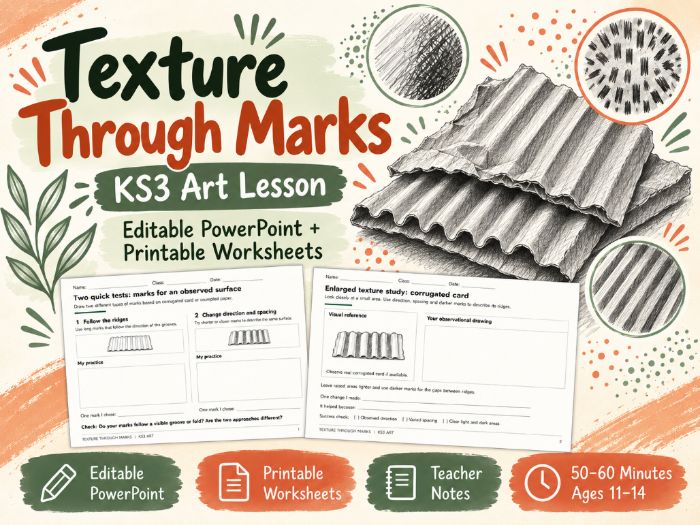
Complete KS3 Art lesson on texture through mark making, with an editable PowerPoint, teacher notes and two printable drawing worksheets.
This ready-to-teach 50–60 minute Art lesson introduces students to the use of pencil marks to represent observed textures.
Students investigate the ridges, grooves and folds of corrugated cardboard and crumpled paper. Through guided observation, a step-by-step demonstration and practical drawing activities, they learn to select marks that communicate the appearance of a surface.
The lesson also includes an artist connection to Albrecht Dürer’s The Rhinoceros (1515), encouraging students to recognise how varied lines and patterns can suggest different surface qualities.
What’s Included1. Editable PowerPoint Presentation
- Structured 50–60 minute lesson
- Starter (Do Now) drawing activity
- Guided observation of textured surfaces
- Artist reference to Albrecht Dürer’s The Rhinoceros
- Three-step drawing demonstration
- Short mark-making practice
- Main observational drawing activity
- Support and extension tasks
- Midpoint assessment and improvement opportunity
- Success criteria and feedback prompts
- Final reflection and classroom tidy-up
- Teacher notes, material requirements and lesson timings
- Image credits and source references
2. Printable Worksheets (PDF)
Two A4 landscape worksheets:
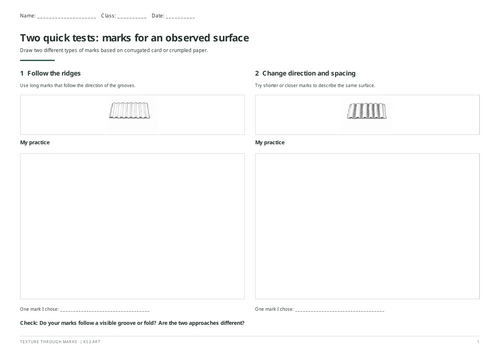
- Mark-Making Practice: Two large drawing areas for experimenting with different marks based on an observed surface.
- Enlarged Texture Study: A large drawing area for studying corrugated cardboard or folded paper, including a brief reference diagram, improvement reflection and self-assessment.
The worksheets can be used independently or alongside students’ sketchbooks.
Something went wrong, please try again later.
This resource hasn't been reviewed yet
To ensure quality for our reviews, only customers who have purchased this resource can review it
Report this resourceto let us know if it violates our terms and conditions.
Our customer service team will review your report and will be in touch.
£3.00