zip, 100.4 KB
zip, 100.4 KB

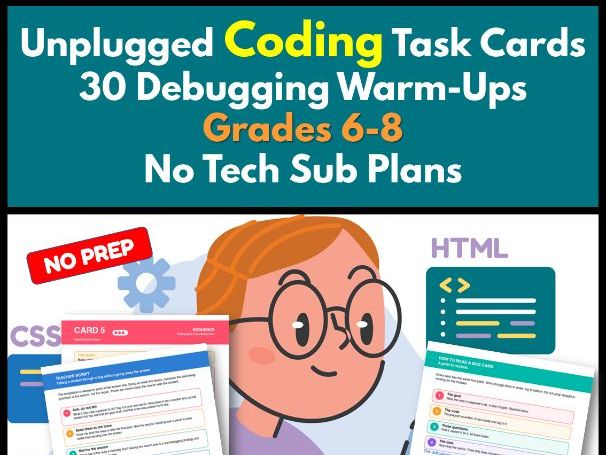
Find the Bug: Python Debugging Warm-Ups for Grades 6–8 is a low-prep resource featuring 30 Python 3 debugging challenges that teach middle school students how to identify, explain, fix, and test real coding errors. Instead of simply searching for incorrect lines, students learn to use evidence from output, tracebacks, code behavior, and expected results to systematically diagnose problems.

The resource includes six PDF files: a six-page Teacher Guide with implementation guidance, questioning scripts, standards alignment, scope and sequence, and a two-week pacing option; a two-page Student Reference with the debugging cycle and eight-step checklist; two Recording Pages for responses, bug-type tracking, and progress monitoring; 30 Python Bug Cards; and a 10-page Answer Key containing corrections, explanations, misconceptions, and alternate valid solutions when appropriate.

The 30 challenges cover six major bug types: Order and Flow; Loops and range(); Loop Control; Booleans and Logic; Variables and Types; and Lists and Indexing. Three difficulty levels allow teachers to differentiate instruction, from easily identifiable errors to subtler problems requiring careful tracing and testing.

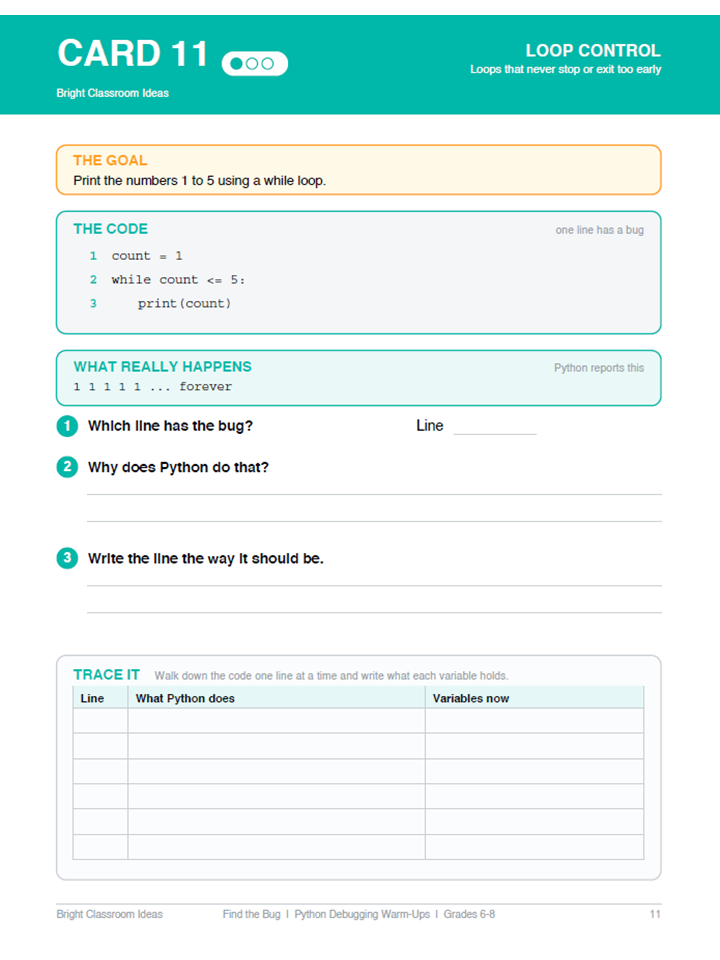
Each card follows a consistent process: Goal, Code, What Really Happens, Find It, Explain It, Fix It, and Test. Students compare expected and actual output, read Python errors and tracebacks, trace variables and loops, check data types, test boundary cases, and explain why their corrections work.

The cards are flexible enough for daily bell-ringers, stations, substitute plans, targeted reteaching, or additional programming practice. A card takes approximately six minutes for independent or partner work, while five cards can support a 15-minute station rotation. The activities can be completed on paper, although students with access to devices can run the code and deepen their understanding. No login or prior computer science knowledge is required for using the cards as structured debugging practice.

Learning goals include systematic program testing and refinement, problem decomposition, understanding Python errors, Boolean logic, data types, loops, lists, indexing, mutation, and aliasing. The resource aligns with CSTA standards including 2-AP-17 and 2-AP-13, with additional connections to 2-AP-11, 2-AP-12, 2-AP-16, and 2-AP-19, as well as selected Common Core mathematical practice standards.

A major strength is the misconception-focused Answer Key, which helps teachers identify why students make particular errors and target reteaching more effectively. Students can also track their progress and identify challenging bug types.

Overall, this resource turns authentic Python errors into structured learning opportunities while building debugging habits that transfer directly to real programming.

Get this resource as part of a bundle and save up to 19%

A bundle is a package of resources grouped together to teach a particular topic, or a series of lessons, in one place.

Bundle

Unplugged Coding Task Cards | 30 Debugging WarmUps K-8 | No Tech Sub Plans

Unplugged Coding Task Cards Bundle for Grades K–8 provides 90 screen-free debugging warm-ups designed to help students develop computational thinking, sequencing, problem-solving, and debugging skills without computers or internet access. The bundle combines three grade-band resources: K–2, Grades 3–5, and Grades 6–8, with 30 task cards for each level. This progression allows students to build increasingly sophisticated coding and debugging skills from Kindergarten through middle school. The task cards are designed for flexible classroom use and can be incorporated into daily coding warm-ups, bell ringers, morning work, STEM centers, computer science stations, early-finisher activities, small-group practice, whole-group problem solving, technology-free lessons, emergency no-tech days, and substitute teacher plans. Their short format makes it easy to add computational thinking practice to an existing schedule without requiring a complete coding lesson. Students work through coding-style challenges entirely offline. They learn to identify errors in sequences or instructions, determine where a process goes wrong, correct mistakes, and test and revise solutions. The activities also develop broader computational thinking skills, including breaking problems into manageable steps, recognizing patterns, following algorithms, thinking logically, and approaching problems systematically. The bundle reinforces sequencing and algorithmic thinking by having students arrange steps correctly, follow precise directions, create logical sequences, and understand how instructions influence outcomes. Problem-solving activities encourage students to analyze situations, test possible solutions, learn from mistakes, and explain their reasoning. The three grade bands provide developmentally appropriate challenges, making the bundle useful for schools that want a consistent unplugged computer science approach across multiple grade levels. Teachers can select activities based on students' developmental needs and gradually increase complexity as learners progress. A key benefit is the misconception-focused answer key, which goes beyond providing correct answers by identifying the reasoning errors behind common mistakes. This gives teachers useful information for conferencing, reteaching, and supporting struggling students. With 90 total task cards, 30 debugging warm-ups per grade band, minimal preparation, and no technology requirements, the bundle offers a practical solution for keeping computer science instruction active even when devices are unavailable. It provides repeated opportunities for students to practice debugging, algorithms, sequencing, logical reasoning, and problem-solving in an accessible, engaging, and flexible format. Overall, this K–8 bundle gives teachers a ready-to-use collection of screen-free coding activities that can support computer science and STEM instruction throughout the school year while building transferable problem-solving habits.

$17.00

Reviews

Something went wrong, please try again later.

This resource hasn't been reviewed yet

To ensure quality for our reviews, only customers who have purchased this resource can review it

Report this resourceto let us know if it violates our terms and conditions.
Our customer service team will review your report and will be in touch.